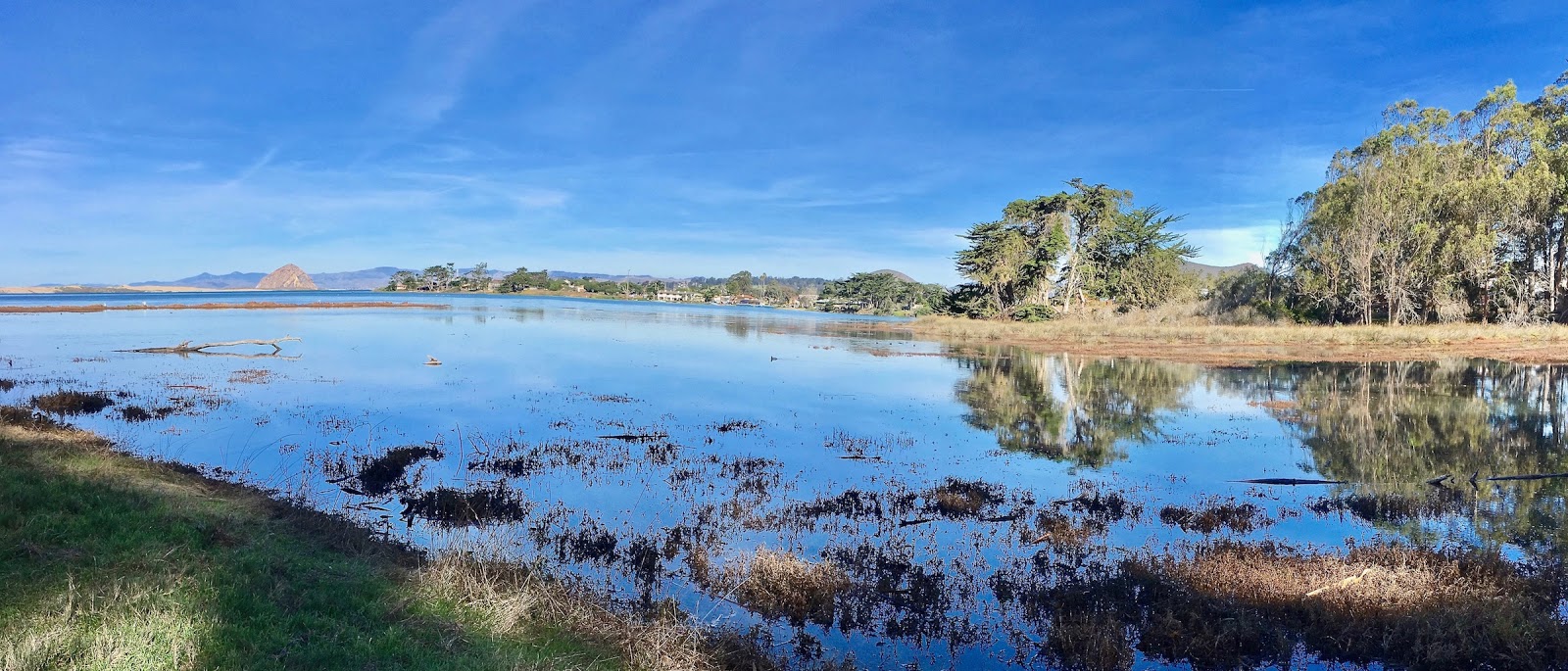
Sweet Springs - From the East Overlook - Green-winged Teal, Willet, Godwit, Ring-billed Gull, and a large brace of Ruddy Duck with a smattering of Bufflehead. To the west a smaller brace of Scaup. Whether they were Greater Scaup or Lesser Scaup, I was unable to determine. I am working on my Scaup ID skills.
From left to right, Lesser Scaup and Greater Scaup (google photo) The lesser has a narrower, purplish head and smaller bill. The Greater is 1.5 inches larger, has roundish, greenish head, and larger bill. I am quite convinced some birds intentionally make identification difficult.
The Pond - Watched 20 Blue-winged Teal splash down in the pond. (above) They immediately began a vigorous, high spirited bath that entailed much splashing and dunking. Also in the pond, Green-winged Teal, one Pied-bill Grebe, and two pair of Pintail.
The brilliant white breast of the Pintail is most evident when they are resting along the edge of the pond. Below a male Kingfisher let itself be known as it landed on a branch. Their distinct call is described as a loud, dry rattle.
West Overlook - Feeding along the edge of the bay, Willet, Godwit, Western Sandpiper, Greater Yellowleg, Great Blue Heron, and two Black-bellied Plover. Looking up is a must when you want to see a Bald Eagle or an Osprey in Sweet Springs. Looking up this fine morning produced a magnificent Bald Eagle. Yeah!
MontaƱa de Oro - Black Oystercatcher Update - The family of three continue together. Seeing this precious family warms my heart. The juvenile, the one with the two tone bill, is feeding in a splash zone. Oystercatcher photos by Gary O'Neill.
Showing posts with label morro bay winter birds. Show all posts
Wednesday, January 22, 2020
Sunday, November 24, 2019
Return of the Winter Birds
Morro Bay - Sweet Spring East Overlook - The tide was slowly ebbing, perfect conditions for viewing the new arrivals. There were shorebirds, wading birds, and water birds. Wow! Where to look first - A flock of 100 plus Least Sandpiper were busy probing the wet sand for tasty morsels. Sprinkled among them were Sanderlings (below) easy to identity as they are larger and appear quite white in contrast to their smaller cousins.
On the periphery of the flock were two Semipalmated Plover - "semipalmated" refers to the bird's "half-webbed toes" which enable them to walk on mud without sinking. Nearby were Great and Snowy Egret, two Killdeer, two Black-bellied Plover, two Greater Yellowleg, and a Partridge in a pear tree.
Such a beautiful day. A small flock of Ruddy Duck floated peacefully; Bufflehead were doing what they do best - diving. Overhead looking for an unsuspecting fish were two Caspian and five Forester's Tern. Several Blue-winged Teal splashed down. (Sweet Springs Blue-winged Teal by Gary O'Neall)
Out on the bay, but close enough for a good look, were about 150 Black Brant Geese, accompanied by a few darker juveniles. My first sighting this season of our iconic goose, and my first sighting ever of juvenile Brant. (Brant by Mike Baird)
Brant used to number in the thousands. Now, we are fortunate to have a couple hundred. Notice that the center Brant in the above photo is eating Eelgrass which is their primary food source. Today 90% of the Eelgrass has vanished. Eelgrass is critical to the health of the estuary. (Brant in flight by Gary O'Neill)
Sweet Springs West Overlook - Feeding along the edge of the Bay were Willet, Godwit, and a Long-billed Curlew. The female Curlew is larger and has a longer bill than the male. For years I was befuddled over Curlew bills. Some were really long and others seemed short. For awhile I thought the short-billed Curlew were Whimbrels. To confuse the situation, juvenile Curlew have shorter bills. Birding does have its challenges.
West of the overlook in front of a rickety pier were more Brant. (pier is on the far left of the photo) Brant are long lived and mate for life. When migrating non-stop from Alaska to Morro Bay they are beside each other; juveniles accompany their migrating parents. Seeing the Brant and hearing their gentle chatter made my day.
For details on the collapse of Eelgrass in Morro Bay click on the following link.
https://archive.fisheries.noaa.gov/wcr/stories/2017/11_09112017_eelgrass_collapse.html
Wednesday, January 2, 2019
Highlights of The 2019 Morro Bay Winter Bird Olympics
* Highlights of Events *
Feeding Pose - Open to all long-legged shorebirds - Allison Avocet from Tulare County, Ca. won first place. It took two years of rigorous training for Allison to perfect her winning pose. Her amazing time of 8.13 minutes exceeded the world record by .48 seconds. After the event Allison graciously posed for photographers.
Willet Half Marathon - A Team Event
The powerful team from Pakowki Lake basin, Alberta Canada was the first team to cross the finish line. Unfortunately, when the judges reviewed the instant replay, they found a ringer, a Godwit posing as a Willet, a definite no, no. It appeared that the coach had made a poor last minute decision when a team member needed to be replaced.
Raptor Catch and Release
The competitor must catch a fish and gently carry it 300 meters (984ft) to the release pond. The fish must be alive and active upon it’s release. Oscar Osprey from Shasta Lake Ca. was nearing the finish line when he heard the crowd chanting his name. The distraction caused Oscar to tighten his grip on the fish. Oops! Oscar graciously acknowledged his loss, flew up to a branch, and proceeded to eat his lunch with gusto.
One-Leg Sand Stand - Open to all Godwits, Willets, Whimbrels, and Long--billed Curlews.
Coralina Curlew from Oregon's remote grasslands comes from a long line of one-leg sand standers. On the day of the event conditions on the beach were less than optimal. For over six hours she persevered through fog, wind, and blowing sand. What cinched her win was an impromptu flyover by a Peregrine Falcon that caused all but Coralina to take flight. Later in the day as the winners were stepping up to the podium Gladys Godwit, known for being a poor looser, accused Coralina of using a pain killer on her ankle.
Kingfisher Synchronized High Dive - Open to all Kingfishers
The Kingfishers synchronized dive competition is fierce. Few males enter the event as they cannot grasp the synchronized concept. This year there were two male teams, three mixed gender teams, and 22 female teams. Karmen and Klara* from Nome Alaska won the gold with three out of three beautiful dives. No photos were allowed at the event as the photo/video rights had been sold to an international publication. Fortunately a friend of mine managed to get a photo of Klara practicing her dive.
Golf Course Challenge - A Team Event
This year's Golf Course Challenge was simplified, as last year's event caused mass confusion among the Coots. The revised Challenge consisted of three segments, circle the 9th tee, waddle in a line to the pond, exit the pond and return to the 9th tee. Much to their surprise and delight, the local team took 3rd place.

When our local team was exiting the pond he snatched the last Coot that happened to be the team captain. B. B. Eagle returned to his perch with the team captain securely clutched in his razor sharp talons. I will spare you the rest of the details.
I hope this glimpse into the highlights of the Morro Bay Winter Bird Olympics whets your appetite to attend next year's Bird Olympics.
* photos of Klara Kingfisher, Willet Half Marathon, and B. B. Eagle by Gary O'Neill.
Friday, December 14, 2018
The Morro Bay 2019 Winter Bird Olympics
The Morro Bay 2019 Bird Olympics are coming to town. I can guarantee they will be just as exciting or more so than last years Olympics. To refresh your memory of 2018 Bird Olympics I have included a link.
http://birdingthecentralcoast.blogspot.com/2018/02/the-morro-bay-winter-bird-olympics.html
Olympic Athletes are arriving on the Central Coast daily. Most of the athletes take several days resting and spending time renewing their energy supply before they begin practicing for their chosen events. What amazes me is the amount of time they spend in frivolous pursuits such as gossiping, stealing food, and partying on the beach.

Don't wait till the last minute to secure lodging, as accommodations are going fast. Come prepared for cold and wet or warm and windy weather, a bright sun and fog. Bring binoculars, a scope if possible, snacks, definitely a flashlight, hand warmers and sunscreen. All events are free, children 3 and younger are welcome as long as they are attached to an adult by a child safety harness.
Saturday, February 3, 2018
Where are the Dabbling Ducks?
Thursday morning at 10:00 the tide was very high (6.5). At the Sweet Springs Preserve the extreme tide covered nearly all the pickleweed, filled in the channels and the ponds, with the exception of the tiny wetland where the springs bubbles forth.
Usually coming into Sweet Spring on the incoming tide, dabbling ducks such as Northern Pintail, Northern Shoveler, American Wigeon, Green and Blue-winged Teal (above) and Cinnamon Teal adapt their dabbling to finding tasty morsels in the flooded pickleweed.
For comparison, the above photo shows the flooded pickleweed at an average tide.”
As I entered the preserve two female deer were feeding in the new grass growing along the edge of the boardwalk. Both of the deer alerted to my presence. In a few moments they disappeared into the brush.
Coots were feeding in the grass. I guess they wanted a change from the Sea Pines Golf Course where they usually hang out. What I did not see were dabbling ducks.
Searching the pond I noticed a mixed flock of about 20 Teal, sound asleep on the edges of the wetland. Perhaps they were exhausted from their flight to Morro Bay. Usually ducks notice a close human presence. These little darling did not even blink.
Scanning the far side of the flooded pickleweed I spotted a few more Teal, but where was the bounty of dabblers I had been expecting? For several years I've noticed that fewer water fowl are wintering in Morro Bay.
From the photo, taken at Sweet Springs in January 2007, there is no doubt in my mind that fewer ducks are wintering in Morro Bay. Can you find the Eurasian Wigeon?
I am hoping that the missing dabblers are busy feeding in another area of the bay.
Usually coming into Sweet Spring on the incoming tide, dabbling ducks such as Northern Pintail, Northern Shoveler, American Wigeon, Green and Blue-winged Teal (above) and Cinnamon Teal adapt their dabbling to finding tasty morsels in the flooded pickleweed.
For comparison, the above photo shows the flooded pickleweed at an average tide.”
As I entered the preserve two female deer were feeding in the new grass growing along the edge of the boardwalk. Both of the deer alerted to my presence. In a few moments they disappeared into the brush.
Coots were feeding in the grass. I guess they wanted a change from the Sea Pines Golf Course where they usually hang out. What I did not see were dabbling ducks.
Searching the pond I noticed a mixed flock of about 20 Teal, sound asleep on the edges of the wetland. Perhaps they were exhausted from their flight to Morro Bay. Usually ducks notice a close human presence. These little darling did not even blink.
Scanning the far side of the flooded pickleweed I spotted a few more Teal, but where was the bounty of dabblers I had been expecting? For several years I've noticed that fewer water fowl are wintering in Morro Bay.
From the photo, taken at Sweet Springs in January 2007, there is no doubt in my mind that fewer ducks are wintering in Morro Bay. Can you find the Eurasian Wigeon?
I am hoping that the missing dabblers are busy feeding in another area of the bay.
Monday, October 2, 2017
Morro Bay Estuary - Return of the Winter Birds
The photo shows the estuary as the tide is ebbing. The marina is center left in front of the trees.
Thousands of birds winter on the Central Coast. Primarily, the first of the winter arrivals are the shore birds. Then come the Terns, gulls, Geese, White Pelican, water fowl, and much to the delight of the birding community, the occasional rare or seldom seen bird. Oops, must not forget the songbirds, such as Warblers, and my favorites, the White-crowned and Golden-crowned Sparrow, and Ruby-crowned Kinglet. By the first of October large numbers of shore birds can be seen feeding in the Pickleweed and along the edges of the bay.
A few days ago Mike Baird and I went to the Morro Bay Marina (above photo) to check out the birds. The Marina is located across from the entrance to the M. B. State Park Campground. The loop boardwalk/Trail is at the east end of the parking area. The weather was delightful. We were hoping to see a true rarity to the Central Coast, actually a first time visitor to our county, a juvenile Yellow-crowned Night Heron (Nyctanassa violacea). It is thought that this Night Heron may have come up from Santa Barbara.
Last week I had seen the Yellow-crowned Night Heron perched on the stern railing (above) of one of the marina sailboats. Mike and I checked out the boats and the Eucalyptus trees that line the parking area. Unfortunately success alluded us in locating the Night Heron.
From the boardwalk we observed numerous, Willet, Godwit, Long-billed Curlew, and two Greater Yellowleg feeding in the pickleweed. Mike spotted a small flock of White Pelican. (photo by Mike Baird)
They appear completely white except in flight when one can see their 9 ft black and white wings - a most impressive sight.
The Spotted Sandpiper that returns to the marina in late summer was exactly where I expected it to be. She bobs her little behind as she walks, and there she was bobbing along the sandy edge of the marina. I love that bird!
As we came off the trail and headed to the car š we noticed a women looking through her camera into the trees. Her face was hidden by her hat and her camera. We were nearing the car when she called out, “Joyce, is that the Yellow-crowned Night Heron?” As soon as she spoke I knew who she was. I looked into the area she was focused on and sure enough there was the Yellow-crowned Night Heron, perched nearby was a Black-crowned Night Heron. “Yes,” I said.
A difficult shot for my little camera. But there he/she is, napping in a Eucalyptus tree. Night Herons often hunt at night and sleep during the day.
Wednesday, September 25, 2013
WINDY WEATHER
Fall winds were churning up the bay this morning. At the Audubon Overlook was a assortment of shorebirds. Most notable was a Black-necked Stilt (photo taken on Parkfield Road in SLO County). The Stilt was a beauty; her graceful long legs were very pink. She was among a mixed flock of Greater Yellowlegs, Long-billed Dowitcher (photo), Western Sandpiper, and two Black-bellied Plovers.
The wind was such, that as the graceful Stilt attempted to move and feed in the shallow water, the wind blew her sideways. The other birds, not having the height of the stilt were not blown about. Black-necked Stilts have the second-longest legs in proportion to their body of any bird, exceeded only by Flamingos.
Working my way through the Los Osos sewer construction, managed to get to Cuesta Inlet and Pecho Willows. Although quite windy on the west facing side of the bay, it did nothing to hamper a feeding frenzy that had just begun. The first to arrive were the Terns, next Double-crested Cormorant, and finally Brown Pelican.
I find the intense noise of the sewer construction extremely distracting on my limited birding skills. Tomorrow morning; no later that 8:00, I am promising myself, that I will bird in peace and quiet, Islay Creek mouth, and the campground at Montana de Oro St. Park.
Working my way through the Los Osos sewer construction, managed to get to Cuesta Inlet and Pecho Willows. Although quite windy on the west facing side of the bay, it did nothing to hamper a feeding frenzy that had just begun. The first to arrive were the Terns, next Double-crested Cormorant, and finally Brown Pelican.
I find the intense noise of the sewer construction extremely distracting on my limited birding skills. Tomorrow morning; no later that 8:00, I am promising myself, that I will bird in peace and quiet, Islay Creek mouth, and the campground at Montana de Oro St. Park.
Sunday, August 18, 2013
BIRDING THE MIGRANTS
First stop - Turri Road Ponds - In the farthest pond from South Bay Blvd. several hundred Least and Western Sandpiper (photo) and one Spotted Sandpiper. It is hard to imagine, that these precious little sandpipers have recently flown in from their breeding grounds in Alaska.
Back to Baywood - I was focused on the ponds this morning and neglected to check out the action from the estuary access path at the north end of 4th St. Wonderful sighting of 4 Black-bellied Plover in their breeding finery. Another week or so, their breeding colors will change to a soft sand color. Also present were Long-billed Curlew, Godwit, Willet, 2 Greater Yellowlegs, and numerous Semipalmated Plover who breed on mossy tundra from Alaska to Newfoundland and Nova Scotia. (the Semipalmated Plover photo was taken on Morro Strand Beach)
Checked out the mouth of Morro Creek. Nothing notable. Could hear the grating "karreck" of the Elegant Tern - a sound that is music to my ears.
On to the Marina Boardwalk - slim pickings - Black Phoebe and one White-crowned Sparrow, who looked like he wished it was spring again.
Along the edge of the pickle weed, nearly lost in the fog, was a large flock of sandpipers, Dowitcher, Curlew, and Godwit. Further along, a huge flock of Brown Pelican and Egret.
On the way home stopped by Sweet Springs - 20 species - scads and scads of Chickadee, and a noisy Kingfisher - a pleasant end to a wonderful morning of birding.
Back to Baywood - I was focused on the ponds this morning and neglected to check out the action from the estuary access path at the north end of 4th St. Wonderful sighting of 4 Black-bellied Plover in their breeding finery. Another week or so, their breeding colors will change to a soft sand color. Also present were Long-billed Curlew, Godwit, Willet, 2 Greater Yellowlegs, and numerous Semipalmated Plover who breed on mossy tundra from Alaska to Newfoundland and Nova Scotia. (the Semipalmated Plover photo was taken on Morro Strand Beach)
Checked out the mouth of Morro Creek. Nothing notable. Could hear the grating "karreck" of the Elegant Tern - a sound that is music to my ears.
On to the Marina Boardwalk - slim pickings - Black Phoebe and one White-crowned Sparrow, who looked like he wished it was spring again.
Along the edge of the pickle weed, nearly lost in the fog, was a large flock of sandpipers, Dowitcher, Curlew, and Godwit. Further along, a huge flock of Brown Pelican and Egret.
On the way home stopped by Sweet Springs - 20 species - scads and scads of Chickadee, and a noisy Kingfisher - a pleasant end to a wonderful morning of birding.
Tuesday, September 13, 2011
BIRDING THE BEACH
The morning was warm, barely a breeze, the birds were most cooperative. (Photo - reflection of Morro Rock in Morro Creek Lagoon.) In, on, and around the Morro Creek Lagoon, much large than the last visit due to high tides, had great sightings of one Pectoral Sandpiper, four Baird's Sandpiper, scads of the Red-necked Phalarope, three Avocet, one Spotted Sandpiper, Royal and Elegant Tern, and Willet, Whimbrel, Long-billed Curlew. The Terns, mostly Elegant with a few of the larger Royal, were hanging with a flock of Heermann's Gull. (They do compliment each other. I wonder if they know that.) I am feeling more confident with Tern identification and believe, am not 100% positive though, I know the difference between the Elegant and Royal. The Royal is a couple of inches larger than the Elegant and the Elegant has a pointier, slightly drooping bill. I believe the photo shows the difference between the two species. The Royal is the larger bird in the foreground.
Next birding adventure will be looking for early fall migrants in the willows at Islay Creek.
Friday, March 11, 2011
TSUNAMI BIRDING

The photo below was taken from the 3rd St. Coastal Access. In the distance is the Morro Bay Marina. The tide was on its way out when a Tsunami surge entered the bay. The ducks and shorebirds appeared confused as the rushing surge overtook them. There was a whirlwind of noise and flight. The time difference between the two photos is 4 minutes. On a usual day tidal movement is very gradual.
I had to smile when the surge reversed itself and a small flock of Blue-winged Teal were pulled backwards. Within a moment they were speeding in reverse. The birds were in a fright mode, reacting in the same manner as they do when a Peregrine Falcon comes looking for a snack.
Even though the water was shallow, the power of the surge was most evident.
Labels:
morro bay,
Morro Bay Tsunami,
morro bay winter birds
Saturday, February 26, 2011
RAIL AT THE CLOISTER'S
Morro Bay - Cloister's Pond - Time about 4:00 - Weather cool and breezy. I'm standing at the overlook looking out into the pond hoping for a glimpse of a Virginia Rail (Rallus limicola). The only birds on the pond, that I can see, are 2 Pied-billed Grebes. Red-winged Blackbirds are singing. No Rail in sight, but to my right, from a tangle of reeds and willows, came the call of a male Rail. Yeah! Persistence does pay off (have yet to see the Eagle, though). Never did see the little guy, but his call came through loud and clear. To hear the call click on the Flickr link for a 22 second sound vid.Virginia Rail | Flickr - Photo Sharing!
Thursday, August 5, 2010
BAYWOOD BIRDING
Three species of shore birds by the Baywood Pier - one Godwit, one Greater Yellowleg, five Killdeer. To the south/east of the pier about 50 gulls, composed of Western and Ring-billed. One lonely Snowy Egret. In the distance heard several Caspian Tern. Weather breezy and cold, sun thinking about coming out - all in all, another perfect Baywood afternoon. (photo - view of Sweet Springs from near 3rd St.)
Tuesday, June 1, 2010
BRANT AND CANADIAN GEESE

Photo-Brant Goose on Morro Bay-
Today, observed from the Audubon Overlook, located at the end of 4th St. in Baywood, 7 Brant Goose, and 8 Canadian Goose with goslings. The distance was quite far, so did not get a good look. Last year was the first time I noticed a family of Canadian Goose on the bay. At that time I wondered if they had nested in the rather hidden cove to the east of the Audubon Overlook. The Sweet Springs Owls continue to be popular with local birdwatchers and photographers.
Subscribe to:
Posts (Atom)