Showing posts with label Black Oystercatcher. Show all posts

Friday, October 2, 2020

Birding Estero Bluffs Pocket Beach

Estero Bluffs State Park Ca. stretches north four miles from Cayucos to villa Creek.  I was meeting Mike at the Villa Creek parking area.  The morning's goal, a small pocket beach, a tad south of the creek.
As we progressed through the park numerous delightful trails led to views of Estero Bluffs' dramatic, rocky coastline.
The pocket beach was full of surprises.  We had a marvelous view of the beach and the birds from our perch on the bluff.  The darker birds in the damp sand are adult and juvenile Heermann's Gull; the grey and white birds, Western and Ringed-billed Gull; the white birds, Elegant and Caspian Tern, and more than likely there were one or two Royal Tern.  Two of the Caspian Tern can be seen in the below photo.  Look for a very red bill.
Here and there, particularly on and around the kelp, were Black Turnstone (below).  They become nearly invisible when feeding on kelp.  
Black Turnstone was not the only one with a taste for kelp flies and their larva.  Joining in on the feast were Willet, Whimbrel, Godwit, Long-billed Curlew, Killdeer, Black and Say's Phoebe, and an American Pipit.

Kelp flies breed on decaying kelp.  A female lays five clutches of 80 eggs each, a total of 400 eggs; the larva feeds on bacteria coming from the decaying kelp.  The warmer the weather, the faster the kelp decays, the quicker the eggs hatch.  Their life cycle is about 30 days.
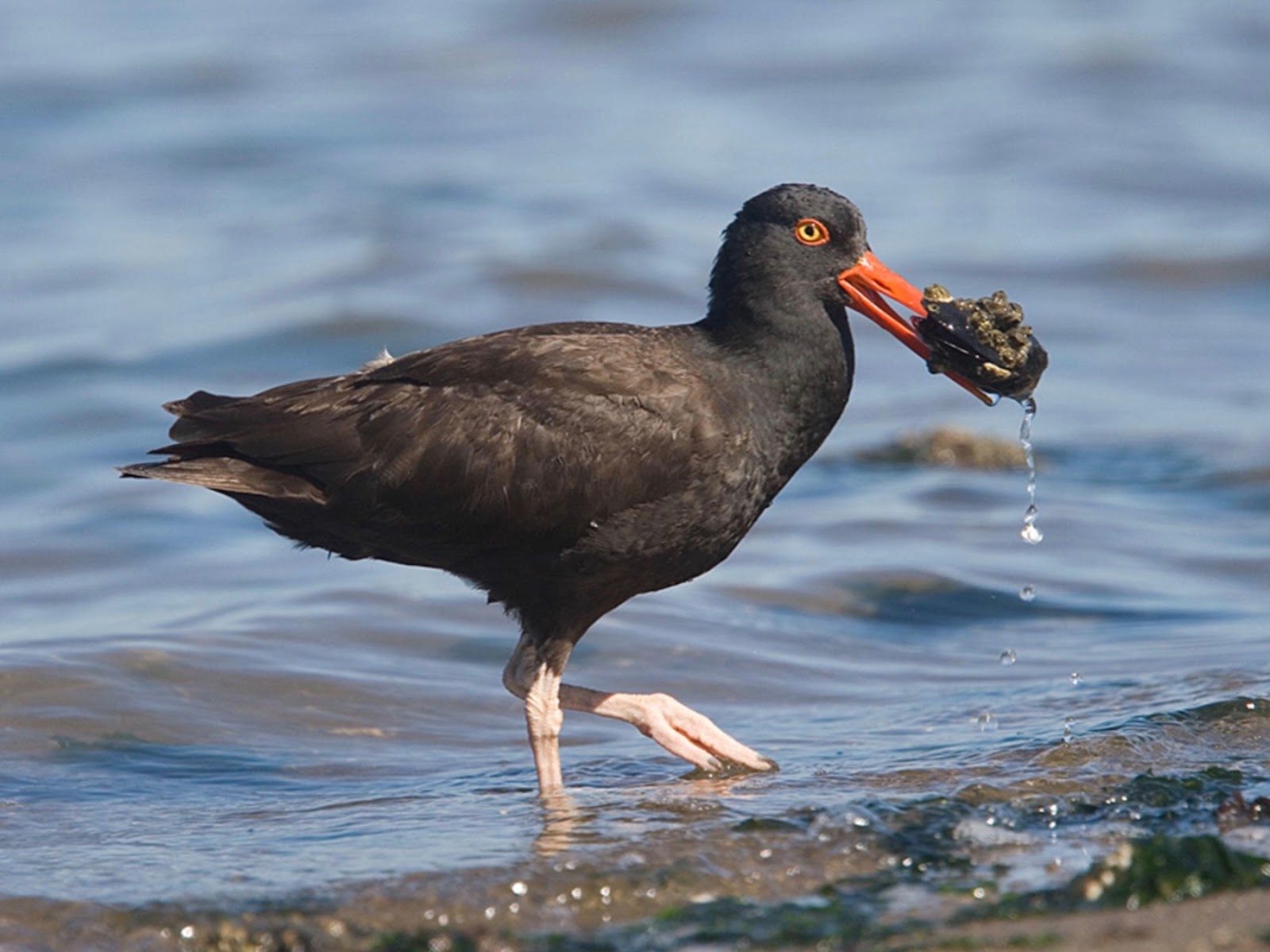
A tad south of the pocket beach, a Black Oystercatcher was feeding as a wave broke over her.  She flew out of the surf and onto a higher rock.  Although a rare happening, Black Oystercatchers are capable of swimming.
The rocks the Oystercatcher was feeding on have eroded out of the Franciscan Complex which dates back about 140 million years to the late Jurassic Period.  It was rather mind boggling when I realized the Oystercatcher was feeding on a rock that was created during the late Jurassic, and that under my feet were 140 million years of geologic history. 

Like all the state parks on the Central Coast, Estero Bluffs is free and well worth a visit.


Friday, August 14, 2020

Sweet Springs Easy Birding plus Oystercatcher Monitoring Update

Sweet Springs Preserve - 9:00 to 10:00 - Heavy moist overcast.  Some people might consider a grey morning rather unpleasant and dull.  For me it was an ideal morning to bird Sweet Springs.  The bay was serene in its stillness.
Shorebirds were racing back and forth across the narrow strip of muddy sand.  Semipalmated Plover were numerous.  These tiny migrant Plovers may have just arrived from their breeding grounds in Alaska.

There were a few Least Sandpiper.  They really are tiny.  Two Greater Yellowleg were focused on probing the sand, while two handsome Black-bellied Plover, in fading breeding plumage, were strolling sedately along the edge of the bay.  I must not forget the Willet, the Marbled Godwit, and dear, faithful Black Phoebe.  A Green Heron flying into the pond area was the highlight of the morning.

      Oystercatcher Monitoring Update
July 29, 2020 - Last photo of the family.  Chicks were nearly a month old.
The last few days of monitoring - July 3 -Parents on duty, one chick visible.  I briefly saw the entire chick moments before taking the photo.
July 7 - Parents on duty, chicks absent.  They could not fly and they could not have wandered far as their rock formation was separate from the other formations.  July 10 - Parents on duty, chicks absent.  One parent flew off, returning with a food morsel clutched in her bill.  She walked down the rock face disappearing into the cracks, sadly emerging with the morsel still clutched in her bill.  I knew in my heart she was searching for her chicks.
What had taken the Oystercatcher chicks?  Was it a raptor?  Was it the sea?  In my estimation, the unforgiving sea had taken the chicks.  Between July 1 and July 6, extremely high tides, combined with a powerful storm surge, had swept them off the rocks.

I have not given up hope.  During the winter months Oystercatchers are often seen feeding along the edge of the surf in Corallina Cove, and I will be there looking for a juvenile with its two-toned bill.


Wednesday, January 22, 2020

Birding Tuesday

Sweet Springs -  From the East Overlook - Green-winged Teal, Willet, Godwit, Ring-billed Gull, and a large brace of Ruddy Duck with a smattering of Bufflehead.  To the west a smaller brace of Scaup.  Whether they were Greater Scaup or Lesser Scaup, I was unable to determine.  I am working on my Scaup ID skills.
From left to right, Lesser Scaup and Greater Scaup (google photo)  The lesser has a narrower, purplish  head and smaller bill.  The Greater is 1.5 inches larger, has roundish, greenish head, and larger bill.  I am quite convinced some birds intentionally make identification difficult.
The Pond - Watched 20 Blue-winged Teal splash down in the pond. (above)  They immediately began a vigorous, high spirited bath that entailed much splashing and dunking.  Also in the pond, Green-winged Teal, one Pied-bill Grebe, and two pair of Pintail.
The brilliant white breast of the Pintail is most evident when they are resting along the edge of the pond.  Below a male Kingfisher let itself be known as it landed on a branch.  Their distinct call is described as a loud, dry rattle.
West Overlook - Feeding along the edge of the bay, Willet, Godwit, Western Sandpiper, Greater Yellowleg, Great Blue Heron, and two Black-bellied Plover.  Looking up is a must when you want to see a Bald Eagle or an Osprey in Sweet Springs.  Looking up this fine morning produced a magnificent Bald Eagle.  Yeah!
Montaña de Oro - Black Oystercatcher Update - The family of three continue together.  Seeing this precious family warms my heart.  The juvenile, the one with the two tone bill, is feeding in a splash zone.  Oystercatcher photos by Gary O'Neill.


Friday, January 3, 2020

Highlights of The Black Bloy Competition


January 3, 2020 - Montaña de Oro - The day was beautiful, sun warming, sea and sky a quiet azure.  Parking was not a problem as many of the Bloy (acronym for Black Oystercatcher) fans had either hiked, biked, or kayaked into the park.  For those who were unable to attend the events, a podcast will be available online.***

      Highlights of the Competition

Race to Hazard Reef - A paired race - From Islay Point (above photo) to Hazard Reef.  Each Bloy had to collect a food morsel, hold it securely in its bill and and fly back to the starting point.  Food morsels could not be eaten until after the morsels were weighed by the judges.  (many of the athletes could not resist eating their morsels)  The pair with the shortest flight time and the heaviest morsels won the event.  Briana and Bruce Bloy from Rug Rock were the proud winners.  As you can see in the photos they have a close relationship.

Pebble Toss - A precision sport - A pebble is tossed into a slight depression similar to the size of a Bloy nest.  The toss is judged on distance and how close the pebble comes to the center of the depression.  Too strong a toss could cause the pebble to bounce out.  Brandy Bloy from Point Buchon had been practicing her toss all year.  Brandy has a loyal following, as she is an environmental activist on climate change.  If it wasn't for the waves pounding against the rocks, you could have heard a pin drop when she executed her winning, no bounce toss of 12.38 feet.  Although shy, she posed for photographers.

Feeding Pose - Considered a difficult event - Participants had to hold a pose for a considerable period of time.  Since none of the entrants lasted more than three minutes, not much was expected of the last performer.  Brayden (below) the teenage son of Briana and Bruce Bloy astounded the crowd with a time of 9.35 minutes.  Brayden said he owed his success to his parents love and support.

Mussel Relay Race - A timed event - 5 teams of 5 were up for the challenge.  Team members were stationed about every half mile between Islay Point and Coon Creek.  The team member at Islay point began the race by collecting a mussel and flying it to team mate #2.  When the mussel finally reached team mate #6 at Coon Creek the mussel had to be relayed back to #1 at Islay Point.  If the mussel was dropped, the team member had to find a replacement.  The event was chaotic as all 5 teams were racing at the same time.
Team captain Bridget and her mates (below photo) won first place as they were the only team to complete the race with their original bivalve and all their original team mates.  Each Member of the winning team received a portion of the mussel's tasty adductor muscle.  In the above photo Bridget is demonstrating her winning grip.
Moments before the start of the next to the last event, a Marathon Flyathon between point Buchon and Morro Rock, there was an announcement - The competitors would be taking a four hour break to feast on a smorgasbord of delights that had been exposed by a minus tide.

As a consequence of the announcement, the "Black Bloy Competition" was officially placed on hiatus.

Photos by - Gary O'Neill, Mike Baird, J.A. Cory

***This is a work of fiction.  Any resemblance to actual events is entirely coincidental.  


Friday, December 27, 2019

Breaking Bird News


***The 2020 Morro Bay Winter Bird Olympics has been cancelled.  Unusually stormy weather along the Pacific Flyway caused many of the migrating athletes to abort their flights.  At the point of desperation, seeking food and rest, a rag tag flock finally found respite at the Stone Lakes National Wildlife Refuge in the Sacramento Delta.  A smaller flock from Alberta Canada came down at Mono Lake on the eastern side of the Sierra.  They immediately chowed down on the abundant supply of brine flies.
Unfortunately, Alexy Kuznetsov (center of photo), the captain of the Siberian Scaup Synchronized Diving Team, was struck by lightening while crossing the Bering Strait.   RIP Alexy
The news is not all bad.  Local Black Oystercatchers (Bloys) will be presenting, for the first time, "The Black Bloy Competition."  Montaña de Oro State Park (MdO) will host the competition along its rocky coastline.  The date is January 3, 2020 - from dawn to dusk Bloys from MdO and Point Buchon will demonstrate their extraordinary athletic abilities. (below photo by Gary O'Neill)
From left to right Briana, Brayden, and Bruce Bloy.  Admission is free - Parking limited.  Refreshments and Bloy memorabilia available at the Ranch House and Quarry Cove.

***This is a work of fiction.  Any resemblance to actual events is entirely coincidental.


Saturday, February 11, 2017

Pre-Spring Observations

Montaña de Oro State Park - Oystercatcher's can often be seen on the rugged shale formations that reach out into the sea (above photo).   A few days ago observed three Oystercatcher's participating in what could be described as a mating ritual.  A pair possibly males, while cheeping loudly, were in unison, prancing and bobbing their heads while another Oystercatcher (below photo), possibly a female and slightly larger than the two prancers, sedately observed the action.  
Obviously she was not impressed with their performance, as she flew off.  The two males wasted not a moment, cheeping loudly, they dashed after her.  To my disappointment they flew out of sight.
Continuing with Montaña de Oro Observations - About two weeks ago California Thrasher, known as an exuberant songster, began his spring song fest.  Thrasher vocalizations mark territory, demonstrate motivation, and if luck prevails, attract females.  Like their cousin, the Northern Mockingbird, they are mimics.  The more varied their repertoire, the greater their attraction to females.

One of the delightful aspects of Thrashers is when they sing, they are perched atop a large bush and easy to observe.  The California Thrasher in the photo is perched on a Dune Lupine Bush.
Another songster that has begun his pre-spring vocalization at Montaña de Oro is the perky Wrentit.  Although the male sings all year, as spring approaches his song is more frequent.  Unfortunately, unlike the Thrasher, Wrentits are difficult to observe, as they spend most of their time well hidden in the brush, which this year is dense due to abundant rain.  When birding the coastal areas of California and you hear a song ending in a descending ping pong ball trill, you know that somewhere in the brush is a Wrentit. 


Wednesday, June 17, 2015

Pied-billed Grebe - Black Oystercatcher - Pigeon Guillemot

Update - Cloisters Pond - Good News!  At the back of the pond, a few weeks after my April 5th posting, four tiny Grebes appeared.  A week later an additional three little Grebes appeared at the font of the pond; all have grown to maturity.  Considering the hungry Hawks and Raccoons that frequent the area, their survival rate is amazing.
Update - Black Oystercatcher - Oystercatchers are nesting at Montaña de Oro.  A monogamous pair makes a nest by tossing rock flakes, pebbles, or shell fragments toward their chosen nest site.  Two eggs can be seen in a nest, located on a seamount about 100 feet from the cliff.  Only one egg is visible (nest circled in red).  Unfortunately, anytime a person walks out to the point, the Oystercatcher gets off the nest;  when the person finally moves on, the Oystercatcher returns to the nest.  The photo by Mike Baird shows the proximity of the nest to the people standing on the trail.  Unfortunately, the viability of the nest depends on how many people walk out on this popular trail and how long they spend looking at the view.  This area is also popular with fisherman.
Update - Pigeon Guillemots - The action continues - Guillemots are dashing between rocks and the water and the water and the holes in the cliff, but much to my disappointment I have yet to find a nest that I can actually recognize as a nest.  The Guillemots are numerous, so there is hope that some are nesting.   A juvenile Guillemot usually leaves the nest at night; they flutter and tumble from the cliffs to the sea.  Once in the sea, it will take another couple of weeks for their flight feathers to fully develop.  I am thinking positively that during those weeks, I will see a juvenile Guillemot before it fully matures and flies out to sea.  
I am afraid that our love of nature is taking its toll on the nature we love.

Monday, January 5, 2015

Day of the Oystercatcher


Mid morning - Montaña de Oro Bluff Trail - The resident Black Oystercatchers were carrying on something fierce - in groups of four to six, they were flying noisily between rock formations, and I do mean noisily. (above photo - Oystercatcher habitat)

Their high piercing sound, which makes them easy to identify, can be heard at a distance of at least a 1/4 mile.  The Oystercatchers were very active along the bluffs this warm, spring like morning.
Fortune shined when the opportunity arose to observe two separate flocks of four, flying between formations.  The lead pair would find a suitable rock and land. The second pair looking like they were going to land in the same area, would suddenly veer off to a nearby, but not close, rock. (Oystercatcher pair by Mike Baird)
Being a romantic at heart I thought this behavior might indicate the beginning of the breeding season, as fledged juveniles do not go off on their own until the next breeding season.  Perhaps this behavior was an indication that breeding season was near and that the juveniles now have to face the reality that adulthood is just around the next rock. (flying Oystercatchers by Mike Baird)

Today, Black Oystercatchers dominated the scene.  I wonder what tomorrow will bring.