Showing posts with label Birds of Montaña de Oro. Show all posts

Saturday, March 9, 2019

Birding Between Rain Storms


    Coreopsis at the entrance to Sweet Springs Preserve

Sweet Springs - The break in the clouds was brief.  The shower began just as I was entering the preserve.  My rain jacked has been getting a lot of use lately.  The pond was very quiet.  The only ducks were a male and female Mallard that appeared to be chasing one another with much splashing.  They both disappeared under the water.  I was clueless at that moment as to what was going on.  The male began to appear; underneath him the female.  He was clutching her head.  I thought, "Oh my gosh, he's going to drown her."  She survived.  This was my first experience observing the brief mating process of Mallards, if I had blinked, I would have missed the event.   

There were the usual birds with two exceptions -  The usual were - Bushtit, Song Sparrow, Junco, California Towhee, California Quail, Common Yellowthroat; Nuttall’s Woodpecker and Northern Flicker were busy drumming - Exception one, watching a Merlin (Falco columbarius) fly on to a perch in a tall deceased tree across from the pond. (below).   Exception two, listening to the song of a Purple Finch.  Purple Finch often hang out at the tip top of high trees and can be difficult to see.
Montaña de Oro - Spooners Cove and Bluff Trail -  My favorite sighting - 2 beautiful Peahens delicately nibbling on green vegetation growing in Spooner's Cove.  They paid no attention to my presence.  The Peahens arrived about two years ago.  I have a question.  How have they avoided being eaten by one of Montaña de Oro's many hungry predators?
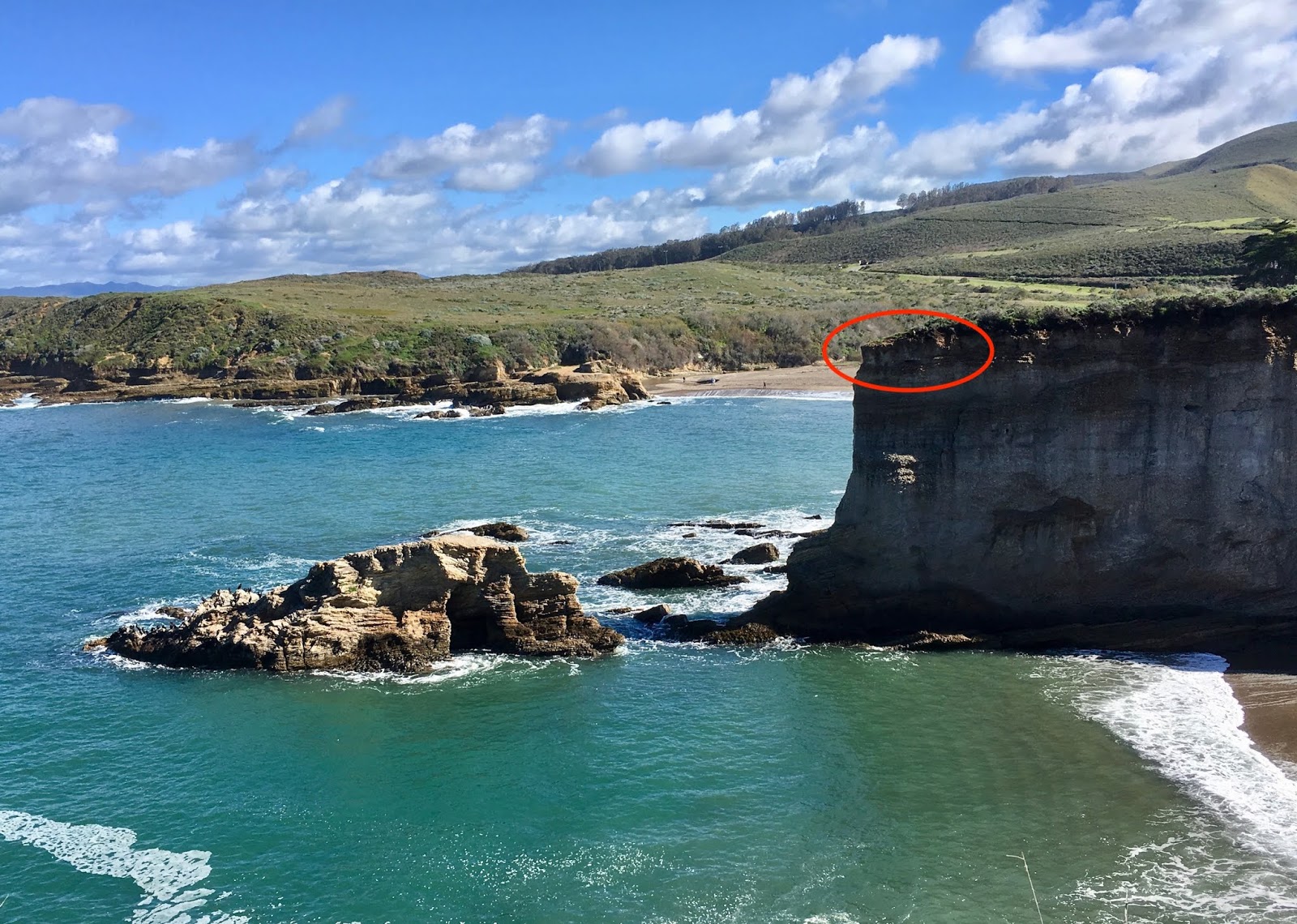
The Peregrine appear to be in the nesting mode.  They have been seen mating, and the male is bringing her food.  The female spends much of her time perched on the point or close to the nest opening (below photo).  On the formation below were Brandt's and Pelagic Cormorant and three Oystercatcher.
Pelagic Cormorants are beginning to transition into their breeding plumage.  On some of the Pelagic their white flank patches can be seen.  This group of Pelagic Cormorants are located a short distance north of Corallina Cove.  They may nest on Morro Rock or on a Sea Stack near Morro Rock. 
Song birds along the Bluff Trail were also in the mating mode.  Much singing and chasing through the brush.  Spring is definitely in the air.  Meanwhile the rain ☔️ ☔️ continues. 


Sunday, July 15, 2018

Birding the Bluff Trail

Bluff Trail Montaña de Oro - Coon Creek Cove - This is the farthest one can walk south on the Bluff Trail.  At this point the trail gently curves north/east, about .70 of a mile to the Coon Creek Trail Head and parking area.
I heard the Pigeon Guillemot’s high, piercing whistle before I saw them.  They are frequently seen conversing with each other.  It appears they have much to say.
 These hardy, compact sea birds arrive at MdO in mid-March to nest in the holes and niches found in the rocky cliffs of the Bluff Trail. 
Sharp claws on their webbed very red feet help them to climb the rugged vertical shale formations.  I was wondering if the Guillemot on the left was not fully mature, as its feet were not the bright red of an adult.  In mid-August they will return to the open sea.  Fortunately there are always a few that hang around for awhile.

The Bluff Trail birds were very cooperative.  Noticed a pair of, difficult to see, Wrentit chasing each other through the brush, Spotted Towhee seemed to be everywhere, California Thrasher, and Bewick's Wren were singing.  The highlight of the morning was a precious California Quail family with 11 tiny chicks, mom leading the way, dad taking up the rear.  I never cease to be amazed that these itty bitty creatures are independent foragers at birth.  I wish them all a long and fruitful life.


Thursday, June 8, 2017

Late Spring Islay Creek Birding

 In every direction is a wild and beautiful landscape. This morning the hill were aglow with blooming Sticky Monkey Flower and GoldenYarrow (below). 
The morning sun was warm, the breeze a caress.  Islay Creek was alive with song - all the usual birds plus Swainson's Thrush, Purple Finch, and Cliff Swallow.  I was birding without binoculars.  There are several bird APPS that can be helpful with identification.  I use IBird Plus which does not require an internet connection; there are songs and call for each bird that one can listen to.  

This morning I recorded one minute of bird sounds.  How many can you identify? 
http://www.youtube.com/watch?v=T4pD9Og2jXs 
 
Names of birds are noted in the morning's bird list by an asterisk. 


Bird List - *Northern Flicker, *Spotted Towhee, *Wilson's Warbler, *Wrentit, *Purple Finch, Calif. Thrasher, Calif. Towhee, Bushtit, Calif. Quail, Scrub Jay, Bewick's Wren,  Pacific Flycatcher, Song Sparrow, Cliff Swallow, Red-tailed Hawk, Turkey Vulture

Sunday, April 9, 2017

Wrentit - Extended Trill


        Hazard Canyon Wrentit Habitat
The male Wrentit song consists of a few sharp whistled "pit" notes with a descending 3-4 second trill at the end.  It is considered the classic sound of the Coastal Sage Scrub community. This week I hiked up Hazard canyon.  Wrentits were active and singing.  One Wrentit was defending his territory of blooming Hemlock from a persistent Anna's Hummingbird.  Every time the hummer hovered over a blossom, the Wrentit chased her off.  
 Wrentits are faithful to their territory, remaining in the same area for up to 12 years; they defend and define their territory by singing.  About a mile up the canyon I heard a Wrentit song with an extended trill.  Fortunately, he repeated it several times.  I felt his breathlessness, if that was possible.  His song was saying, in no uncertain terms, "This is my territory and you do not belong."  It is more than likely that his life mate was sitting on their nest.

The video consists of three segments. The photo of the Wren separates the segments. For comparison, the first and last segment are the usual song with a 2.83 sec. trill.  The middle segment has the extended 9.13 sec. trill.  When you are watching the video keep in mind that, as he trills, his tail is vigorously vibrating.     https://youtu.be/-pBjwCYZUwM

Saturday, February 11, 2017

Pre-Spring Observations

Montaña de Oro State Park - Oystercatcher's can often be seen on the rugged shale formations that reach out into the sea (above photo).   A few days ago observed three Oystercatcher's participating in what could be described as a mating ritual.  A pair possibly males, while cheeping loudly, were in unison, prancing and bobbing their heads while another Oystercatcher (below photo), possibly a female and slightly larger than the two prancers, sedately observed the action.  
Obviously she was not impressed with their performance, as she flew off.  The two males wasted not a moment, cheeping loudly, they dashed after her.  To my disappointment they flew out of sight.
Continuing with Montaña de Oro Observations - About two weeks ago California Thrasher, known as an exuberant songster, began his spring song fest.  Thrasher vocalizations mark territory, demonstrate motivation, and if luck prevails, attract females.  Like their cousin, the Northern Mockingbird, they are mimics.  The more varied their repertoire, the greater their attraction to females.

One of the delightful aspects of Thrashers is when they sing, they are perched atop a large bush and easy to observe.  The California Thrasher in the photo is perched on a Dune Lupine Bush.
Another songster that has begun his pre-spring vocalization at Montaña de Oro is the perky Wrentit.  Although the male sings all year, as spring approaches his song is more frequent.  Unfortunately, unlike the Thrasher, Wrentits are difficult to observe, as they spend most of their time well hidden in the brush, which this year is dense due to abundant rain.  When birding the coastal areas of California and you hear a song ending in a descending ping pong ball trill, you know that somewhere in the brush is a Wrentit. 


Monday, May 18, 2015

The Pigeon Guillemots of Montaña de Oro

Of all my favorite birds, the Pigeon Guillemot (Cepphus columba) is number one.  During the breeding season, their rounded body is very black with brilliant white wing patches (photo by Mike Baird).  Their legs, feet, and mouth lining a brilliant orange-red; the feet are so red they look like they have been photoshopped.

Montaña de Oro's rocky shoreline with all its nooks and crannies provides the Pigeon Guillemot with ample areas to nest.  Like clockwork, every March, these hardy little sea birds arrive in Montaña de Oro.
 The Pigeon Guillemot uses its short strong wings to swim while searching for food, diving to depths of 150 ft.  When not feeding, they often rest on cliff edges (above photo).  By vigorous flapping of their wings, combined with the use of sharp claws on webbed feet, the Guillemot is able to climb the steep, rocky cliffs. 

A few days ago, from the Bluff Trail, I observed several pairs of Guillemots acting very frisky, with much splashing, wing stretching, and shallow dives.  I focused on a pair that was the easiest to view. For the ease of explanation I will call them Frank and Doris.  I would describe their antics as a pre-mating ritual.  Like some males Frank was the aggressor.  Doris was enjoying the attention but was rather standoffish, not ready for the grand finale.  Frank would close in, and Doris would scoot out of reach.  They participated in this behavior repeatedly.  Twice they flew to and from a nesting hole in the cliff. 

 As Frank (above photo, lower right) chased Doris he was constantly chatting.  Unable to understand the high pitched sounds, I made an unscientific assumption.  Frank was telling Doris that time was of the essence, as they must return to sea mid August.  He was reminding her that incubation takes at least 30 - 32 days, and then there is the intense 35 - 50 days of feeding the little darling; two eggs may be laid, but only one chick will fledge. (below photo - Doris checking out a nesting area)
Both parents incubate the egg and bring small fish to their chick.  Success raising a chick to maturity depends on the weather, the impact of human activity, and the warming ocean and its disastrous affect on the food chain.  Hopefully, Doris and Frank will incubate an egg, produce a healthy, well adjusted nestling which will one day return to the rocky cliffs of Montaña de Oro.