Showing posts with label joyce cory. Show all posts

Friday, May 20, 2022

Central Coast Ibis - Here Today Gone Tomorrow

Turri Road - Los Osos Ca - Seeking a White-faced Ibis and a Solitary Sandpiper.  I was headed east on Turri Road, a scenic rural route between South Bay Blvd and Los Osos Valley Road.  From South Bay Blvd I traveled about a mile and a half to a dilapidated cattle pen, nearly adjacent to an ephemeral pond/wetland, often used by cattle and migratory birds.

Fortune shined this cloudy morning.  The White-faced Ibis were peacefully feeding in the wetland, their glossy maroon and metallic green feathers appearing to shimmer in the morning light.  
White-faced Ibis, with their long decurved bill, eat a variety of organisms such as insects, frogs, snails, small fish, spiders, and earthworms. 
The Solitary Sandpiper was difficult to locate as it was feeding in tall grass.  Now and then I caught a glimpse.  Finally it came out of the grass and I was able to identify the little darling.  What proved to be helpful was its tendency to bob.  Every time her tail went up, it exposed her startlingly white "derriere." Her movement was similar to the Spotted Sandpiper's tail bobbing, but slower.
The Solitary Sandpiper is smaller than a Lesser Yellowleg and larger than a Western Sandpiper; it has distinctive white eye rings, and greenish/yellow legs.  It prefers to forage in small stagnant pools, just like the one off Turri Road. 

Adding to the marvelous morning was a "wake" of  Turkey Vultures feeding on a small raccoon carcass.  Several were in the air, circling, while others perched on the nearby fence.  I am charmed by their gentleness and patience.
Up the hillside from the pond/wetland is an isolated section of fence.  When I arrived four turkey Vultures were perched on the fence.  Joining the Vultures was a Western Bluebird and a Cassin's Kingbird.  Both eat insects.  From the fence they would fly up, hovering for several moments, checking the air and grassland for prey.  
Cassin's caught its prey in mid-air while the Western Bluebird found its prey on the ground.  With goals achieved, they returned to their original perch. 
 
 Other Birds of the morning - Across the road in a Willow/Sycamore/Oak thicket were Wilson's Warbler, Yellow Warbler, Song Sparrow, Oak Titmouse, Northern Flicker, and a Downey Woodpecker continually drumming.

The Ibis are gone now, but there is a good chance they will return next season, that is IF we get rain.


Monday, December 21, 2020

Birding On The Ninth Day Of Christmas


On the Ninth day of Christmas Mother Nature gave to all. . . 9 Brant a Chattering

8  Willet Flying

7  Teal a Paddling . . .

6  Tern a Standing . . . 


5  Ruddy Duck a Gliding . . .
4  Goslings a Gandering . . .
3  Vultures Feasting . . .
2  Godwit Probing . .  .

And a Bald Eagle in an Old Tree.

           Wishing you Merry Christmas and Happy Hanukkah


Friday, October 2, 2020

Birding Estero Bluffs Pocket Beach

Estero Bluffs State Park Ca. stretches north four miles from Cayucos to villa Creek.  I was meeting Mike at the Villa Creek parking area.  The morning's goal, a small pocket beach, a tad south of the creek.
As we progressed through the park numerous delightful trails led to views of Estero Bluffs' dramatic, rocky coastline.
The pocket beach was full of surprises.  We had a marvelous view of the beach and the birds from our perch on the bluff.  The darker birds in the damp sand are adult and juvenile Heermann's Gull; the grey and white birds, Western and Ringed-billed Gull; the white birds, Elegant and Caspian Tern, and more than likely there were one or two Royal Tern.  Two of the Caspian Tern can be seen in the below photo.  Look for a very red bill.
Here and there, particularly on and around the kelp, were Black Turnstone (below).  They become nearly invisible when feeding on kelp.  
Black Turnstone was not the only one with a taste for kelp flies and their larva.  Joining in on the feast were Willet, Whimbrel, Godwit, Long-billed Curlew, Killdeer, Black and Say's Phoebe, and an American Pipit.

Kelp flies breed on decaying kelp.  A female lays five clutches of 80 eggs each, a total of 400 eggs; the larva feeds on bacteria coming from the decaying kelp.  The warmer the weather, the faster the kelp decays, the quicker the eggs hatch.  Their life cycle is about 30 days.
A tad south of the pocket beach, a Black Oystercatcher was feeding as a wave broke over her.  She flew out of the surf and onto a higher rock.  Although a rare happening, Black Oystercatchers are capable of swimming.
The rocks the Oystercatcher was feeding on have eroded out of the Franciscan Complex which dates back about 140 million years to the late Jurassic Period.  It was rather mind boggling when I realized the Oystercatcher was feeding on a rock that was created during the late Jurassic, and that under my feet were 140 million years of geologic history. 

Like all the state parks on the Central Coast, Estero Bluffs is free and well worth a visit.


Saturday, August 1, 2020

Birding Villa Creek

The morning was grey, sea calm.  Villa Creek is located at the northern terminus of Estero Bluffs State Park.  Although easily accessible, it has yet to be discovered, with the exception of course, of the occasional birder.
At either end of the cove rugged promontories calm the incoming sea.
I was fascinated by the floral patterns the ebbing tide had etched in the sand.
Upon entering the beach my first sighting was of Snowy Plovers.  It is rather mind boggling how fast their tiny legs move when they are feeding on teensy, weensy black sand flies.
Not wanting to be left out, a Semipalmated Plover joined the fly feeding frenzy.
Villa Creek and its lagoon are out of sight from the beach, as the beach is lower than the lagoon.  I was birding with Mike.  He spotted an Osprey who was not the least concerned as to our presence on the beach. (Due to the zoom effect, the distant background appears closer.)
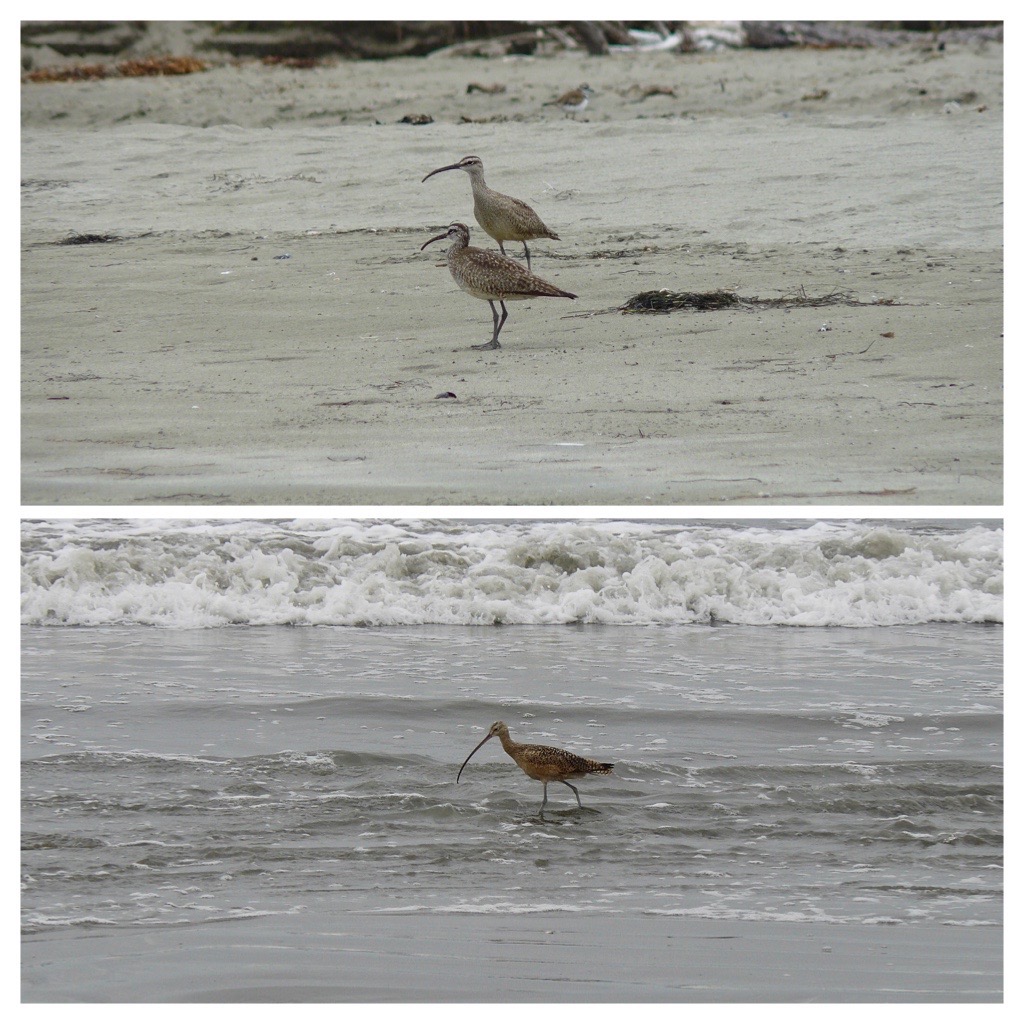
Heading toward the lagoon we saw Whimbrel and Long-billed Curlew.  I admit there have been many times when I have pondered the question, "Is it a Curlew or a Whimbrel?"  Can you tell which is which?

At the narrow end of the lagoon we saw Black Phoebe, Killdeer, Great Egret, Great Blue Heron, Western Sandpiper, and no ducks.  Overhead flew a pair of Black Oystercatcher, Red-tailed Hawk, and Turkey Vultures.  Accessing the further reaches of the lagoon meant tromping through a tangle of vegetation that included dry grass, a favored habitat for ticks.  I decided not to walk through the grass.  Mike, on the other hand ventured forth.  No ducks, but he did confirm my tick theory when he found he had six unwanted guests.  
The finale of birding Villa Creek and its environs was watching a Surf Scoter feeding in the surf.  The collage compares an Adult Scoter with the one I observed.  It was either a juvenile or an adult in molting (eclipse) plumage.  More than likely it was a juvenile.  I do intend on returning to Villa Creek, but will wait for a sunny day.


Wednesday, May 27, 2020

Black Oystercatcher Monitoring


The Black Oystercatcher is considered an indicator species for intertidal health.  They live, feed and breed on rocky, intertidal shorelines that are vulnerable to rising sea levels, human interference, and predators.  Last year, at Montaña de Oro State Park Ca (MdO), only one of nine recorded nesting attempts produced a nestling that grew to maturity.
The Juvenile that grew to maturity is on the left, to the right, the proud parents of Site 7.  Note the two tone bill of the juvenile. (above photo by Gary O'Neill.)

Conservation efforts for Oystercatchers was limited by lack of baseline information.  A study was needed.  MdO nest monitoring began in 2007.  I am familiar with the MdO Oystercatcher population, having learned details on nesting habits from Sara Kelly, an experienced Oystercatcher (bloy) monitor.  I volunteered to be a nest monitor at Site 7. 
During nesting season Bloys are highly territorial, often nesting in the same location as the year before.  The nest may be in a slight depression or in a space between shale layers.  They share all nesting duties including chasing off interlopers.
9:08 am, Thursday May 21 -  My first monitoring experience began at site 7 aka "Danger Sign," on the north side of Quarry Cove.  The sign has been there as long as I have been volunteering at MdO, and that is over two decades.  I greatly doubt anyone has ever heeded the warning.
Monitoring should be done far enough away from the nest site so as not to cause the Bloy to alert.  They may abandon the nest.  Last year symbolic fencing was installed to keep people from disturbing the Bloys.  Do people climb over it?  YES!!
As soon as I arrived I took out my binocs and began monitoring.  I knew the approximate nest location (center of red circle), but only saw slabs of uplifted shale.  I assumed that hidden from view was a Bloy incubating two to three eggs.  While watching what I thought was the nest site, I took quick looks around for the mate.  About 10 minutes into monitoring a Bloy flew to a nearby
rock and began preening.

Since male and female Bloys look alike, I have named them Babbs and Bob.  Babbs was on a rock preening, Bob was hopefully on the nest.  After a few more minutes Bob rose up from a crack to the right of where I had been focused.  Babbs move in and settled down.  Through a crack in the shale I could see a tiny sliver of a bright red bill.  Now I knew where to look.!!  I had just experienced my first nest exchange. ( At the end of the blog is a youtube video of the exchange.)

The morning was beautiful, sunny, no wind.  Now, Bob was preening and Babbs was sitting on the nest.  All of a sudden chaos reigned.  Three raucous Bloy were flying over the next site.  Bob joined them and a moment later Babbs deserted the nest and flew off with the group.  I was in shock.  No one was sitting on the nest.  I felt helpless.  Fortunately, five minutes later Babbs returned to the nest.  Bob was across the cove feeding.  Later I learned this type of behavior is not unusual. 


My first monitoring experience was very interesting.  I do hope that this pair is successful.  At the present time it is the only nesting pair at MdO.
 
You may have to watch the video more than once, but you can see Babbs settle into the nest site.  From now on I will bring a real camera.

Thursday, April 9, 2020

Birding With a Bleak Soul

The San Luis Obispo County "stay-at-home" announcement was on March 18, 2020 - feels like that was months ago.  Like many of our residents, I take walks, making a point of keeping six feet from other humans.  Actually, I'm more comfortable at 10 - 15 feet.  People wave, smile, and at times engage in pleasant conversation.

Saturday morning I threw caution to the wind and took off for the Audubon Overlook (6 blocks from my house) and nearby Turri Road.  Total driving distance about 6 miles.
Audubon Overlook - A Song Sparrow was gaily singing as I proceeded down the path to the overlook.  The morning was without flaw.  Across the bay (upper Photo), along the edge of the pickleweed, was a sizable flock of Brant Goose, their delightful chatter carried across the bay.  Photo shows the same flock of Brant feeding in pickleweed on a foggy January day.
Other Birds: Caspian and Forster's Tern, Willet bathing, and a Black-bellied Plover in gray winter plumage.  Out on the bay floated a large flock of mostly Ruddy Duck -  Rufus Hummingbird feeding on pink flowers of a mallow shrub was a special treat.  He was a beauty!
Turri Road Ponds -  On a tiny island, in the center of the photo, perched a Greater Yellowleg.  Upper right, eleven Green-winged Teal, and three Northern Shoveler dabbled.  A dabbling duck is a shallow water duck that feeds primarily along the surface or by tipping headfirst into the water.

   Now, you know the origin of the idiom, "bottoms up."

The next stop, about a mile up the road, is one of my favorite places to bird.  I have named it the cattle pond.  In the rainy season the pond fills.  What a privileged to be here, breathing in the scenery, the scents, and the sounds of the birds.
Five male Cinnamon Teal were feeding in the far section.  Streaking over the pond were White-throated Swifts and Swallows, along the edge two Willet searched for edibles. 
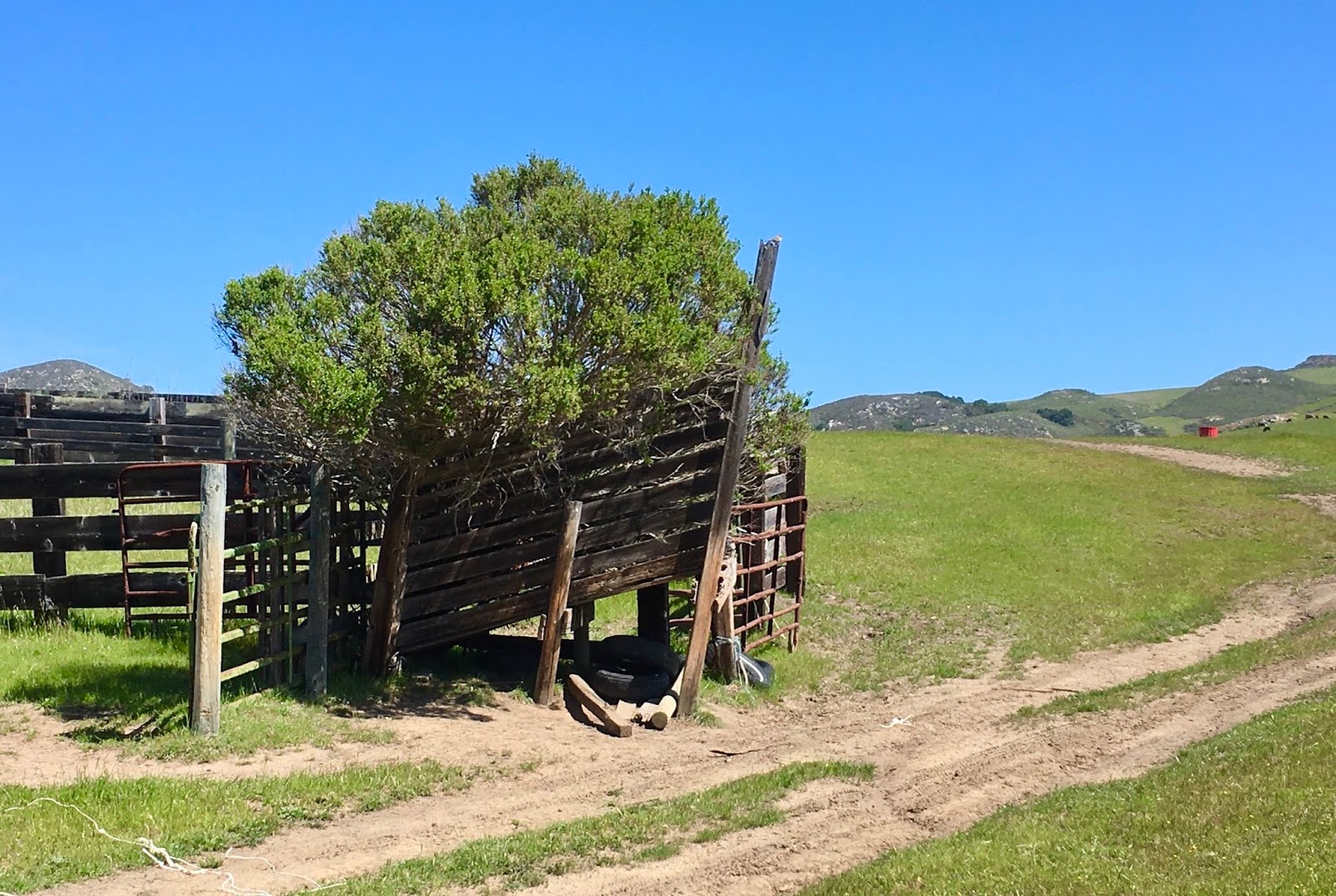
West of the pond is a dilapidated cattle pen.  The corner of the pen, with its old loading chute, scruffy little tree, and aging wooden fencing was attracting three species of birds.  American Goldfinch, House Finch, and California Towhee (photo) were flying in and out of the foliage.  From a section of barbed wire fencing two Cassin's Kingbirds sallied forth in pursuit of insects.  Wilson's Warbler sang from a willow thicket.
Best sighting of the morning was a Lark Sparrow (below) perched atop an old post.  Every few minutes he sang - this was first time I had heard a Lark Sparrow sing.  During breeding season males sing from elevated perches and that is just what he was doing - made my day! 
Afterthought:  As I jotted down my thought, I realized how privileged and fortunate I am to be able to drive to a peaceful rural area and spend time thinking only of birds and the beauty of the day . . . . .


Wednesday, January 22, 2020

Birding Tuesday

Sweet Springs -  From the East Overlook - Green-winged Teal, Willet, Godwit, Ring-billed Gull, and a large brace of Ruddy Duck with a smattering of Bufflehead.  To the west a smaller brace of Scaup.  Whether they were Greater Scaup or Lesser Scaup, I was unable to determine.  I am working on my Scaup ID skills.
From left to right, Lesser Scaup and Greater Scaup (google photo)  The lesser has a narrower, purplish  head and smaller bill.  The Greater is 1.5 inches larger, has roundish, greenish head, and larger bill.  I am quite convinced some birds intentionally make identification difficult.
The Pond - Watched 20 Blue-winged Teal splash down in the pond. (above)  They immediately began a vigorous, high spirited bath that entailed much splashing and dunking.  Also in the pond, Green-winged Teal, one Pied-bill Grebe, and two pair of Pintail.
The brilliant white breast of the Pintail is most evident when they are resting along the edge of the pond.  Below a male Kingfisher let itself be known as it landed on a branch.  Their distinct call is described as a loud, dry rattle.
West Overlook - Feeding along the edge of the bay, Willet, Godwit, Western Sandpiper, Greater Yellowleg, Great Blue Heron, and two Black-bellied Plover.  Looking up is a must when you want to see a Bald Eagle or an Osprey in Sweet Springs.  Looking up this fine morning produced a magnificent Bald Eagle.  Yeah!
Montaña de Oro - Black Oystercatcher Update - The family of three continue together.  Seeing this precious family warms my heart.  The juvenile, the one with the two tone bill, is feeding in a splash zone.  Oystercatcher photos by Gary O'Neill.