Showing posts with label snowy plover. Show all posts

Saturday, August 1, 2020

Birding Villa Creek

The morning was grey, sea calm.  Villa Creek is located at the northern terminus of Estero Bluffs State Park.  Although easily accessible, it has yet to be discovered, with the exception of course, of the occasional birder.
At either end of the cove rugged promontories calm the incoming sea.
I was fascinated by the floral patterns the ebbing tide had etched in the sand.
Upon entering the beach my first sighting was of Snowy Plovers.  It is rather mind boggling how fast their tiny legs move when they are feeding on teensy, weensy black sand flies.
Not wanting to be left out, a Semipalmated Plover joined the fly feeding frenzy.
Villa Creek and its lagoon are out of sight from the beach, as the beach is lower than the lagoon.  I was birding with Mike.  He spotted an Osprey who was not the least concerned as to our presence on the beach. (Due to the zoom effect, the distant background appears closer.)
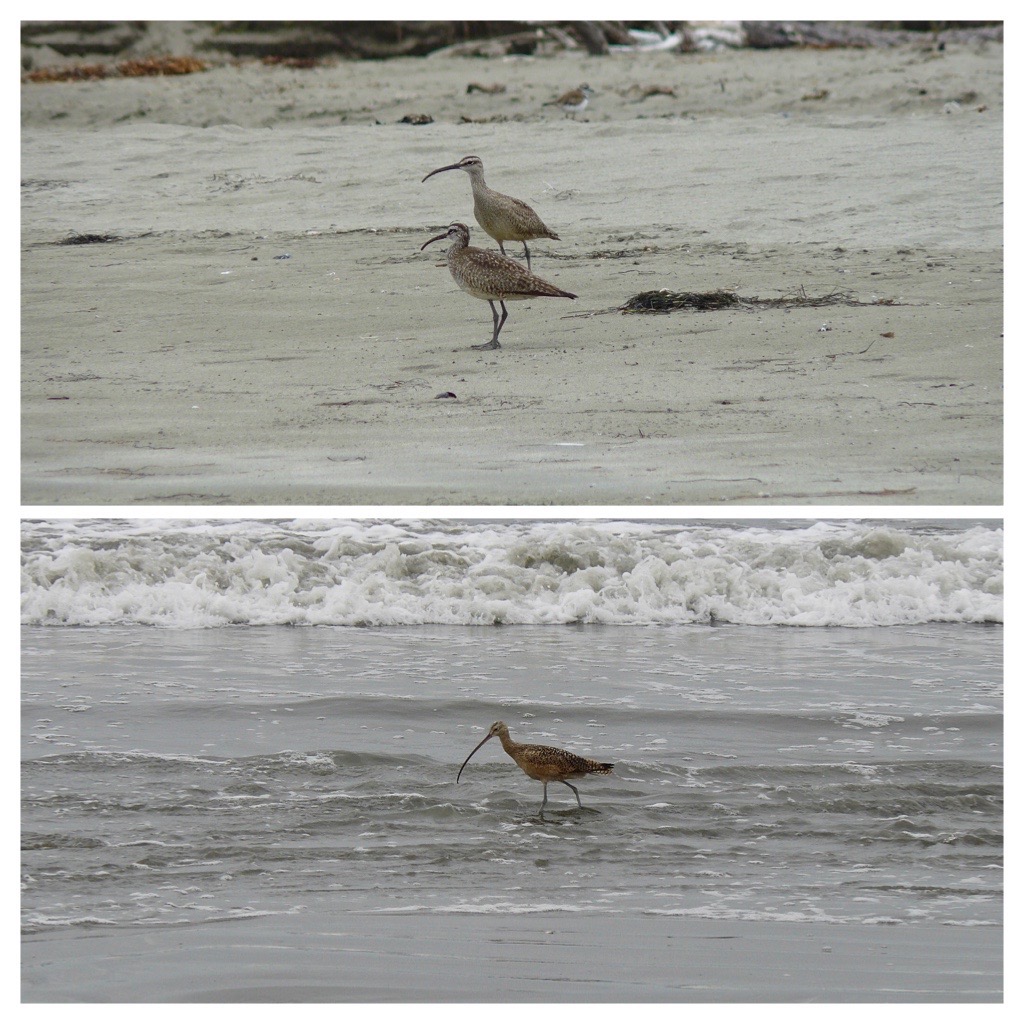
Heading toward the lagoon we saw Whimbrel and Long-billed Curlew.  I admit there have been many times when I have pondered the question, "Is it a Curlew or a Whimbrel?"  Can you tell which is which?

At the narrow end of the lagoon we saw Black Phoebe, Killdeer, Great Egret, Great Blue Heron, Western Sandpiper, and no ducks.  Overhead flew a pair of Black Oystercatcher, Red-tailed Hawk, and Turkey Vultures.  Accessing the further reaches of the lagoon meant tromping through a tangle of vegetation that included dry grass, a favored habitat for ticks.  I decided not to walk through the grass.  Mike, on the other hand ventured forth.  No ducks, but he did confirm my tick theory when he found he had six unwanted guests.  
The finale of birding Villa Creek and its environs was watching a Surf Scoter feeding in the surf.  The collage compares an Adult Scoter with the one I observed.  It was either a juvenile or an adult in molting (eclipse) plumage.  More than likely it was a juvenile.  I do intend on returning to Villa Creek, but will wait for a sunny day.


Saturday, October 28, 2017

Estero Bluffs State Park - Villa Creek Beach

                 
Estero Bluffs State Park begins directly after the community of Cayucos.   The park follows along Highway 1 for about 5 miles until the road takes a slight curve inland. 
Between the highway and the Pacific Ocean is a vast grassland dotted with a few greenish serpentine rock clusters and the occasional clump of brush. 

Destination of this morning’s birding adventure, Villa Creek Beach, located at the northern end of the park.  Several days ago migrant Mountain Plover had been sighted.   I had high hopes that at least one of the three that had been seen by local birders would appear in my binoculars.  
 As I was following the trail to the beach, I asked a gentleman birder if he had seen the Plover.   He said he had and that it was easy to see. 
                             Mountain Plover
After walking a few yards along the beach, I spotted the Mountain Plover, (first time sighting) chasing flies with her cousins the Snowy Plover.  I was delighted to get a photo of the Mountain Plover, as it was constantly on the move chasing kelp flies.  While watching the Plovers two of the Snowy got into a rough and tumble disagreement, feathers were actually flying.  (Photo - Snowy Plover often rests in small depressions.) 
Other birds on the beach: American Pipit, Black-bellied Plover, Killdeer, Godwit (below photo), Whimbrel, and of course, my faithful friend, Black Phoebe. 
After the beach I walked through a few acres of the Grasslands:  Red-tailed Hawk, Loggerhead Shrike, a very cheeky House Wren, Western Meadowlark, American Pipit, numerous White-crowned Sparrow, excellent sightings of Savanna Sparrow, and Black Phoebe.  Birding Villa Creek Beach and the grasslands was absolutely "Supercalifragilisticexpialidocious."


Sunday, July 13, 2014

A Birding Change of Pace

Since June, I have been a participant in the docent rover program at Montaña de Oro State Park (MdO).  "What is that," you ask.  Roving is a fairly new program at MdO.  Rovers either rove the trails or people an information table at a trail head.  I rove the trails,  answering questions, interpreting nature, and have a cell phone if an emergency should arise with visitors or wildlife; sometimes, the visitors are the wildlife.  (click on the photo for a larger image)
 On June 27th. a dead Humpback Whale came ashore at Hazard Beach, one of the more remote beach areas of MdO.  The following morning Mike, a fellow rover, and I were down at the site.  Two whale researchers from Santa Barbara were gathering data.  It appeared that a severe wound to the tail, above the flukes, contributed to the death of this peaceful denizen of the deep.  For a brief video on my observations go to  http://youtu.be/cvSGR77Mx28

 Observing this magnificent mammal was, to say the very least, an experience of my lifetime.   A few days after the first visit I was back at the site, along with many photo taking visitors (the teens were being photographed by their mother).  News of the whale's arrival had spread fast.  In the process of decomposition, gases such as ammonia, methane, and sodium nitrate build up causing the whale to bloat and turn over; now its under side was exposed and the severity of the wound to the tail could be seen.  More than likely the humpback had become entangled - a recent study showed that entanglement in fishing gear is the primary cause of Humpback Whale death.  I have a one minute video that shows the whale in the process of decomposition.  http://youtu.be/jhUdQV6waVI

While on the beach had the pleasure of seeing a few Snowy Plover, Oystercatcher, a large flock of Heermann's Gull, Willet, Whimbrel, and a Great Egret feeding in the surf.  Oh, I must not forget the 50 or more Turkey Vultures circling over the area.

I have not been active at MdO for a couple of years and it is good to be back.


Sunday, April 7, 2013

SAN SIMEON STATE PARK LAGOON

9:30 am - Weather perfect.  Met Harry and Norma at San Simeon State Park Lagoon.  Passing over San Simeon Creek is Hwy 1.  The bridge is ideal for Swallows to paste their mud nests.  Some swallows were actually nesting inside the bridge, entering thru small round openings.  Nest building was in progress by Northern Rough-winged (photo below) and Cliff Swallow.
As we approached the Lagoon we were met by a Song Sparrow who let us know, with his splendid song, that we were infringing upon his territory.   Great-tailed Grackle entertained us from the Willows (so much for peace and quiet).  A pair of Brant Goose, a pair of Mallard (photo below) plus a Double-creasted Cormorant, one Curlew, and a handful of Least Sandpiper were along the edge of the Lagoon.
We were hoping to see Snowy Plover (photo by Mike Baird).  When they are not moving they are nearly impossible to see, as they blend in perfectly with their environment. Fortunately we saw several fly; once they land they are invisible.
Nesting season has begun for the Snow Plover, "a species of special concern." Usually, nests are built on flat, open beaches or dunes.  Nests consist of a shallow scrape or depression lined with beach debris   (small pebbles, shell fragments, plant debris).  Driftwood, kelp, and dune plants provide cover for chicks that crouch near objects to hide from predators.  State Parks protects the Plover by fencing off the nesting area with a single cord and signs, and placing wire protection over the nests.

One of our best sightings of the morning was a Pacific-slope Flycatcher.  First we heard it, then saw it flitting about in Willows by the creek.  I have often heard the bird, but this was the first time in years that I have actually seen the little darling.   Our next and last stop was Lynn's patio in Cambria. Lunch and, of course desert, was Yummie!!