Showing posts with label bird the central coast. Show all posts

Saturday, August 1, 2020

Birding Villa Creek

The morning was grey, sea calm.  Villa Creek is located at the northern terminus of Estero Bluffs State Park.  Although easily accessible, it has yet to be discovered, with the exception of course, of the occasional birder.
At either end of the cove rugged promontories calm the incoming sea.
I was fascinated by the floral patterns the ebbing tide had etched in the sand.
Upon entering the beach my first sighting was of Snowy Plovers.  It is rather mind boggling how fast their tiny legs move when they are feeding on teensy, weensy black sand flies.
Not wanting to be left out, a Semipalmated Plover joined the fly feeding frenzy.
Villa Creek and its lagoon are out of sight from the beach, as the beach is lower than the lagoon.  I was birding with Mike.  He spotted an Osprey who was not the least concerned as to our presence on the beach. (Due to the zoom effect, the distant background appears closer.)
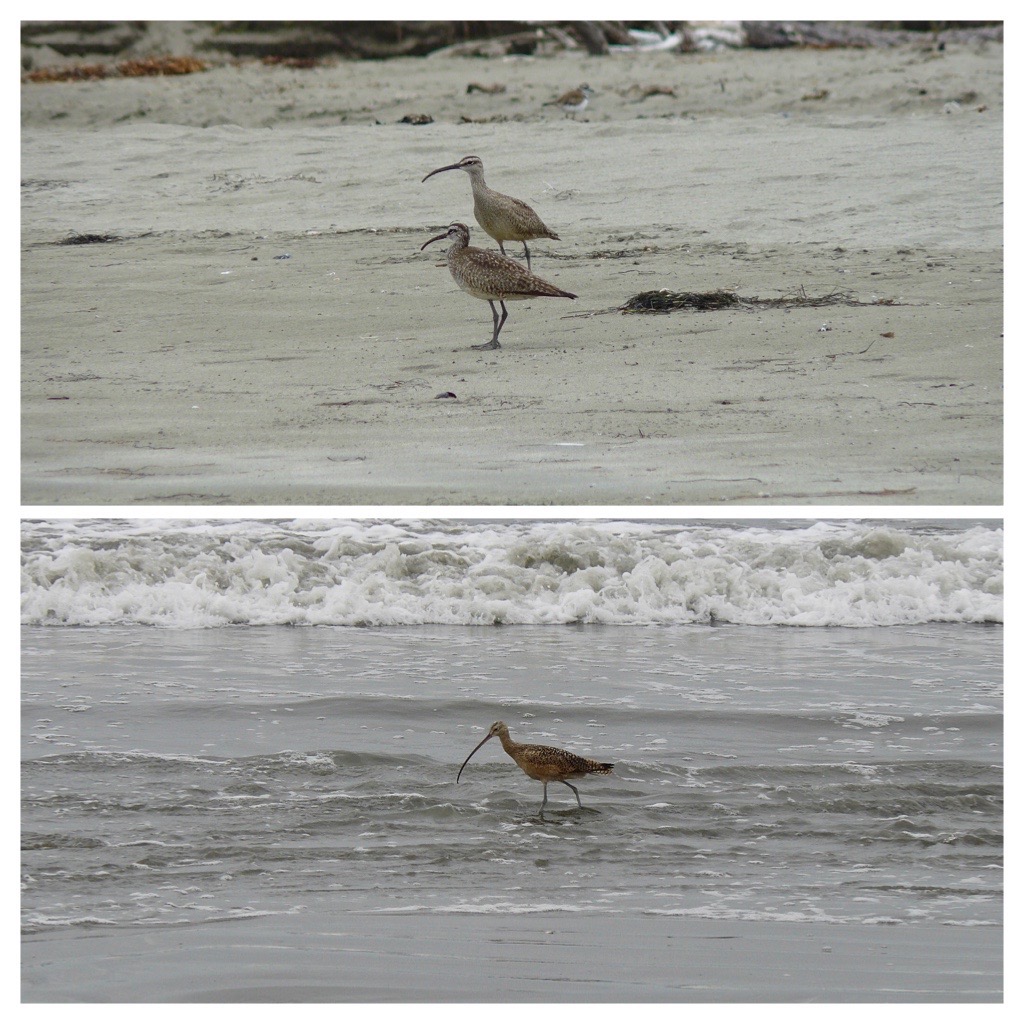
Heading toward the lagoon we saw Whimbrel and Long-billed Curlew.  I admit there have been many times when I have pondered the question, "Is it a Curlew or a Whimbrel?"  Can you tell which is which?

At the narrow end of the lagoon we saw Black Phoebe, Killdeer, Great Egret, Great Blue Heron, Western Sandpiper, and no ducks.  Overhead flew a pair of Black Oystercatcher, Red-tailed Hawk, and Turkey Vultures.  Accessing the further reaches of the lagoon meant tromping through a tangle of vegetation that included dry grass, a favored habitat for ticks.  I decided not to walk through the grass.  Mike, on the other hand ventured forth.  No ducks, but he did confirm my tick theory when he found he had six unwanted guests.  
The finale of birding Villa Creek and its environs was watching a Surf Scoter feeding in the surf.  The collage compares an Adult Scoter with the one I observed.  It was either a juvenile or an adult in molting (eclipse) plumage.  More than likely it was a juvenile.  I do intend on returning to Villa Creek, but will wait for a sunny day.


Tuesday, June 18, 2019

Nesting Pigeon Guillemot of Montaña de Oro


Pigeon Guillemot (Cepphus Columba) begin appearing along the rocky coast of Montaña de Oro State Park in mid-March.  The season of breeding/nesting had begun.  The numerous cracks, crevices, and holes in the cliffs and rock formations offer to this plump sea bird, with the startling red legs, a variety of cozy nesting sites.  (red arrow points to a possible nest site)

The breeding range for the Guillemot is vast, from the North Pacific waters to Alaska and along the Pacific Coast through California.  In winter California Guillemots migrate north to the inland marine waters of Washington.
Pigeon Guillemots belong to the Auk family - related to Murrelet, Auklet, and Puffin.
From my observations at MdO I have come to the conclusion that it takes quite a bit of time for Guillemots to sort out their relationships.  Occasionally, I have seen them come ashore where they do bill touching, chasing, and posturing.   On one occasion I observed a pair mating.  If I had blinked I would have missed it.  Much of the mating ritual occurs in the water with much bill touching, and dashing about under the water.  Guillemots are quite vocal, their high pitched whistles are prevalent during courtship.
Guillemots are monogamists.  Notice how they are in pairs.
Both parents incubate and feed the young.  Hatching takes 33 - 38 days.  Nestlings are fed small fish and marine invertebrates.
There has been much coming and going into this crevice, noted by the red arrow.  The actual nest is difficult to see.  I am hopeful there is, or will be, an egg or two to hatch.  They are the only Auk that will lay two eggs.

Four to six weeks after hatching young will leave the nest by scrambling and fluttering down to the water.  After leaving the nest they are completely independent.  This transition between dependence and independence often happens at night.  They can dive and swim, but it will take two to three weeks before they are strong enough to fly.
The Pigeon Guillemot scales rock faces and cliffs by flapping its wings combined with the use of  sharp claws on its webbed feet.  
“Both sexes are alike in appearance, except for the Californian birds - females were found to have larger bills than males.” (a quote from Wikipedia)  I have spent quite a bit of time comparing Guillemot bills and see no difference between male and female.

The best place to observe Pigeon Guillemots is on the rocks and cliffs of the small cove below the last overlook on the Bluff Trail.  In the many years of observing Guillemots at MdO I have yet to see a juvenile, but remain hopeful of a sighting in the near future.


Thursday, January 17, 2019

Birding Between Rain Storms


 Laguna Lake - The rain had just stopped and I was headed to Laguna Lake.  I believe I was the only birder in the county that had not seen the Vermilion Flycatcher.  It’s not that I hadn’t tried.  Upon arrival at the small fishing dock, actually the area where the little darling has frequently been seen,  I heard a sweet, yet unfamiliar song.  On are twig, at the top of a scraggly willow, perched the Vermilion Flycatcher. ( Photo of the Laguna Lake Flycatcher by Roger Zachary.)
This little traveler is considered a rare visitor to the Central Coast.  He may have journeyed here from East Texas or from suitable regions in the Eastern Ca. deserts such as Zzyzx, near Baker Ca. or the Big Morongo Preserve, east of Palm Springs, Ca. where the Vermilion Flycatcher has been known to nest.

Turri Road - The weather was blustery.  In recently plowed fields were large flocks of Red-winged Blackbirds.  Perched on fencing were Say’s Phoebe, Western Bluebird, and Lark Sparrow (below).
 Morro Bay Marina - Looks like the storm has passed - Seven species of underwater foragers, Bufflehead, Ruddy Duck, Common Loon, Western Grebe, Eared Grebe, Pied-billed Grebe, Double-creasted Cormorant, and a cooperative male Belted Kingfisher (below).  I love birding the Marina as the water birds are in a confined space and much easier to identify.
Sweet Springs -  Two Ruby-crowned Kinglet and a Blue-grey Gnatcatcher frolicked in Silver Lupine bushes growing along the path to the east overlook.  Kinglet and Gnatcatcher can be difficult to observe as they are usually flitting thru dense foliage. 
In the shallower water, Cinnamon Teal, Blue-winged Teal (above), Green-winged Teal, and American Wigeon.  In the deeper water many hundreds of water birds.  Regardless of the weather birding the Central Coast is always a memorable experience.

My favorite photo of the day, California Towhee bathing.