Showing posts with label nature. Show all posts

Thursday, March 28, 2024

SPRING BIRDING ON THE CENTRAL COAST


Turri Road San Luis Obispo County - The morning adventure begins.  Wanting to make the most of every moment, my little Honda inched along at a snail's pace.


A raptor was perched on an old utility pole.  I knew it was not a Red-tailed or a Red-shouldered Hawk.  While I was mulling over identification, the raptor took flight.  It was a female Northern Harrier.  My first sighting was a winner!


The first quarter mile is Western Bluebird territory.   A pair were perched on top of their nesting box.  Both male and female feed the nestlings.  Inside the box a hungry chick was wondering when lunch would be served.  On both sides of the road Meadowlarks were singing. 


My top speed was about five mph, car windows wide open to hear bird songs when suddenly I heard a very loud and piercing Meadowlark song.  Oh, my gosh it had flown into the car through the open back window.  Well, it had certainly not flown into the car, but for a few moments I was convinced there was a Meadowlark in the backseat.


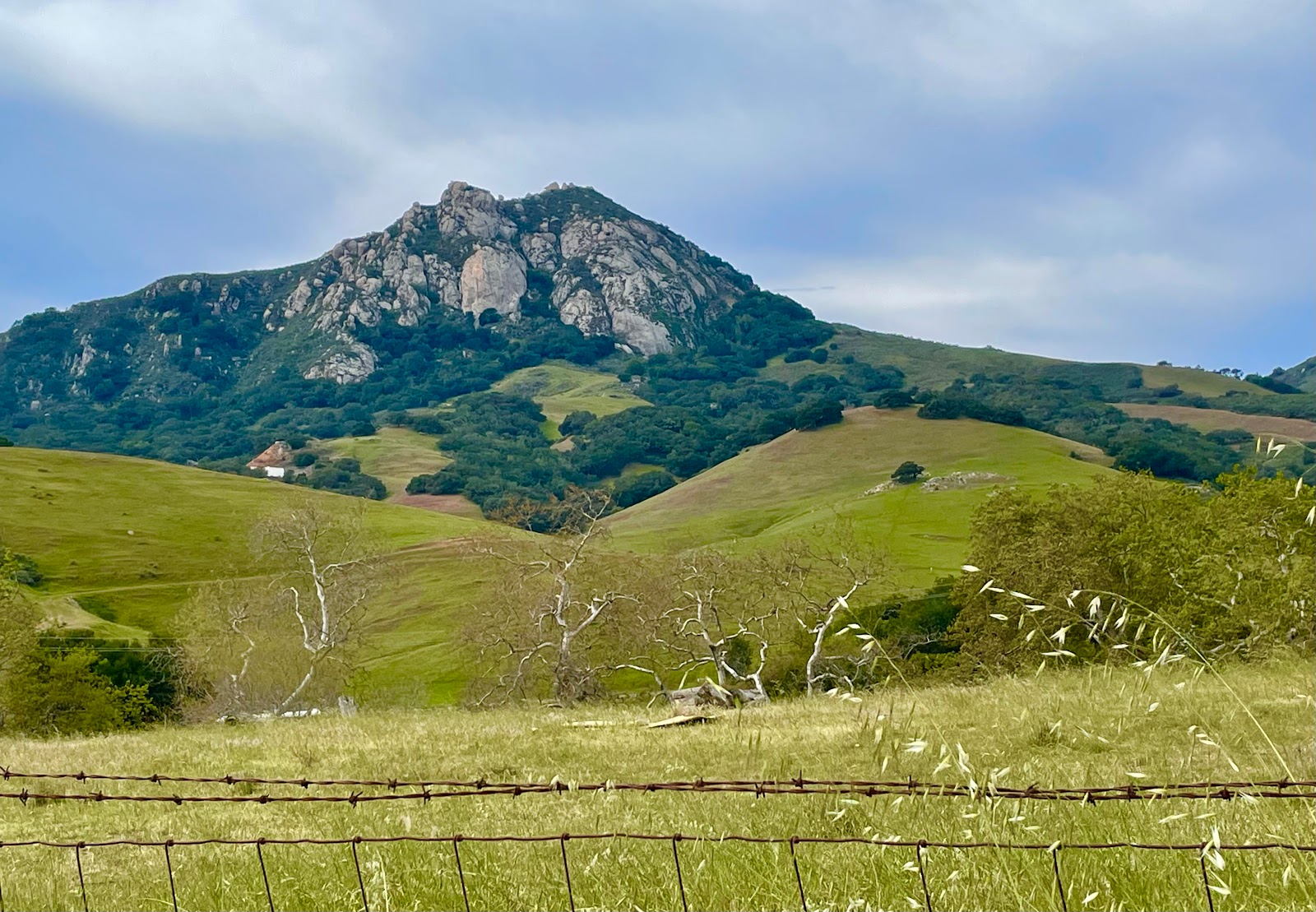
Continuing up the hill, the mesmerizing beauty of the hills, the deep blue of roadside Lupine, Poppies bursting with life, and glistening fields of yellow Buttercups were a joy to behold.  Finally made it to the top of the hill.


Red-winged Blackbirds, from the pond down below, were dashing over the fields.  I could even hear Mallard Ducks.

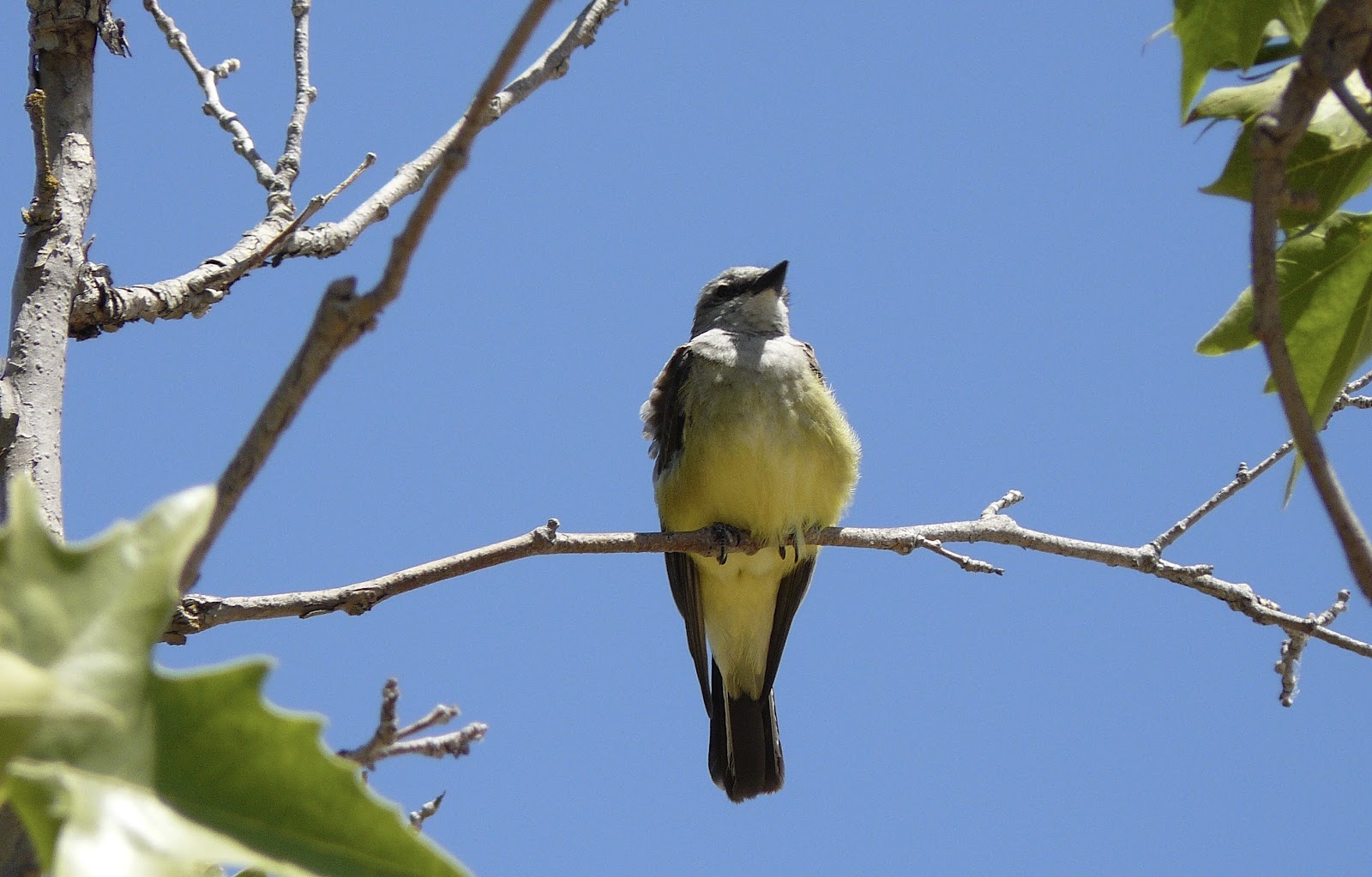
I continued my forward progress.  Around the next bend in the road I was anticipating seeing Cassin's Kingbird. Yes!  There they were, a pair of Kingbirds, flycatching from an old fence. 


Next, the ephemeral cattle pond, my favorite stop.  I love the pond, the dilapidated cattle shoot, and the old barbed wire fence (behind the gate) that goes nowhere.  Perched on the fence were Western Bluebird, and Cassin's Kingbird.  


At the far end of the fence, Tree Swallow's rested, though not for long, but long enough for me to get a good look.  Depending on the lighting, their iridescent feathers appear greenish or blueish. 


From the wetland across the road came a variety of bird calls** including a female Turkey who had just discovered she was alone.  She seemed anxious.  From observations of wild Turkeys I have come to the conclusion they get anxious when finding themselves alone, flockless.  I'm including a short video on young Turkeys hurrying to join the flock.              

https://youtu.be/8RlePt7MDNY?si=QAkuNAKXcFOZyTKm


The morning's birding was positively delightful.  What will be the next adventure?  Perhaps Raptors, Ravens and Wildflowers?   


**Birds heard but not seen - Song Sparrow, Bewick's Wren, Wilson's Warbler, Oak Titmouse, Ruby-crowned Kinglet, Chestnut-backed Chickadee, Pacific Flycatcher, California Towhee, Red-shouldered Hawk. 


Wednesday, September 20, 2023

Back to Birding Turri Road


Turri Road - This Morning I was birding with Linda who was on her very first birding adventure.  In mid September migratory birds are just beginning to arrive on the Central Coast.  Some stop for fuel and rest before continuing their journey, others stay through the end of the winter season.
Migrating Brant Geese by local birding photographer Mike Baird. 

We were slowly making our way up Turri Road when I noticed a white car parked in the road and a woman with a camera.  I was hoping she would be a friendly birding photographer.  Luck was with us.
I stopped beside her, "Might I ask what you are looking at?"  She replied, "Bald Eagles."  I said excitedly, "Bald Eagles," stressing the "s."  When she arrived two Bald Eagles were perched on a low hill.  Coincidentally, the hill happened to be the same one I had taken a photo of a few days earlier.  (By clicking on the photo you can see a Bald Eagle, though it does resemble a black and white blob, it is a Bald Eagle.)  Now the hill was bereft of Eagles.  The women pointed to the Sky - The Eagles were soaring over the landscape.  Linda's first sighting was a soaring Bald Eagle.
When we arrived at Hinds Summit a Meadowlark was singing.  Notice the sign, the elevation is in chains.  In the 17th century an English clergyman and mathematician Edmund Gunter invented a distance measuring devise, a chain that was 66 feet long and had 100 links.  It was known as Gunter's Chain and was used in land surveying.  It is still in use today in Great Briton and Canada for surveying land in rural areas.

From our comfortable perch on the hand hewn bench we watched a flock of Brewer's Blackbirds.  An American Kestrel was perched on a nearby fencepost.  Although the Blackbirds were fluttering all around him, the Kestrel was not dislodged from its post.  
As we meandered downhill to the ponds we saw Cassin's Kingbird, Western Bluebird, and Lark Sparrow.
Our good luck continued.  Several Red-necked Phalarope were feeding in the pond.  I find Phalarope amusing as they have a unique method of feeding. 
They swim very fast, in tight circles, creating little whirlpools, which brings plankton to the surface where they can grab them with their bills. This unique feeding method is known as "whirling." Feeding on the edge of the pond were the less exciting, but marvelous, Western Sandpiper and Semipalmated Plover.
Our final stop was the Morro Bay Marina.  We heard California Quail and the coarse ra-tat-tat of a Kingfisher; saw Great Blue Heron, two Pied-billed Grebe, and a marvelous view of an Osprey.   In the estuary were scads of Snowy and Great Egret, Cormorants, Brown Pelicans, and a variety of shorebirds.  In less than an hour and a half we identified 20 species.  Wow!  Linda definitely has great birding Karma. Can hardly wait for our next birding adventure.


Tuesday, June 14, 2022

Birding Laguna Lake Park


Laguna Lake - The weather was perfect, warming sun with a slight breeze.  The hill, center left, is Bishop Peak.  The hill to the right is Cerro San Luis aka Madonna Mountain.

With boisterous enthusiasm a Great-tailed Grackle welcomed me to the park.
I had noticed, from a distance, a few water fowl; could not determine species, so found an area closer to the water.
A perky Marsh Wren was dashing through the reeds, loudly calling.  Perhaps my presence had disturbed him.  
The male Marsh Wren is quite vocal when it comes to protecting his territory.  He may build numerous nests in hopes of attracting a mate.  The more nests he builds, the more chances he has of success.
Singing from a Willow thicket were Song Sparrow, House Finch, and a handsome Pacific Flycatcher. (photo). The wind was picking up.  Tiny waves were lapping at the shore line.  Since most of our winter guests have returned to their breeding areas, birds on the lake were scarce - two Pied-billed Grebe, two female Northern Shoveler, one Canada Goose, and a lonely male Ruddy Duck. 
Across the lake a Sora was calling (photo taken at Cloisters Pond).  Like all rails, the Sora has big feet, making it easier to walk on floating reeds.  The Sora, when it emerges from the reeds, does not appear to mind huge two legged creatures staring at them. 
The treat for the morning was seeing a Lark Sparrow.  As I neared the barbed wire fence that separates the park from the open space, I could see a Lark Sparrow perched on the old fence, her tiny feet carefully placed between the forever sharp barbs.  I kept my distance - watched her find a morning morsel, and then fly off with a tiny insect securely held in her beak -  perhaps to her nestlings that were eagerly waiting her return. 


Friday, May 20, 2022

Central Coast Ibis - Here Today Gone Tomorrow

Turri Road - Los Osos Ca - Seeking a White-faced Ibis and a Solitary Sandpiper.  I was headed east on Turri Road, a scenic rural route between South Bay Blvd and Los Osos Valley Road.  From South Bay Blvd I traveled about a mile and a half to a dilapidated cattle pen, nearly adjacent to an ephemeral pond/wetland, often used by cattle and migratory birds.

Fortune shined this cloudy morning.  The White-faced Ibis were peacefully feeding in the wetland, their glossy maroon and metallic green feathers appearing to shimmer in the morning light.  
White-faced Ibis, with their long decurved bill, eat a variety of organisms such as insects, frogs, snails, small fish, spiders, and earthworms. 
The Solitary Sandpiper was difficult to locate as it was feeding in tall grass.  Now and then I caught a glimpse.  Finally it came out of the grass and I was able to identify the little darling.  What proved to be helpful was its tendency to bob.  Every time her tail went up, it exposed her startlingly white "derriere." Her movement was similar to the Spotted Sandpiper's tail bobbing, but slower.
The Solitary Sandpiper is smaller than a Lesser Yellowleg and larger than a Western Sandpiper; it has distinctive white eye rings, and greenish/yellow legs.  It prefers to forage in small stagnant pools, just like the one off Turri Road. 

Adding to the marvelous morning was a "wake" of  Turkey Vultures feeding on a small raccoon carcass.  Several were in the air, circling, while others perched on the nearby fence.  I am charmed by their gentleness and patience.
Up the hillside from the pond/wetland is an isolated section of fence.  When I arrived four turkey Vultures were perched on the fence.  Joining the Vultures was a Western Bluebird and a Cassin's Kingbird.  Both eat insects.  From the fence they would fly up, hovering for several moments, checking the air and grassland for prey.  
Cassin's caught its prey in mid-air while the Western Bluebird found its prey on the ground.  With goals achieved, they returned to their original perch. 
 
 Other Birds of the morning - Across the road in a Willow/Sycamore/Oak thicket were Wilson's Warbler, Yellow Warbler, Song Sparrow, Oak Titmouse, Northern Flicker, and a Downey Woodpecker continually drumming.

The Ibis are gone now, but there is a good chance they will return next season, that is IF we get rain.


Wednesday, March 16, 2022

Birding Cal Poly

Stenner Creek Road passes through the Cal Poly University outback- First sighting, Bishop Peak.  Elevation 1546 feet; it is the highest in a chain of volcanic remnants known as the "Nine Sisters.

Next sighting, a Black Angus bull - a double take kind of experience, as I had never seen an Angus Bull close enough to touch.  It was enormous!  Cal Poly is known for its extensive beef cattle program. 

Back to birding - A few yards from the cattle pens was a pond with four Northern Shoveler; three male and one female actively feeding. 

 Across the road White-crowned Sparrow, Western Bluebird; Cassin's Kingbird sallied out from it's perch to take insects in midair (photo by Mike Baird).  Brewer's Blackbirds in the thousands around the cattle pens.  Overhead a Red-tailed Hawk soared with Turkey Vultures.  It had been awhile since I had been out and about - every sighting was a joy to behold. 

After passing through an extensive grove of mature avocado trees I came to Stenner Creek.  Sycamore, Arroyo Willow, and Live Oak were the primary trees along and in the creek.  The scrub brush was dry and dense. 
 
80 feet overhead was an impressive, heavily rusted 129 year old train trestle with a span of 950 feet.  Freight and passenger trains cross this elderly trestle on a daily basis.  
For additional details on Stenner Creek Trestle
 http://mycoastalcalifornia.blogspot.com/2014/09/stenner-creek-bridge-snippet-of-coastal.html

Dominating the birding scene was a pair of vocal Red-shouldered Hawk actively nest building in a tall Sycamore.  Only one Hawk was doing the work, going back and forth.  The mate was perched on a nearby post supervising.  I believe they were refurbishing a prior year's nest. (photo by Mike Baird)
Birds around the creek - Nuttall's Woodpecker, Lesser Goldfinch, Spotted Towhee, Calif. Towhee, Bewick's Wren, Oak Titmouse, Calif Scrub Jay, Black Phoebe.  Birds heard but not seen - Calif Quail, Northern Flicker.

I had been hoping to have an unusual sighting, but so far just the usuals.  I pushed on, past the peaceful bulls, into the maze of the Cal Poly campus on an attempt to locate the "swine pond" where a Common Moorhen had been seen.  A Moorhen is a member of the Rail family and resembles a Coot.  Lacking success at locating the swine pond, I decided to look more thoroughly at a pond I had just passed.  The pond was sorry looking, lacking vegetation, not even a weed.  Although the pond was not a pleasant sight, I had an unexpected, delightful sighting.  At the edge of the water, standing among a pile of cow pies was a seldom seen, Wilson's Snipe.  Yeah!  A great way to end the day.  Wilson's Snipe is not the usual shorebird.   Check out Cornell Lab's Overview.   Wilson's Snipe Overview, All About Birds, Cornell Lab of Ornithology


Saturday, October 2, 2021

Fall Birding - A Little Here and a Little There

Sweet Sweet Springs - The tide was high and the fog was meditating on its power to grant the people of peaceful Baywood the unique privilege of experiencing the sun's warmth.  

Nuttall's Woodpecker was active in a tall Cypress; Chickadees, Oak Titmouse were flitting through a stand of low growing oak.  In the pond numerous Mallards slept, preened and chatted about their recent travels; Song Sparrow darted through pond-side vegetation, and a great and Snowy Egret, perched high in a tall Eucalyptus, watched the action.
A noisy Belted Kingfisher (photo by Gary O'Neill) searched for lunch.
In a Channel, carved by time and tides, 26 Blue-winged Teal fed.  I consider them the "Early Birds," as every year they are the first small migratory duck to arrive in Sweet Springs.
Estero Bluffs State Park - Vila Creek - Blooming along the path to the beach and pond was Tar Weed and Mock Heather.  My friend Phoebe and I were hoping to see a migrant species that is seen only occasionally on the Central Coast, a Black-necked Stilt.  It would be a first sighting for Phoebe.

A few migratory shorebirds, Western Sandpiper, Godwit, Whimbrel and a few Long-billed Curlew were feeding along the edge of the beach.  Higher up the beach, Killdeer, a pair of Pectoral Sandpiper and four Turkey Vultures.  Numerous Snowy Plover were busy chasing kelp flies.  In the background of the top image in the collage, symbolic fencing can be seen.  The fencing, along with signage, encourages people to respect the Snowy Plover nesting grounds.   https://www.mbnep.org/2016/03/04/symbolic-fencing-helps-morro-bays-snowy-plovers/ 
We finally reached the pond where there had been several recent sightings of a juvenile Black-necked Stilt.  At the bend in the creek perched a Great Egret; a few feet out from the Egret was a pair of Mallards.  A few feet from the Mallards strode a black and white, pink legged Black-necked Stilt.  They can swim and dive but prefer to wade in shallow water.
The photo was taken by local birder/photographer Maggie Smith about two hours before we arrived at Villa Creek pond.  


Sunday, March 21, 2021

Cinnamon Teal - Spatula cyanoptera


Turri Road - I was immersed in the sights and sounds of Spring.  On this glorious morning, there were five pair of Cinnamon Teal feeding in the ephemeral cattle pond on Turri Road.  A week ago a friend of mine told me she had seen a group of red ducks in the pond as she passed by on her bicycle.  I really doubted that they would still be in the pond, but thought it worth a try.  And there they were a dabbling.


The males were aglow in their breeding finery. *

The small pond and its nearness to the road allowed for excellent views of the dabblers.  Without binoculars they would have been difficult to see.  I always keep an emergency pair in my car.  Through the twiggy trees, I had the pleasure of observing their courtship display of pre-nuptial head bobbing - not just a pair, all ten of them bobbing at the same time.  It was a real birding moment.

All the black specks in the distance are Black Angus Cattle. 

Other sighting - A few yards up from the pond a pair of Western Bluebird (Sialia mexicana) sallied forth, in pursuit of insects, from their perch on an old barbed wire fence.  The male's cobalt-blue coloring was stunning.  

Heard but not seen birds - Northern Flicker, House Finch, Song Sparrow, and the memorable, flute like, song of a Western Meadowlark.  Check out the link to hear its beautiful song.   https://youtu.be/Sk4S2spFdcs  

*Cinnamon Teal by Mike Baird