Showing posts with label Birding Turri Road. Show all posts

Friday, May 20, 2022

Central Coast Ibis - Here Today Gone Tomorrow

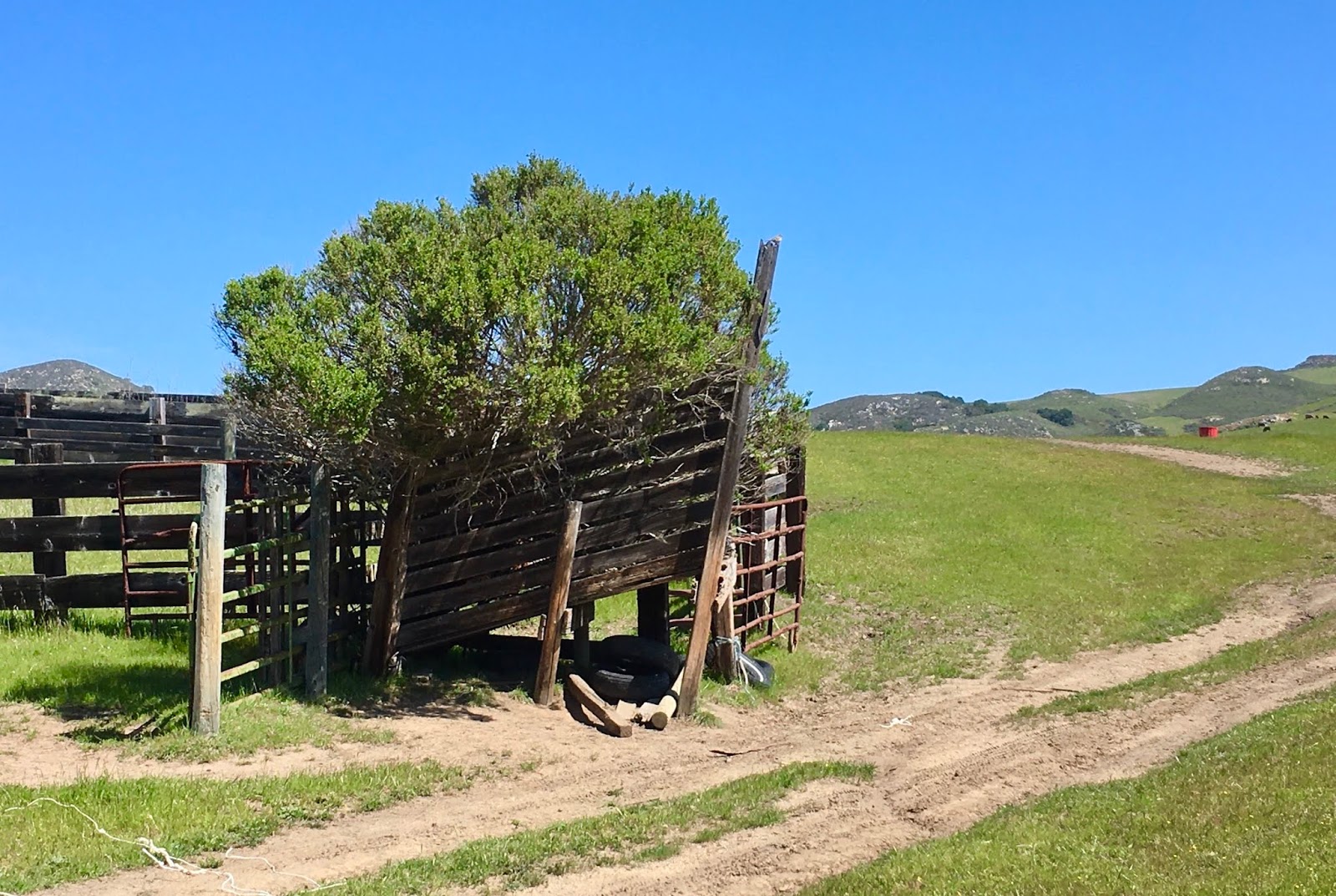
Turri Road - Los Osos Ca - Seeking a White-faced Ibis and a Solitary Sandpiper.  I was headed east on Turri Road, a scenic rural route between South Bay Blvd and Los Osos Valley Road.  From South Bay Blvd I traveled about a mile and a half to a dilapidated cattle pen, nearly adjacent to an ephemeral pond/wetland, often used by cattle and migratory birds.

Fortune shined this cloudy morning.  The White-faced Ibis were peacefully feeding in the wetland, their glossy maroon and metallic green feathers appearing to shimmer in the morning light.  
White-faced Ibis, with their long decurved bill, eat a variety of organisms such as insects, frogs, snails, small fish, spiders, and earthworms. 
The Solitary Sandpiper was difficult to locate as it was feeding in tall grass.  Now and then I caught a glimpse.  Finally it came out of the grass and I was able to identify the little darling.  What proved to be helpful was its tendency to bob.  Every time her tail went up, it exposed her startlingly white "derriere." Her movement was similar to the Spotted Sandpiper's tail bobbing, but slower.
The Solitary Sandpiper is smaller than a Lesser Yellowleg and larger than a Western Sandpiper; it has distinctive white eye rings, and greenish/yellow legs.  It prefers to forage in small stagnant pools, just like the one off Turri Road. 

Adding to the marvelous morning was a "wake" of  Turkey Vultures feeding on a small raccoon carcass.  Several were in the air, circling, while others perched on the nearby fence.  I am charmed by their gentleness and patience.
Up the hillside from the pond/wetland is an isolated section of fence.  When I arrived four turkey Vultures were perched on the fence.  Joining the Vultures was a Western Bluebird and a Cassin's Kingbird.  Both eat insects.  From the fence they would fly up, hovering for several moments, checking the air and grassland for prey.  
Cassin's caught its prey in mid-air while the Western Bluebird found its prey on the ground.  With goals achieved, they returned to their original perch. 
 
 Other Birds of the morning - Across the road in a Willow/Sycamore/Oak thicket were Wilson's Warbler, Yellow Warbler, Song Sparrow, Oak Titmouse, Northern Flicker, and a Downey Woodpecker continually drumming.

The Ibis are gone now, but there is a good chance they will return next season, that is IF we get rain.


Sunday, March 21, 2021

Cinnamon Teal - Spatula cyanoptera


Turri Road - I was immersed in the sights and sounds of Spring.  On this glorious morning, there were five pair of Cinnamon Teal feeding in the ephemeral cattle pond on Turri Road.  A week ago a friend of mine told me she had seen a group of red ducks in the pond as she passed by on her bicycle.  I really doubted that they would still be in the pond, but thought it worth a try.  And there they were a dabbling.


The males were aglow in their breeding finery. *

The small pond and its nearness to the road allowed for excellent views of the dabblers.  Without binoculars they would have been difficult to see.  I always keep an emergency pair in my car.  Through the twiggy trees, I had the pleasure of observing their courtship display of pre-nuptial head bobbing - not just a pair, all ten of them bobbing at the same time.  It was a real birding moment.

All the black specks in the distance are Black Angus Cattle. 

Other sighting - A few yards up from the pond a pair of Western Bluebird (Sialia mexicana) sallied forth, in pursuit of insects, from their perch on an old barbed wire fence.  The male's cobalt-blue coloring was stunning.  

Heard but not seen birds - Northern Flicker, House Finch, Song Sparrow, and the memorable, flute like, song of a Western Meadowlark.  Check out the link to hear its beautiful song.   https://youtu.be/Sk4S2spFdcs  

*Cinnamon Teal by Mike Baird


Thursday, April 9, 2020

Birding With a Bleak Soul

The San Luis Obispo County "stay-at-home" announcement was on March 18, 2020 - feels like that was months ago.  Like many of our residents, I take walks, making a point of keeping six feet from other humans.  Actually, I'm more comfortable at 10 - 15 feet.  People wave, smile, and at times engage in pleasant conversation.

Saturday morning I threw caution to the wind and took off for the Audubon Overlook (6 blocks from my house) and nearby Turri Road.  Total driving distance about 6 miles.
Audubon Overlook - A Song Sparrow was gaily singing as I proceeded down the path to the overlook.  The morning was without flaw.  Across the bay (upper Photo), along the edge of the pickleweed, was a sizable flock of Brant Goose, their delightful chatter carried across the bay.  Photo shows the same flock of Brant feeding in pickleweed on a foggy January day.
Other Birds: Caspian and Forster's Tern, Willet bathing, and a Black-bellied Plover in gray winter plumage.  Out on the bay floated a large flock of mostly Ruddy Duck -  Rufus Hummingbird feeding on pink flowers of a mallow shrub was a special treat.  He was a beauty!
Turri Road Ponds -  On a tiny island, in the center of the photo, perched a Greater Yellowleg.  Upper right, eleven Green-winged Teal, and three Northern Shoveler dabbled.  A dabbling duck is a shallow water duck that feeds primarily along the surface or by tipping headfirst into the water.

   Now, you know the origin of the idiom, "bottoms up."

The next stop, about a mile up the road, is one of my favorite places to bird.  I have named it the cattle pond.  In the rainy season the pond fills.  What a privileged to be here, breathing in the scenery, the scents, and the sounds of the birds.
Five male Cinnamon Teal were feeding in the far section.  Streaking over the pond were White-throated Swifts and Swallows, along the edge two Willet searched for edibles. 
West of the pond is a dilapidated cattle pen.  The corner of the pen, with its old loading chute, scruffy little tree, and aging wooden fencing was attracting three species of birds.  American Goldfinch, House Finch, and California Towhee (photo) were flying in and out of the foliage.  From a section of barbed wire fencing two Cassin's Kingbirds sallied forth in pursuit of insects.  Wilson's Warbler sang from a willow thicket.
Best sighting of the morning was a Lark Sparrow (below) perched atop an old post.  Every few minutes he sang - this was first time I had heard a Lark Sparrow sing.  During breeding season males sing from elevated perches and that is just what he was doing - made my day! 
Afterthought:  As I jotted down my thought, I realized how privileged and fortunate I am to be able to drive to a peaceful rural area and spend time thinking only of birds and the beauty of the day . . . . .


Thursday, May 5, 2016

Birding Turri Road

Turri Road* gracefully meanders over low hills to the Los Osos Valley agricultural area.  The road is narrow with few areas to park.  With several attempts I managed to back off the road into an unused overgrown lane that leads to private property (above). Willows were dense, a brushy field on the east, open fields to the north.

I had been birding about 20 minutes; experienced an excellent view of Mr. and Mrs. Blue Grosbeak, and a Common Yellowthroat; identified the distant chatter of a Western Kingbird and the persistent song of a Black-headed Grosbeak, but that was it.  I was about ready to try another location when one of the best birders in the county, drove up. 
Immediately, and I do mean immediately, she spotted a Warbling Vireo, Swainson's Thrush, Ash-throated Flycatcher (below) on a twig of a Coyote Bush, and a Lazuli Bunting by the edge of the road.  Her speed of identification was a sight to behold. Unfortunately, she was pressed for time and left after a few minutes.  Needless to say, I was delighted at my good fortune.

Continued on down the Road.  Perched on barbed wire fencing were two Cassin's Kingbirds, a Lark Sparrow, and Say's Phoebe.  In the fields -  Meadow Lark, Red-winged Blackbird and Western Bluebird.  For a complete list see bird list at end of blog.  Once again this peaceful country road proved to be a birding goldmine.  As soon as we get a sunny morning, I will return for another look at these beautiful little darlings.

 * Turri Road is located on the Central Coast of California between the Communities of Morro Bay and Los Osos.

Bird List:  American Kestrel, Ash-throated Flycatcher, Black-headed Grosbeak, Blue Grosbeak, Cassin's Kingbird, Western Kingbird, Common Yellowthroat, House Finch, Lazuli Bunting, Meadowlark, Pacific-slope Flycatcher, Red-tailed Hawk, Song Sparrow, Swainson's Thrush, Turkey Vulture, Warbling Vireo, Western Bluebird, Wilson's Warbler

Sunday, April 27, 2014

Birding Sweet Springs, Cerro Alto, and Turri Road

Sweet Springs - 8:00 am.  I was greeted by a robustly singing White-crowned Sparrow.  Feeding in the pond was a lone, Blue-winged Teal and a pair of Mallards.  Song Sparrow was scratching in the leaf litter, Spotted Towhee was singing.  Best birds were, Tree Swallow, Cedar Wax Wing, and a Purple Finch singing from the top of a tall Cypress.  The highlight of the visit was a lingering look at a Pacific-slope Flycatcher and a Western Tanager.
Cerro Alto - A National Forest campground off Hwy 41, between Morro Bay and Atascadero.  The road to the campground (photo) follows a creek that is densely vegetated with Willow, Oak, Sycamore, California Bay, and Poison Oak.  Wilson's Warbler, singing with intense gusto, flitted through the shrubbery.  Wilson's and Orange-crowned Warbler were numerous, House Wren was active.  As I progressed up the road the singing became intense.  In spite of the cacophony, was able to identify, Black-headed Grosbeak, Western Tanager, and Warbling Vireo.  The walk to the small camping area is beautiful but watch out for the poison oak. 
 
Turri Road -  Yesterday two Blue Grosbeak were seen where the creek comes close to the road; I had no luck finding them.  Continued up the road to the fallow pea field where two years ago I had seen a Blue Grosbeak.  Lazuli Bunting was singing from a large tangle of Willow (photo).  I stationed myself across the road from the Willows, as I did not want to spook the 5 inch little darling.  Finally noticed movement and was sure the bird would show his self when a band of cyclists sped by.  The singing stopped.  I waited, eventually relocating to the other side of the road.  While waiting, observed a pair of Lark Sparrows mating on a twig of a nearby Coyote Bush (a first time sighting).

After a few more minutes of quiet, the Lazuli Bunting perched on an outer twig and began to sing. I could see him perfectly.  Success!  As I was getting into my car 37 motorcycles passed by (I counted).  From now on I will only bird Turri Road on weekdays.

Friday, August 30, 2013

LEUCISTIC RED-TAILED HAWK

Yesterday, about 11:30, made a quick jaunt up Turri Road (photo).  I was hoping to see the thousands of tiny sandpipers had been seen resting in the ponds.  All the ponds were empty of bird life.  My only sighting was of a cheeky Blue-gray Gnatcatcher.  Continued up the road, about a mile, saw several Western Bluebirds and a Loggerhead Shrike; as I was turning around, caught a glimpse of what appeared to be a mostly white hawk; stopped in the road, fortunately there were no other cars in sight.  Was able to get a good view of this unusual beauty soaring over the fields.

The hawk was mostly white, with black wing tips and a slightly reddish tail.  This condition is called Leucism, which is caused by defects in pigment cells - a different condition from albinism. 

This rare Leucistic Red-tailed Hawk was seen in the same area in early July, and I had forgotten all about it.  Needless to say this unanticipated rare sighting was an enormous treat. 

Friday, July 5, 2013

BAYWOOD AND TURRI ROAD


 Wanting to avoid the crush of the 4th of July tourist traffic I birded close to home.  Migrants are returning to the bay (photo - Morro Bay at low tide). About 90 White Pelicans have arrived from their inland breeding areas.  Soaring on a 9 foot wing span, a flock of White Pelicans is an impressive sight.  Large flocks of assorted shore birds are now feeding in the mud flats.  In and around Baywood yesterday observed 26 species.  Best sighting was a Black-bellied Plover in partial breeding plumage (always a treat) and 3 Greater Yellowlegs.  My favorite sighting was of a Long-billed Curlew probing in the mud for little crustaceans.  Before swallowing the crustacean the Curlew rinsed it off - a behavior I had never observed before.

 This morning checked out Turri Road.  High Tides had brought water into the ponds by South Bay Blvd - moist mud brings the shorebirds, and sure enough, seeking breakfast were 4 Killdeer and a female Wilson's Phalarope.  Unlike the other Phalaropes, the Wilson's seldom swims and is often easier to observe.  Up the road in the area of the old pea field and the windmill, sighted Blue Grosbeak, Lazuli Bunting, Lark Sparrow, and a family of Western Bluebird.  Total mileage for 2 mornings of birding, 6 miles.

In my last post I mentioned that I would include in this post the video on Montana de Oro's "Reservoir Flats Trail."  Enjoy!!  http://www.youtube.com/watch?v=-fxLmQVvYWk


Sunday, March 10, 2013

PRE-SPRING ON TURRI ROAD

This morning's birding jaunt on Turri Road was delightful.  The sky was blue with a warming sun.  As soon as I turned on to Turri Road, I spotted a Wrentit.  Most of the year Wrentits are seldom seen, as they keep to the brush, but when the weather warms and spring breeding season begins, the perky little darlings can be seen and easily heard.  I had the pleasure of watching two of them darting about scolding and singing, their Wren tails vibrating as they sang (so cute!).  A Bewick's Wren was doing much scolding as the two Wrentits carried on. (photo - private road I would like to explore)

About a mile up the road, the creek is accessible.   The water was bank to bank as the high tide and recent rains had filled it. There were Cinnamon and Green-winged Teal, Northern Shoveler, Bufflehead and American Wigeon.  The thrill of the moment was watching a Green Heron fly by.
Another mile up the road is an ephemera pond (photo); though much used by cattle, there was enough water left for Green-winged Teal and No. Shoveler to be dabbling.  Along the mucky edge was a lone Greater Yellowleg and two Killdeer.

Using the barbed wire for a perch were Say's and Black Phoebe, and several Western Bluebirds.    On the way home stopped at the Audubon Overlook - on the bay floated a huge mixed flock of Scaup and Ruddy Duck (they travel together), along the shore all the various shore birds feeding in the wet sand.  In a few weeks the majority of  the ducks and shorebirds will take flight to their breeding grounds in the north. Takes awhile for me to adjust to the quiet emptiness of the bay.  Happy Birding!


Wednesday, August 1, 2012

WHITE-TAILED KITE

It was back to Turri Road this morning. Of course I wanted to check out the birds, but I was also in need of a dose of globally warmed sun. In the ponds, full due to a high tide, noticed a pair of Greater and a pair of Lesser Yellowleg. In the shrubbery along the road, a Gnatcatcher and a Wren let me know I was invading their territory. Above, looking for something to eat, a White-tailed Kite hovered (Photo by Kevin Cole) . Watching this bird hover, then to pause in mid-air, its glorious white tail spread out like slim fingers, is an amazing sight.

About 1/2 mile up the road the sun magically appeared. Between the ponds and the pea field, still in bloom and looking beautiful, managed to see immature Western Bluebird and Cassin's Kingbird feeding on tiny insects; at the rusty corral more Cassin's Kingbird, a female Blue Grosbeak, and a family of Indigo Bunting, mom dad and the kids, dashing back and forth across the road. If I were to rate today's birding, I would give it a perfect 16.

Wednesday, July 11, 2012

A Phenominal Week For Birding

About 2 miles east 0n Turri Road, in the area of the windmill and the pea field, birding mania was in full bloom. I believe it all began with the appearance of an Indigo Bunting in the latter part of June (see June 23 blog). Then on July 5th an Eastern Kingbird, rare to our area, was seen. Birders flocked to the site.

In the same clump of Willows, alongside the road where I had first seen the Indigo Bunting, a male (below photo) and female Blue Grosbeak had taken up residence. Two days ago the male sat at the top of the willow singing his melodious song while the female dashed back and forth across the road with insects for her brood, clasped tightly in her beak. Today, the male was singing from a tree across the road and the female was feeding 3, maybe 4 youngsters, that were waiting impatiently in the brush on the edge of the pea field - most delightful to view.

A Lazuli Bunting was feeding along the fence across from the windmill, and the song of an Indigo Bunting could be heard coming from the willows across the field (I hope I have all these names right). Up the road a few yard were several Cassin's Kingbird and a Lark Sparrow. By the old corral a female Bluebird was gathering insects for her nestlings. And perched on barbed wire was a juvenile Cassin's Kingbird fussing for food. Thank you Maggie Smith for use of yourIndigo Bunting and BlueGrosbeak photos.

As of Monday, I had yet to see the Eastern Kingbird. The most success at seeing the bird was early morning or early evening. Yesterday, I set my alarm; at 6:30 I was looking for the Kingbird and there it was sitting on the barbed wire directly across from me. I, per my usual, got a fuzzy photo, but it is proof that I saw the little darling (below photo). He was making his call sound and flying out for insects and back to his perch. Eventually he flew out of sight. I did get caught up in the birding mania and loved every minute of it. Below is a link to a video on my latest birding adventure.
http://youtu.be/fIq4fOVMcEE

Saturday, June 23, 2012

INDIGO BUNTING


For the last few days a handsome Indigo Bunting (Passerina cyanea) has been seen in the area of a glorious pea field about a mile and a half up Turri Rd. from So. Bay Blvd. When looking for a rare bird, the easiest way to find it is to first find the birders. As I rounded a curve in the road, up ahead was a cluster of parked cars and a covey of birders, one with sound recording equipment and a scope. I had arrived.

The Bunting was singing from atop a cluster of willows that was located along the edge of the narrow, two lane road. The scene could not have been more beautiful, for the willows were located in a vast field of flowering peas. Notice, in Maggie Smith's photo, how the subtle color of the peas sets off the deep blue of this precious song bird.


I did a little research and discovered that Indigo Bunting's are actually Black; it is the diffraction of light through their feathers that makes them look blue. It goes without saying that this beautiful Bunting made my day.

(I apologize for the fuzzy pea foto, wrong setting on camera)

Sunday, May 13, 2012

Making the Best of Difficult Circumstances

Turri Road Pond


The difficult circumstances this morning was an overcast, gray sky with light drizzle. My limited birding skills were put to the test, especially when looking into the glare, but I persevered; managing to identify 41 birds in 3 hours.

Little birds, especially if they were at a distance or on a utility line, all looked alike, but due to the season of spring many were singing which helped considerably in their identification. My goal this morning was to see how many birds I could identify along the road.  Fortunately traffic was very light with just a few bicyclists.

First stop was the main pond (Photo).  3 Northern Shoveler, 2 Semipalmated Plover, and a Killdeer.  In the brush were Common Yellowthroat, Red-winged Blackbird, Wrentit, and an Anna's Hummingbird. Overhead, moving at sonic speed, were three species of Swallow and a bird that I adore, the White-throated Swift.

This week, Lazuli Bunting, Purple Martin, Blue Grosbeak, and Grasshopper Sparrow (most adorable) had been seen. I found 2 out of  4 - Lazuli Bunting and Grasshopper Sparrow. As soon as the sun comes out, usually after 1:00, I'll make a return trip to Turri Road to look for the Martin, which I have yet to view. 


Sunday, October 30, 2011

RETURN OF THE MIGRANTS

Morro Strand State Beach - North Point - Sanderlings (Calidris alba ), visitors from the high Arctic tundra, are constantly on the move. Their feeding strategy is to feed in the shallow water left by receding waves; the waves never stop and neither do the Sanderlings; following the movement of the waves, they race back and forth.

Today was warm and magnificent with few people on the beach. From North Point I walked south to the Strand Lagoon, which amazingly, due to high tides and a slight amount of water in the creek, continues to exist. Along the western edge of the lagoon was a flock of 60 Black-bellied Plovers (unusual), a mixed flock of Elegant and Royal Tern, and scads of Long-billed Curlew and Whimbrel.

Next stop, The Cloisters - Maybe one or two birds. Intense growth of reed and willows make it impossible to see into the pond; does bother me a tad, for in mid January I will be leading in the Cloisters an "Easy Birding" walk for the Morro Bay Winter Bird Festival. Morro Bay Winter Bird Festival - California Bird Watching at its Best

After a perker upper at Starbuck's I headed out on Turri Road. About 2 miles east is an old windmill. Attracted to the water were American and Lesser Goldfinch (photo - click for larger image), Western Bluebird, Black and Say's Phoebe. Moving around in the dry grass a flock of Meadowlark, and perched upon an old fence post sat a colorful Kestrel.

Final stop - Audubon Overlook. Tide was perfect for viewing a few of our winter guests - No. Shoveler, No. Pintail, Bufflehead, American Wigeon, Ruddy Duck, Green, Blue and Cinnamon Teal - a never ending treat for me to see 3 species of Teal feeding together. Bird count for the day was 58. My next quest - an Eurasian Wigeon.

Wednesday, September 22, 2010

TURRI ROAD PONDS

Turri Road Ponds - Yesterday morning went to the ponds to see the Black-necked Stilt and Wilson's Phalarope. Saw both of them plus about 100 resting Semipalmated Plover. They rest in and on the edges of clumps of pickleweed and are very had to see.

Stilts are a real treat to observe as they seldom visit our area. They have very long red legs. In fact they have the second-longest legs in proportion to their bodies of any bird, exceeded only by the flamingo. Wilson's Phalarope is the largest of the Phalaropes. It does not have fully lobed toes and rarely swims. Its habitat is shallow, muddy or grassy pools and mudflats.

I had not taken any photos yesterday, so this morning was out at 7:00 (before the sun was fully up) to get a couple of pond photos . Could not find the Stilt but the Phalarope was in the same pond and it was feeding in close proximity to three Mallards, our largest dabbling duck (top photo - Phalarope in center). This was the first time I had observed this feeding strategy. My theory was, the dabbling behavior of the Mallards and the constant movement of their feet churned up the water thereby bringing to the surface the minute food items the Phalarope fed upon, which made easy pickings for the Phalarope.

Before going home for breakfast stopped at the Baywood Pier. My first sighting, this season, of Blue-winged Teal (lower photo), about 30, feeding non-stop in the shallow water by the pier. This seems to be a favorite feeding area for the Blue-winged Teal. Again saw the light-colored Godwit. I have never observed this bird with other of his species.