Showing posts with label dabbling ducks. Show all posts

Thursday, April 9, 2020

Birding With a Bleak Soul

The San Luis Obispo County "stay-at-home" announcement was on March 18, 2020 - feels like that was months ago.  Like many of our residents, I take walks, making a point of keeping six feet from other humans.  Actually, I'm more comfortable at 10 - 15 feet.  People wave, smile, and at times engage in pleasant conversation.

Saturday morning I threw caution to the wind and took off for the Audubon Overlook (6 blocks from my house) and nearby Turri Road.  Total driving distance about 6 miles.
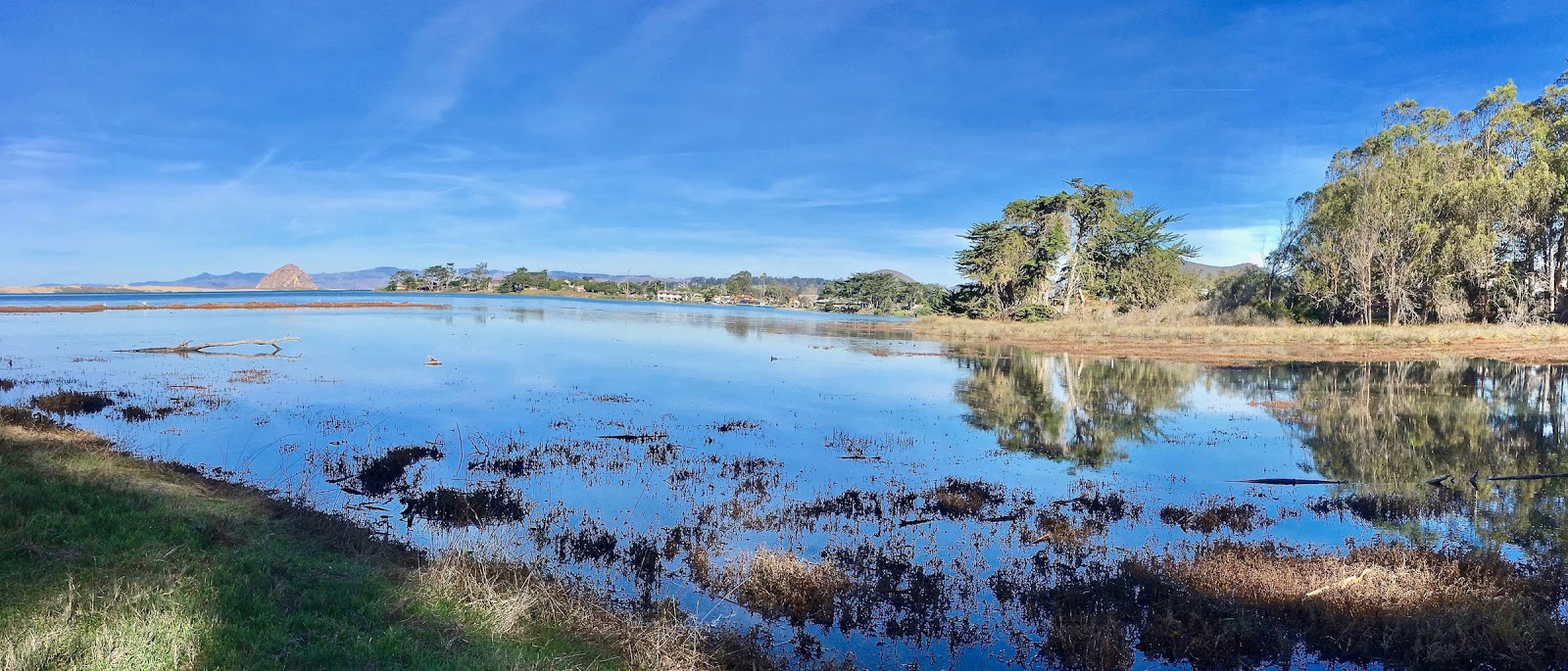
Audubon Overlook - A Song Sparrow was gaily singing as I proceeded down the path to the overlook.  The morning was without flaw.  Across the bay (upper Photo), along the edge of the pickleweed, was a sizable flock of Brant Goose, their delightful chatter carried across the bay.  Photo shows the same flock of Brant feeding in pickleweed on a foggy January day.
Other Birds: Caspian and Forster's Tern, Willet bathing, and a Black-bellied Plover in gray winter plumage.  Out on the bay floated a large flock of mostly Ruddy Duck -  Rufus Hummingbird feeding on pink flowers of a mallow shrub was a special treat.  He was a beauty!
Turri Road Ponds -  On a tiny island, in the center of the photo, perched a Greater Yellowleg.  Upper right, eleven Green-winged Teal, and three Northern Shoveler dabbled.  A dabbling duck is a shallow water duck that feeds primarily along the surface or by tipping headfirst into the water.

   Now, you know the origin of the idiom, "bottoms up."

The next stop, about a mile up the road, is one of my favorite places to bird.  I have named it the cattle pond.  In the rainy season the pond fills.  What a privileged to be here, breathing in the scenery, the scents, and the sounds of the birds.
Five male Cinnamon Teal were feeding in the far section.  Streaking over the pond were White-throated Swifts and Swallows, along the edge two Willet searched for edibles. 
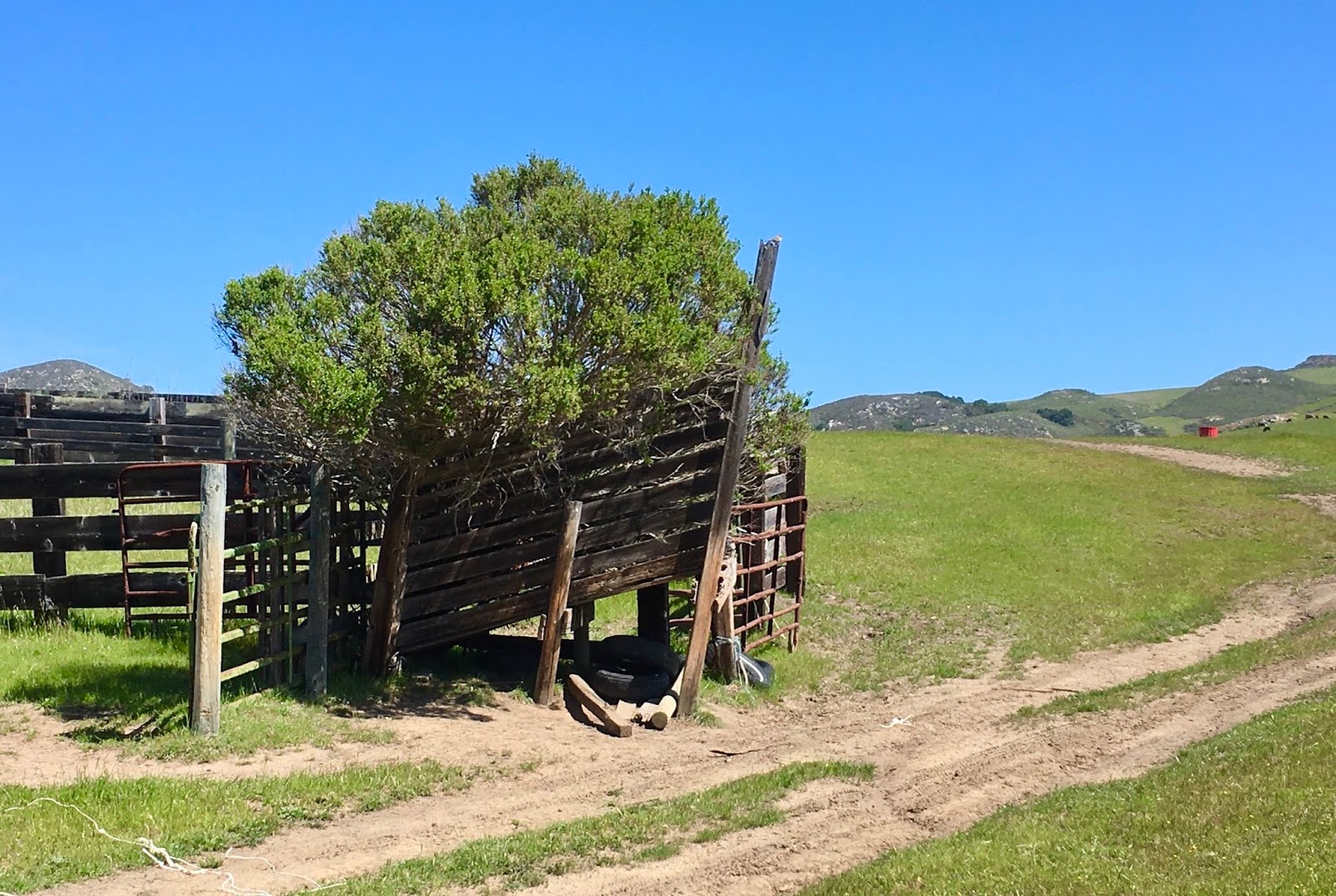
West of the pond is a dilapidated cattle pen.  The corner of the pen, with its old loading chute, scruffy little tree, and aging wooden fencing was attracting three species of birds.  American Goldfinch, House Finch, and California Towhee (photo) were flying in and out of the foliage.  From a section of barbed wire fencing two Cassin's Kingbirds sallied forth in pursuit of insects.  Wilson's Warbler sang from a willow thicket.
Best sighting of the morning was a Lark Sparrow (below) perched atop an old post.  Every few minutes he sang - this was first time I had heard a Lark Sparrow sing.  During breeding season males sing from elevated perches and that is just what he was doing - made my day! 
Afterthought:  As I jotted down my thought, I realized how privileged and fortunate I am to be able to drive to a peaceful rural area and spend time thinking only of birds and the beauty of the day . . . . .




Wednesday, November 7, 2018

Tuesday/Wednesday Birding: Looking for Winter Birds

Late October, early November is often the time of year when we have summer weather.  Monday morning felt like summer, a slight breeze, deep Blue sky, and a beautiful tranquil bay.
 
Sea Pines nine hole golf course has two easily viewable ponds, that is if you do not mind looking through chain link fencing. 

I was Birding with Mike.  Our first sighting was a “commotion” of Coots near the first pond (above).  Over a few greens Mike spotted a “plump” (12) of Greater white-fronted Geese.  A “dabble” of Mallards and a few Coots occupied the second pond (below). 


Sweet Springs - A high tide was just beginning to go out.  From the overlook our best sightings were an “incontinence” (8) of Greater Yellowleg, a “paddling” (22) of Blue-winged Teal, and a “season” (6) of beautiful Killdeer.  Two Black-bellied Plover, clad in their rather dull winter plumage, were having a bit of a tiff.  I think it was an adult and a juvenile.   
Near the Second Street Pier -  A Greater Yellowleg was hanging out with two Coots, out from the pier a Common Loon, in winter plumage, was diving for food.  They can travel underwater quite far as they chase down prey. 

Morro Bay Marina - We had not walked far when we saw the adorable Spotted Sandpiper teetering along the edge of the water.  This little darling is very reliable as she is always feeding along the edge of the marina.


From the boardwalk we could see in the distance large flocks of shorebirds, numerous Great-Blue Heron, Great and Snowy Egret, and Harbor Seals hauled out on the pickleweed. 

A high 6 foot tide took me back to Sweet Springs this morning. (photo taken at 9am) Dabbling in the pickleweed were newly arrived winter ducks, Mallard, American Widgeon, Blue-winged and Green-winged Teal, and what I thought was a Male Northern Pintail,  but was unsure, as I could not get a good enough look.


Local birder/photographer Gary O’Neill, was at the overlook.  We immediately got into a discussion on the birds he had photographed.  Fortunately he had taken a photo of the Pintail, or what we thought was a Pintail, but did not have the long pointed tail.  This evening I compared his photo with photos on the internet and came to the conclusion that it was probably a Mallard/Northern Pintail Hybrid.  In the photo the possibly Mallard/Pintail Hybrid is in the foreground.  Beside him is a male Mallard.  Maybe the Mallard is his dad.  Ah, another bird mystery to resolve.


Saturday, February 3, 2018

Where are the Dabbling Ducks?

Thursday morning at 10:00 the tide was very high (6.5).  At the Sweet Springs Preserve the extreme tide covered nearly all the pickleweed, filled in the channels and the ponds, with the exception of the tiny wetland where the springs bubbles forth. 
Usually coming into Sweet Spring on the incoming tide, dabbling ducks such as Northern Pintail, Northern Shoveler, American Wigeon, Green and Blue-winged Teal (above) and Cinnamon Teal adapt their dabbling to finding tasty morsels in the flooded pickleweed.
For comparison, the above photo shows the flooded pickleweed at an average tide.” 

As I entered the preserve two female deer were feeding in the new grass growing along the edge of the boardwalk.  Both of the deer alerted to my presence.  In a few moments they disappeared into the brush. 
Coots were feeding in the grass.  I guess they wanted a change from the Sea Pines Golf Course where they usually hang out.  What I did not see were dabbling ducks.
Searching the pond I noticed a mixed flock of about 20 Teal, sound asleep on the edges of the wetland.  Perhaps they were exhausted from their flight to Morro Bay.  Usually ducks notice a close human presence.  These little darling did not even blink.

Scanning the far side of the flooded pickleweed I spotted a few more Teal,  but where was the bounty of dabblers I had been expecting?  For several years I've noticed that fewer water fowl are wintering in Morro Bay.

From the photo, taken at Sweet Springs in January 2007, there is no doubt in my mind that fewer ducks are wintering in Morro Bay.     Can you find the Eurasian Wigeon?
  I am hoping that the missing dabblers are busy feeding in another area of the bay.