Showing posts with label sweet springs preserve. Show all posts

Wednesday, November 7, 2018

Tuesday/Wednesday Birding: Looking for Winter Birds

Late October, early November is often the time of year when we have summer weather.  Monday morning felt like summer, a slight breeze, deep Blue sky, and a beautiful tranquil bay.
 
Sea Pines nine hole golf course has two easily viewable ponds, that is if you do not mind looking through chain link fencing. 

I was Birding with Mike.  Our first sighting was a “commotion” of Coots near the first pond (above).  Over a few greens Mike spotted a “plump” (12) of Greater white-fronted Geese.  A “dabble” of Mallards and a few Coots occupied the second pond (below). 


Sweet Springs - A high tide was just beginning to go out.  From the overlook our best sightings were an “incontinence” (8) of Greater Yellowleg, a “paddling” (22) of Blue-winged Teal, and a “season” (6) of beautiful Killdeer.  Two Black-bellied Plover, clad in their rather dull winter plumage, were having a bit of a tiff.  I think it was an adult and a juvenile.   
Near the Second Street Pier -  A Greater Yellowleg was hanging out with two Coots, out from the pier a Common Loon, in winter plumage, was diving for food.  They can travel underwater quite far as they chase down prey. 

Morro Bay Marina - We had not walked far when we saw the adorable Spotted Sandpiper teetering along the edge of the water.  This little darling is very reliable as she is always feeding along the edge of the marina.


From the boardwalk we could see in the distance large flocks of shorebirds, numerous Great-Blue Heron, Great and Snowy Egret, and Harbor Seals hauled out on the pickleweed. 

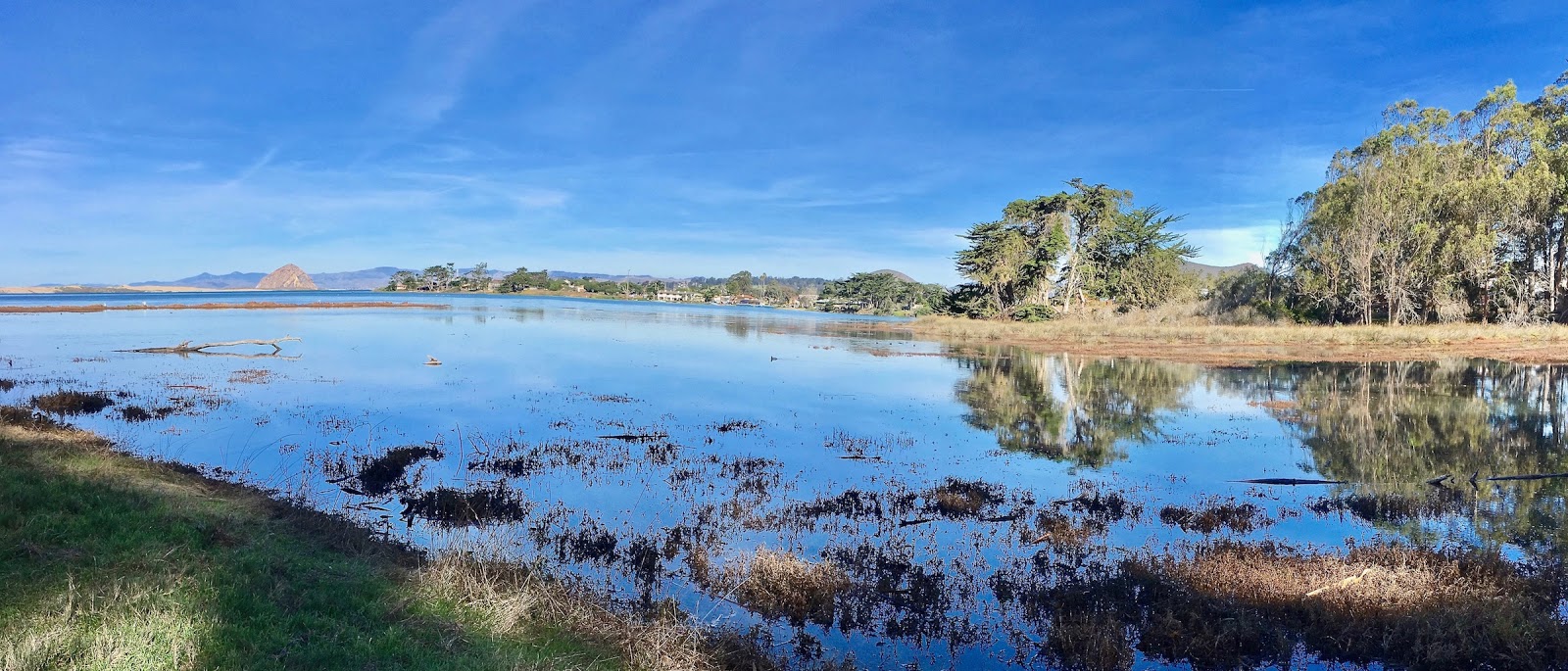
A high 6 foot tide took me back to Sweet Springs this morning. (photo taken at 9am) Dabbling in the pickleweed were newly arrived winter ducks, Mallard, American Widgeon, Blue-winged and Green-winged Teal, and what I thought was a Male Northern Pintail,  but was unsure, as I could not get a good enough look.


Local birder/photographer Gary O’Neill, was at the overlook.  We immediately got into a discussion on the birds he had photographed.  Fortunately he had taken a photo of the Pintail, or what we thought was a Pintail, but did not have the long pointed tail.  This evening I compared his photo with photos on the internet and came to the conclusion that it was probably a Mallard/Northern Pintail Hybrid.  In the photo the possibly Mallard/Pintail Hybrid is in the foreground.  Beside him is a male Mallard.  Maybe the Mallard is his dad.  Ah, another bird mystery to resolve.


Saturday, February 3, 2018

Where are the Dabbling Ducks?

Thursday morning at 10:00 the tide was very high (6.5).  At the Sweet Springs Preserve the extreme tide covered nearly all the pickleweed, filled in the channels and the ponds, with the exception of the tiny wetland where the springs bubbles forth. 
Usually coming into Sweet Spring on the incoming tide, dabbling ducks such as Northern Pintail, Northern Shoveler, American Wigeon, Green and Blue-winged Teal (above) and Cinnamon Teal adapt their dabbling to finding tasty morsels in the flooded pickleweed.
For comparison, the above photo shows the flooded pickleweed at an average tide.” 

As I entered the preserve two female deer were feeding in the new grass growing along the edge of the boardwalk.  Both of the deer alerted to my presence.  In a few moments they disappeared into the brush. 
Coots were feeding in the grass.  I guess they wanted a change from the Sea Pines Golf Course where they usually hang out.  What I did not see were dabbling ducks.
Searching the pond I noticed a mixed flock of about 20 Teal, sound asleep on the edges of the wetland.  Perhaps they were exhausted from their flight to Morro Bay.  Usually ducks notice a close human presence.  These little darling did not even blink.

Scanning the far side of the flooded pickleweed I spotted a few more Teal,  but where was the bounty of dabblers I had been expecting?  For several years I've noticed that fewer water fowl are wintering in Morro Bay.

From the photo, taken at Sweet Springs in January 2007, there is no doubt in my mind that fewer ducks are wintering in Morro Bay.     Can you find the Eurasian Wigeon?
  I am hoping that the missing dabblers are busy feeding in another area of the bay.

Tuesday, May 30, 2017

Sweet Sweet Springs


The welcoming committee this beautiful morning was a California Quail family, mom, dad and four tiny fledglings resembling walnuts with itty bitty legs.  Bird song filled the air.  I had Sweet Springs to myself.

Nuttall's Woodpecker, singing it's flight song, dashed between the trees.  Two Tree Swallow sped overhead in their relentless pursuit of insects.  House Sparrow brightened the semi-sunny morning with it’s cheerful chatter.
High in the canopy, Black-headed Grosbeak sang its little heart out; on the far side of the preserve an answering song could be heard.  (Unfortunately, too breezy to record the song.)
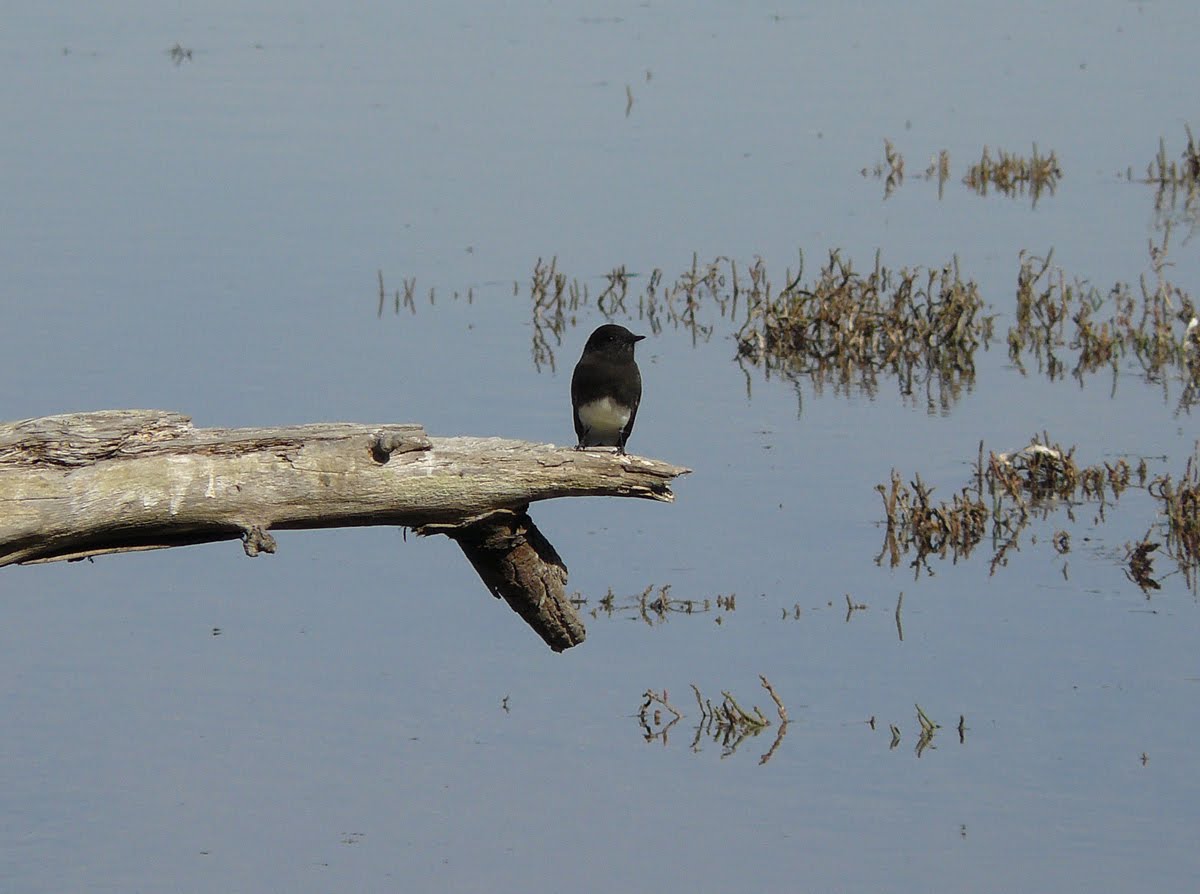
Dark-eyed Junco scratched in the leaf litter.  Four Mallards fed in a channel; I doubt they noticed the melodious song of the Black-headed Grosbeak.  Faithful Black Phoebe was flycatching from her usual perch on a fallen eucalyptus tree. (the channels empty when tides are low)
I experienced birding nirvana for about a half hour in Sweet Springs this morning.  Before I departed for home, I gently educated a pair of gentleman from Mohave who were convinced the Mallards were Northern Shovelers.

Sunday, September 21, 2014

The Red Knot - Calidris Cantus

The Red Knot is a medium sized shore bird, chunky and short legged, quite similar to a Dowitcher but with a shorter bill; its winter plumage is grayish.  Dowitcher plumage is mostly light brownish.   The Knot is a tad smaller than a Dowitcher, and to confuse the identification process both birds have similar feeding strategies such as repeated, rapid probing into wet sand.

A few days ago on a drizzly, foggy morning I was standing on the edge of the pickleweed at the southern end of Morro Bay peering intently at a little gray bird probing in the sand, hoping the image in my binoculars was a Red Knot.  Of course at this time of year there is no redish color; also it would have been helpful if there had been a Dowitcher for comparison.   I was 90% certain it was a Red Knot, well maybe only 85% certain.  Even though it was foggy, fortune shined when a knowledgeable birder came upon the scene and confirmed my identification.  I was delighted with the sighting and had no idea, until I got home and began an internet search, that this sweet little bird was currently in a struggle for survival.

 From its breeding grounds in the high Arctic, the Red Knot makes a 9300 mile journey to its winter grounds in southern South America. Along the way they need to stop two or three times to refuel.  Humans actions or inaction at two of their primary stopovers are directly responsible for the rapid decline of the species.  If you would like more information on the plight of the Red Knot
go to     http://www.pbs.org/wnet/nature/episodes/crash-a-tale-of-two-species/why-save-the-red-knot/597/


Sunday, February 16, 2014

BIRDING HERE AND THERE

 Friday was a divine day at El Chorro Park, located about 5 miles east of Morro Bay.  Weather was warmish, no wind and gloriously quiet except for the sound of birds.  In the grassy area of the park observed several Northern Flicker, Bluebird, Yellow-rumped Warbler, and numerous White-crowned Sparrow feeding on the ground.  Along the old, unused road that meanders up Dairy Creek, Chickadee, Bewick's Wren, American Goldfinch.   The action was overhead, three Red-tailed Hawks swooping and calling. 
This morning at Sweet Springs song birds were getting into the Spring Mode; boldly singing were Song Sparrow, Bewick's Wren, and American Goldfinch.  Gaily chattering was a large flock of Chestnut-backed Chickadee and in the trees, a flock of of beautiful, Cedar Waxwing (below Photo). 
As the tide comes into the pickleweed, the channels fill.  Ducks that feed in shallow water rest in the pickleweed until the tide recedes enough for them to resume feeding.  Resting along the edge of the channels was a large flock of Green-winged and Blue-winged Teal, plus No. Shoveler, Widgeon, Pintail, and one lonely White-fronted Goose.  On the bay a large flock of Ruddy Duck and their close associate, the Scaup.  Out further the divers, Bufflehead and Eared Grebe; a very peaceful scene.

Did not find the Bald Eagle that has been seen numerous times, but did get lasting looks at a Merlin and a Cooper's Hawk.   Birding is Sweet in Sweet Spring.

Sunday, May 12, 2013

SUNDAY BIRDING

First on the agenda was Cuesta Inlet.  The morning was sunny, tide slowly moving in. I was hoping to see or hear an Olive-sided Flycatcher.  Took only a few moments to locate the Flycatcher, as the little darling was doing what it does best, flycatching.   From a perch the Flycatcher flies off to catch an insect and then flies back to the same or nearby perch.  I just stood still watching; eventually it was perched in an oak, close enough to see without binoculars.  What a treat!!
Sweet Springs Preserve could not have been better.  I was surrounded by a plethora of bird song; didn't know where to look first.  At least 4 Pacific-slope Flycatcher.  Juncos were very active.  From the quaint bridge that spans the two ponds, watched a Western Tanager, with his black and white wings, yellow body, and red head, harass a Song Sparrow that was bathing along the edge of the pond.  Mrs. Tanager and Mr. and Mrs. Common Yellowthroat were nearby watching the action.  Overhead, a flock of Cedar Waxwing fed on Eucalyptus blossoms.  Sweet Springs at its Best!

My next stop was the hardware store to purchase peanut butter suet.  Tiny Bushtits are nesting in a brushy small tree in my front yard, organic peanut butter suet is their favorite,  Nothing but the best for my nesting Bushtits.


Sunday, October 14, 2012

SWEET SPRINGS - RETURN OF THE MIGRANTS

This morning a bevy of birds, migrating in for the fall/winter season, greeted me. Reliable old friends had, once again returned to the Central Coast. (photo - Sweet Springs High tide)

To the west of the Sweet Springs boardwalk leading out to the overlook was a White-tailed Kite sitting atop a shrub, Snowy Egret and Gr. Blue Heron, and a resident Bewick's Wren singing.  On the bay about 30 Ruddy Duck; many of the males still sported their breeding plumage, 5 Western Grebe, and 3 Scaup.

A mixed flock of ducks rested in the pickleweed along the main channel - Northern Pintail, Northern Shoveler, Blue and Green-winged Teal. In the vicinity of the ponds, many Mallards and a Female Kingfisher.  Flitting about in the Cypress trees were Yellow-rumped and Townsend's Warbler. Oh, nearly forgot - the morning's weather was warm to hot - unusual to say the least.


Saturday, June 2, 2012

SWEET SWEET SPRINGS

A few days ago a friend mentioned hearing an unusual bird song in Sweet Springs. (photo - Eucalyptus reflected in pond)  The morning was lovely, partially sunny, with a soft fog over the bay and the distant dunes.  Perfect conditions for checking out the action in Sweet Springs.  Numerous songs could be heard but nothing unusual.  To my delight, observed Willow Flycatcher and Pacific-slope Flycatcher in the Eucalyptus trees.  Had not seen either one of these little darlings for at least a year.  Both the Flycatchers have unusual songs, but they were not singing, just darting about eating insects.

To my added delight a couple of  the resident Common Yellowthroat, one on each side of the pond, were having a song fest.  Recorded a short video of a Yellowthroat song.  In the background may be heard (besides the swoosh of automobiles) Song Sparrow and White-crowned Sparrow.  http://youtu.be/YKgMfhwaKiQ
  
The Juncos were lively - youngsters chasing after parents in hopes of getting a handout. Hmm, sounds familiar. Thank you Sweet Springs.  You never disappoint. 

Sunday, April 15, 2012

A TIME OF TRANSITION

The majority of the winter migrants have left for their breeding grounds. The Blue-winged Teal (photo) from my observation are often the last to go. They breed throughout the western U. S. Their preferred nesting habitats include marshes and shallow ponds.

Teals are dabblers. They feed in shallow water, either skimming the water or dabbling below the surface. This lovely morning, Blue-winged Teal, Cinnamon Teal, and Northern shoveler were feeding out from the Audubon Overlook. In the shallower water a large flock of Avocet fed, bills swaying rhythmically. Many in transition to their breeding colors - their head and breast turning from white to a deep cinnamon.

On the bay was an Eared Grebe, looking exotic in its breeding plumage. Total species for this morning's birding, 27. Sweet Spring was alive with sound. Heard Pacific-slope Flycatcher (a spring migrant), Kestrel, Chickadee, Common Yellowthroat, and Kingfisher. The Kingfisher will soon be heading out. They usually nest in a tunnel which they excavate into a riverbank.

I have done much fiddling with youtube. Here goes another try. This movie is a semi-humorous attempt at birding around the Phoenix waste water treatment facility. Some of the photos are fuzzy (due to using an iTouch), but the music is jolly.

http://www.youtube.com/watch?v=UCB7K3sZzAI


Wednesday, March 21, 2012

SPRING IN SWEET SPRINGS

Spring was in full bloom (photo) this Morning. Common Yellowthroat and Song Sparrow were singing their little hearts out. A pair of Red-shouldered Hawks were noisily chasing each other through the trees. Wildflowers were blooming - Humming Bird Sage, Wallflower, Phacelia, Coreopsis, Chinese Houses. Floating along in the bay was a large flock of Ruddy Duck; many of the males transitioning to their breeding colors - dark head, vivid white cheek, blue bill, a ruddy cinnamon body, and of course their "piece de resistance," perky tail feathers.

In the pickleweed, along the channels, were resting Shoveler, Cinnamon, Blue and Green Winged Teal, a solitary Canada Goose, and an assortment of Egrets and shorebirds. Above, a pair of Tree Swallows dashed about.
On the far side of the wetland two White-tailed Deer (photo) were quietly feeding. Fortunately for the deer, the boardwalk keeps people out of the wetland - has been at least three years since I had seen deer in Sweet Springs.

As I was leaving, I came upon a couple of friendly out of town birders. They had many questions. They asked me if I lived nearby. I said, "Yes." "You live in paradise," said the gentleman. I had to agree.

Monday, December 12, 2011

SWEET SPRINGS OVERLOOK


The morning was fresh. Our glorious sun was playing hid and seek with huge cumulus clouds; rain was on its way. The tide was high. Brant Geese were feeding along the edges of the pickleweed. Behind the Brant were many hundreds of Ruddy Ducks. Feeding nearby were Scaup, Pintail, Widgeon, and Blue and Green-winged Teal. Further out in the bay were huge flocks of mixed ducks and Cormorants. Over head flew the noisy Caspian Tern.

Sunday marked the end of the 30 day Brant hunting season, Yeah! It is rather disconcerting to hear the blast of shotguns when one is quietly checking out the ducks. The season for ducks runs through January 27th. Morro Bay is designated a "Bird Sanctuary." Seems rather odd that hunting is allowed in a sanctuary.
Brant (above photo) are vocally expressive - always murmuring to each other. Perhaps they are discussing their yearly migratory flight from the northern coast of Alaska to Morro Bay. Their gentle sound touches my heart and makes me feel that all is right. (for the moment)

As I was exiting Sweet Spring, heard the high pitched "tsee" of a Brown Creeper. With little effort saw two adorable little Creepers working their way up a Cypress. The sun was now hiding behind the clouds. Definitely time for a cup of tea.

Sunday, June 12, 2011

EASY BIRDING AT SWEET SPRINGS

Walked to Sweet Springs. The morning was sunny with a slight breeze. Took the path to the right that loops around the pond. Nine turtles were sunning themselves on a board in the pond. I believe the board was placed there just for the turtles. For awhile I was the only person enjoying the preserve. Birds twittering and singing - music to my ears. Saw or heard 21 species. (Photo - Black Phoebe)

I was sitting on a bench rebooting my iPod, which now serves as my bird book, when Teddy, a photographer/birding friend happened by. She mentioned the Great Horned Owls that live in the preserve, and asked if I had seen them. Last year I had seen them, but was not quite certain where to look this year. Teddy had taken photos of them and said she knew where they were. There were two fluffy teenage owlets, so very precious, and a parent. A real treat to see them.

Another treat was finally getting to see a Pacific Slope Flycatcher. I often hear them, but had not seen one this year. How fortunate I am to have this wonderful birding area so close to home.

Thursday, January 13, 2011

BIRDING THE PHOTOGRAPHIC HOT SPOTS

The Morro Bay Bird Festival begins tomorrow. At 8:00 Linda will be taking a group of 15 to several photographic hot spots that feature great scenery and great birding. This morning Linda and I took a trial run. We began at the Morro Bay Marina sand spit. In the marina were 2 Western Grebe and 3 Pied-billed Grebe that were being a bit feisty (the breeding season has begun). In the shrubbery we saw the usual, plus Song Sparrow, Meadowlark, Gray-blue Gnatcatcher, Yellow-rumped Warbler. Out in the mud flats were thousands of diving and dabbling ducks, cormorants, Brant, Sanderlings, Sandpipers, White Pelican.

Next stop, The Elfin Forest - The Fuchsia-flowering Gooseberry is beginning to bloom. We saw Calif. Thrasher (photo), Bewick's Wren, Gnatcatcher, Anna's Hummingbird. At the overlook (the tide was lowish), American Wigeon, Cinnamon and Green-winged Teal, Avocet, Dowitcher, Pintail, and scads of shorebirds. In the shrubbery and pine trees by the parking area were 2 Hermit Thrush and Junco.

Last stop Sweet Springs. A gentleman pointed out a Great Horned Owl. Well, that made the morning. A Kingfisher was in the area of the pond. From the overlook we could see thousands and thousands shorebirds, ducks, Terns, and a huge flock of Brant. The birding was beyond amazing. Without a doubt, Linda's photographic/birding event will be a tremendous success.

Saturday, December 25, 2010

CHRISTMAS DAY

The morning was cold, cloudy, dark, and windy. Sea Pines Golf Course pond - Four Ruddy Duck, three eared Grebe, two Canada Goose, and a Partridge in a pear tree.

Sweet Springs Preserve - Out from the overlook: A forlorn looking Snowy Egret (photo), Four Greater Yellowleg, Northern Pintail, hundreds of Ruddy Duck and Greater Scaup, and a sprinkling of Brant Goose. Four Red-shouldered Hawks were soaring, and in the distance could hear a Flicker and a Kingfisher. Brrrrr, I was chilled to the bone. Time for a hot cup of Starbucks Coffee.

Thursday, December 9, 2010

SWEET SPRINGS

Beautiful in Sweet Springs this morning. Mallards were abundant in the large pond. A Great Egret (photo) was looking for breakfast by the second bridge. In the distant channel were Blue-winged Teal, American Wigeon, Northern Pintail (the male is always dressed in his formal attire).

Out from the overlook were scads of Brant Goose, Ruddy Duck, Am. Wigeon, Cinnamon Teal, Bufflehead, Scaup, No. Shoveler, West. Grebe, Caspian Tern. In the brush along the boardwalk got a good view of a Hermit Thrush. Hermit Thrush may come to your birdfeeder if you put out raisins, currants or nut meal.

Saturday, November 20, 2010

SWEET SPRINGS

On my way to run a few errands this morning I stopped at Sweet Springs. The day was magnificent with baby blue sky and puffy cumulus clouds. Sleeping in the pickleweed that line the channels, were several groups of Blue-winged Teal (photo, male Blue-winged Teal). Had to really look to see them, as they blended in perfectly with the vegetation.

Close to the overlook were about 28 Ruddy Duck (first sighting of the season). Love their perky tail feathers. Two Brant were nearby.

Not in a big hurry, I checked the ponds at Sea Pines Golf Course. Between the two ponds were 48 Coots; in the center of the flock were two Canada Goose. The flock was so intent upon feeding that they did not so much as raise an eyebrow when a golf ball landed in their midst.

Wednesday, September 1, 2010

BIRDING BAYWOOD

Beautiful, sunny morning in Baywood. First stop Sweet Springs - 17 species. Most memorable, a female Kingfisher. Local Kingfishers breed outside of the area and return in late summer/fall. Other birds of note Oak Titmouse, many Chickadees, Nuttall's and Downey Woodpecker.

Like us, birds are creatures of habit. I believe it was part of the same small mixed flock I had seen a few days ago. 6 Greater Yellowleg, 4 Killdeer, one Willet, and one light colored Godwit. At the Audubon Overlook, 8 Greater Yellowleg, two of the three Brant Goose I had seen On August 26th., and a large flock of Western Sandpiper.

Friday, June 11, 2010

SWEET SPRINGS - FRIDAY


Sweet Springs was peaceful this morning. Only one of the three juvenile Great Horned Owls was to be seen. Sightings: Junco, Spotted Towhee, Tree Swallow, Nuttall's Woodpecker, Song Sparrow, Common Yellow-throat, Snowy Egret. Out in the bay there was a small feeding frenzy - Great Egret, White Pelican, Double-crested Cormorant, Caspian Tern (2 )were feasting on the small fish that come in to the bay on the incoming tide. Below is a another funky video taken with an iPod Nano.