Showing posts with label Morro Creek Lagoon. Show all posts

Saturday, September 19, 2020

Birding on a Smoky Morning

Morro Creek, Morro Bay Ca. - To say the least, smoke was prevalent, birds were few.  I was wearing a mask and was determined to make the most of my time on the beach.
Morro Creek travels from the foothills to the Pacific Ocean.  Before it reaches the sea, the creek sometimes forms a lagoon.  Beach lagoons come and go depending on the time of year, the fresh water, high tides, and surf conditions. 

Greater Yellow-leg, Willet, and Snowy Egret were feeding in shallow water.  Nearby, a Semi-palmated Plover, two Killdeer, and my special friend, Black Phoebe.

Most amusing was watching the Snowy Egret foraging.  It swiftly darted back and forth, then 
suddenly stopped to jiggle one of its bright yellow feet under the water.
Would this creative behavior stir up an edible critter?  Yes!  What ever it was went down the Snowy's throat faster than I could blink.

A footbridge crosses the creek.  I had parked on the south side of the creek, as I crossed over the bridge, I saw only a few Mallards.  On the way back checked the creek again, noticed three Red-necked Phalarope in non-breeding plumage. (below)
On the edge of the wet sand a small flock of Least Sandpiper, another handsome Killdeer, and a mystery bird.  I do love a mystery.  I was on the bridge looking down.  It was plump with white stripes on its head and back.  Its head was immersed in the water up to its tiny eye.  
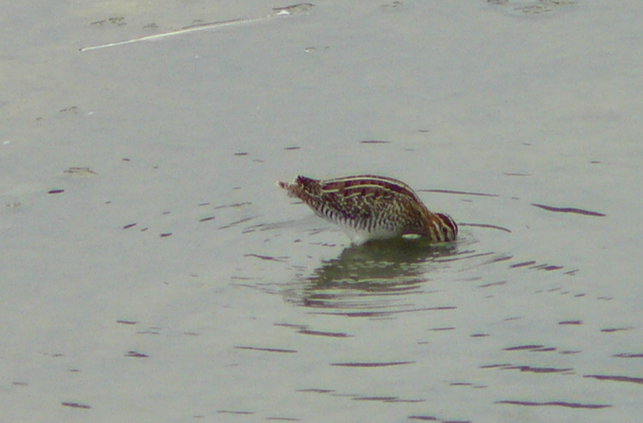
Hoping to identify the bird, I took numerous photos.  Arriving home I searched through my "National Geographic Guide to Birds of No. America" and found Wilson's Snipe - described by the Guide as "stocky; with very long bill; boldly striped head, barred Flanks."  Ah, another mystery solved.
In the above photo, top image is the Snipe followed by two Phalarope.  The large image of Wilson's Snipe was borrowed from Wikipedia to get a good look at its long bill.  The tip of the Snipe's bill remains closed while it consumes invertebrates.  This useful feature allows the Snipe to consume food without lifting its head from the water.  

View of Morro Creek Lagoon from Google Earth.  Ephemeral beach lagoons are important habitats for migrating birds, particularly important now because so much habitat has been lost to fire.


Tuesday, September 13, 2011

BIRDING THE BEACH

The morning was warm, barely a breeze, the birds were most cooperative. (Photo - reflection of Morro Rock in Morro Creek Lagoon.) In, on, and around the Morro Creek Lagoon, much large than the last visit due to high tides, had great sightings of one Pectoral Sandpiper, four Baird's Sandpiper, scads of the Red-necked Phalarope, three Avocet, one Spotted Sandpiper, Royal and Elegant Tern, and Willet, Whimbrel, Long-billed Curlew.

The Terns, mostly Elegant with a few of the larger Royal, were hanging with a flock of Heermann's Gull. (They do compliment each other. I wonder if they know that.) I am feeling more confident with Tern identification and believe, am not 100% positive though, I know the difference between the Elegant and Royal. The Royal is a couple of inches larger than the Elegant and the Elegant has a pointier, slightly drooping bill. I believe the photo shows the difference between the two species. The Royal is the larger bird in the foreground.

Next birding adventure will be looking for early fall migrants in the willows at Islay Creek.

Saturday, September 3, 2011

MORRO CREEK LAGOON

Morro Creek Lagoon, Morro Bay. Weather, cool, and cloudy, just perfect for birding. The photo was taken from a parking area above and to the south of the Lagoon. If this was a panoramic photo, Morro Rock would be on the left. On its way to the sea the Creek forms a couple of wide, yet shallow pools that provide bountiful habitat for a variety of shorebirds.

Fortune shined, and the birds were most cooperative. In and around the Lagoon were about 200 Red-necked Phalarope (spinning and probing), two Wilson's Phalarope, one Dowitcher (short or long-billed - hard to determine), several Killdeer, Semipalmated Plover, Western Sandpiper, and the shorebird I was hoping to see, the Pectoral Sandpiper.

It's not like I have not seen the Pectoral before; I just wanted to get a really good look at the little darling. Well, actually, it is not that little. It is a couple of inches larger that a Western Sandpiper, and it is usually (anyway when I have seen it) apart from the other sandpipers. I was focusing on a little cluster of Western when the Pectoral strode out of the reeds. Yes!!

As I neared my car, I noticed, perched atop a tall shrub on the bank of the creek, a Cooper's Hawk. Directly below him were four young house finch that were waiting for their parents to feed them. I have a feeling the hawk was thinking about breakfast.