Tuesday, April 16, 2019

Coachella Valley - Birds, Wildflowers & Other Delights


Spring had sprung - The desert was calling - Winter birds had taken off to their nesting grounds, and it was time for me to take off for an adventure into the California desert where I could see blooming wildflowers, interesting birds, awesome vistas, and spend time with a friend.
  The rugged, snow capped peak is Mt. San Jacinto at 10,833 ft.
  
A visit to Cathy, my friend in the Coachella Valley, was long overdue.  Cathy loves the desert and is familiar with all the special places that have wildflowers, birds, and beautiful vistas;  she is within a half hour to forty minutes from the Santa Rosa - San Jacinto National Monument, the Big Morongo Preserve, and the Coachella Valley Preserve, which is known for it dense groves of the only native Palm in California, Washingtonia filifera.  Palm sprouts may be seen in left foreground of photo.
Coachella Valley Preserve - The California Palm, also known as petticoat palm, has dense fronds that form a “skirt.”  The fronds hang down to the ground creating habitat for many species of birds, and reptiles.  The San Andreas fault which runs through the Coachella Valley supplies the water necessary for the California Palms to thrive.  A delightful boardwalk meanders through a grove; as you can see in the photo, the skirts overhanging the boardwalk have been trimmed, creating skirt or petticoat tunnels.  It is not everyday one can stroll through, and I do mean through, California native palms.
The open desert presented us with an abundance of blooming shrubs and wildflowers; we marveled at the beauty of Brittlebush (Encelia farinosa), one of my favorite desert plants. To say Brittlebush was prolific is an understatement, miles and miles of desert were covered with this brilliant blooming beauty.
As we walked along the little gully, still wet from recent rain, we spotted a White-winged Dove.  It’s feathers looked like grey velvet.  The White-winged Dove overwinters in Mexico and Central America and comes to our southwestern states to breed.  Unfortunately they are infrequent visitors to the Central Coast. 
Shortly after our Dove sighting we noticed Verdin activity in a thorny Palo Verde Tree.  Verdin are tiny, the same size as Bushtits.  Sitting on a shaded log we watched the little darlings methodically build their breeding nest. 
The female was inside lining the nest while the male was gathering materials.  The opening will be toward the prevailing winds, to bring in cooling air as the weather gets hotter.  Actually, they have two nests.  The winter nest is much thicker for warmth.
Big Morongo Preserve - At the feeding station (above) we saw numerous birds, including a pair of Vermilion Flycatcher and a brilliantly colored Hooded Oriole.  We had a spectacular sighting from an overlook in the riparian section of the preserve.  Thanks to two birder/photographers who readily shared identification, we found we were looking at a small flock of endangered Least Bell’s Vireo.    Their musical chatter was delightful.  
They are officially listed as endangered, primarily due to loss of riparian habitat and cowbird brood parasitism.  Cowbirds lay eggs in various songbird nests.  When the eggs hatch, the hatchlings kill the other chicks. Big Morongo Preserve is one of the few places where Least Bell’s Vireo nests.  I hope there are no Cowbirds in the Big Morongo Preserve.
Santa Rosa-San Jacinto National Monument - An interpretative trail winds its way through a plethora of blooming plants and shrubs.  Oh my gosh, it was a wildflower paradise.  The red flowering shrub is Chuparosa (Justicia californica), a favorite of Costa's Hummingbird.
 A pair of Phainopepla were active in the Mesquite and Palo Verde trees.  The female has a smaller crest, is gray in color; both male and female have red eyes.  To our delight a pair of Verdin were nest building only a few feet above us. After two visits to the Santa Rosa Nat. Mon., I was hoping for a third, but ran out of time. 

A great thank you is due to Cathy and Mother and Father Nature for the most fabulous desert adventure I have ever experienced. 


Saturday, March 9, 2019

Birding Between Rain Storms


    Coreopsis at the entrance to Sweet Springs Preserve

Sweet Springs - The break in the clouds was brief.  The shower began just as I was entering the preserve.  My rain jacked has been getting a lot of use lately.  The pond was very quiet.  The only ducks were a male and female Mallard that appeared to be chasing one another with much splashing.  They both disappeared under the water.  I was clueless at that moment as to what was going on.  The male began to appear; underneath him the female.  He was clutching her head.  I thought, "Oh my gosh, he's going to drown her."  She survived.  This was my first experience observing the brief mating process of Mallards, if I had blinked, I would have missed the event.   

There were the usual birds with two exceptions -  The usual were - Bushtit, Song Sparrow, Junco, California Towhee, California Quail, Common Yellowthroat; Nuttall’s Woodpecker and Northern Flicker were busy drumming - Exception one, watching a Merlin (Falco columbarius) fly on to a perch in a tall deceased tree across from the pond. (below).   Exception two, listening to the song of a Purple Finch.  Purple Finch often hang out at the tip top of high trees and can be difficult to see.
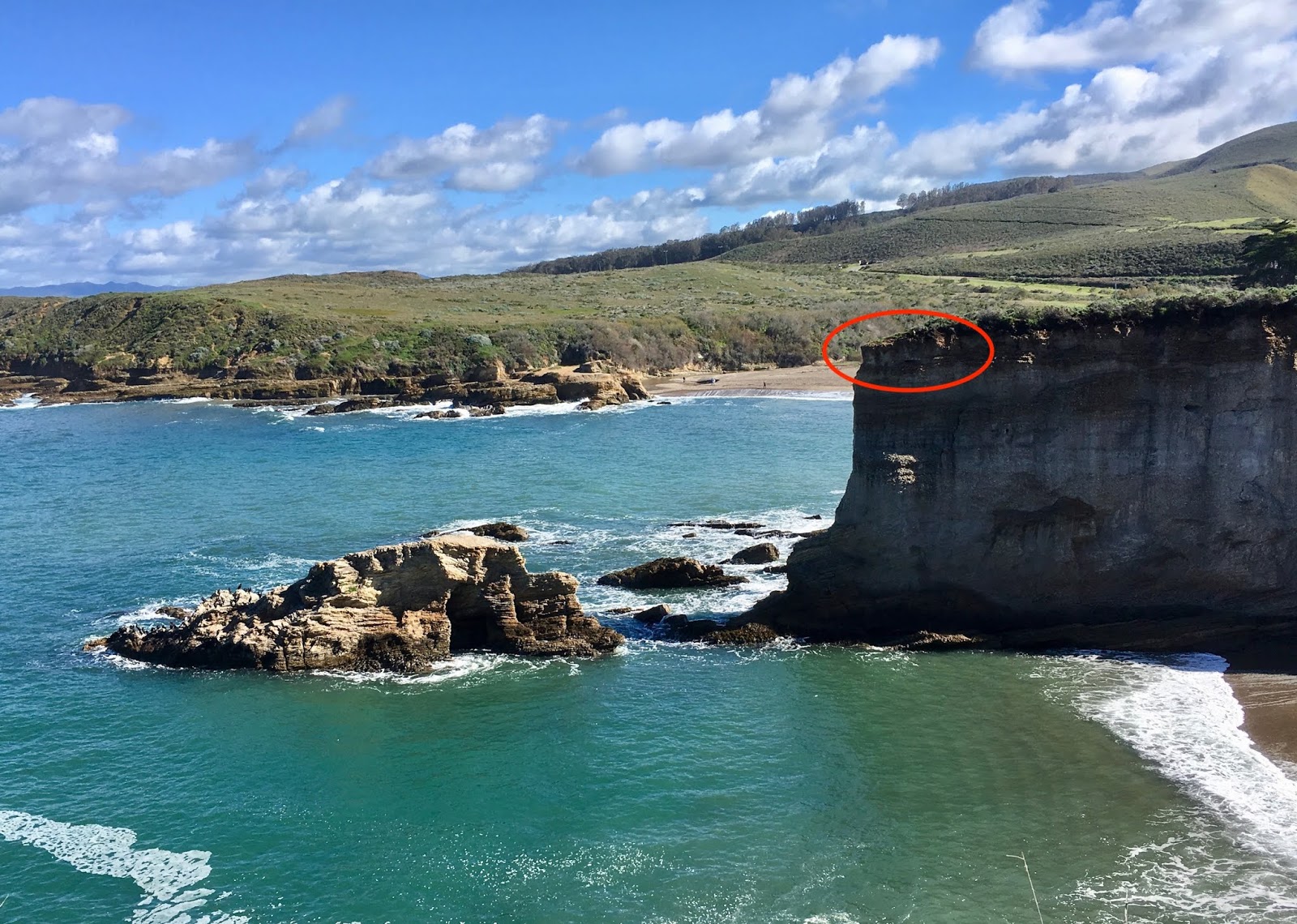
Montaña de Oro - Spooners Cove and Bluff Trail -  My favorite sighting - 2 beautiful Peahens delicately nibbling on green vegetation growing in Spooner's Cove.  They paid no attention to my presence.  The Peahens arrived about two years ago.  I have a question.  How have they avoided being eaten by one of Montaña de Oro's many hungry predators?
The Peregrine appear to be in the nesting mode.  They have been seen mating, and the male is bringing her food.  The female spends much of her time perched on the point or close to the nest opening (below photo).  On the formation below were Brandt's and Pelagic Cormorant and three Oystercatcher.
Pelagic Cormorants are beginning to transition into their breeding plumage.  On some of the Pelagic their white flank patches can be seen.  This group of Pelagic Cormorants are located a short distance north of Corallina Cove.  They may nest on Morro Rock or on a Sea Stack near Morro Rock. 
Song birds along the Bluff Trail were also in the mating mode.  Much singing and chasing through the brush.  Spring is definitely in the air.  Meanwhile the rain ☔️ ☔️ continues. 


Sunday, February 3, 2019

Birding Harmony Headlands

Harmony Headlands State Park - The morning was beautiful, the trail damp from recent rains, a couple of mucky spots, but nothing that was not navigable.
A small stream, meandered alongside the trail.  The hills were thick with green coastal scrub, bird sounds drew my attention into the stream side shrubbery.  Bewick’s Wren, Blue-grey Gnatcatcher, and a Yellow-rumpled Warbler were very active, yet easy to see.   A bright blue Scrub Jay was makings it's presence known. 

Overhead an American Kestrel (photo below), Red-tailed and Red-shouldered Hawk.  On a not too distant outcropping perched a magnificent Golden Eagle.  The Golden Eagle sighting was a delightful surprise.
I find the best time to visit Harmony Headlands is during winter and spring when the hills are green, the ponds are full, and ticks are not a problem. 
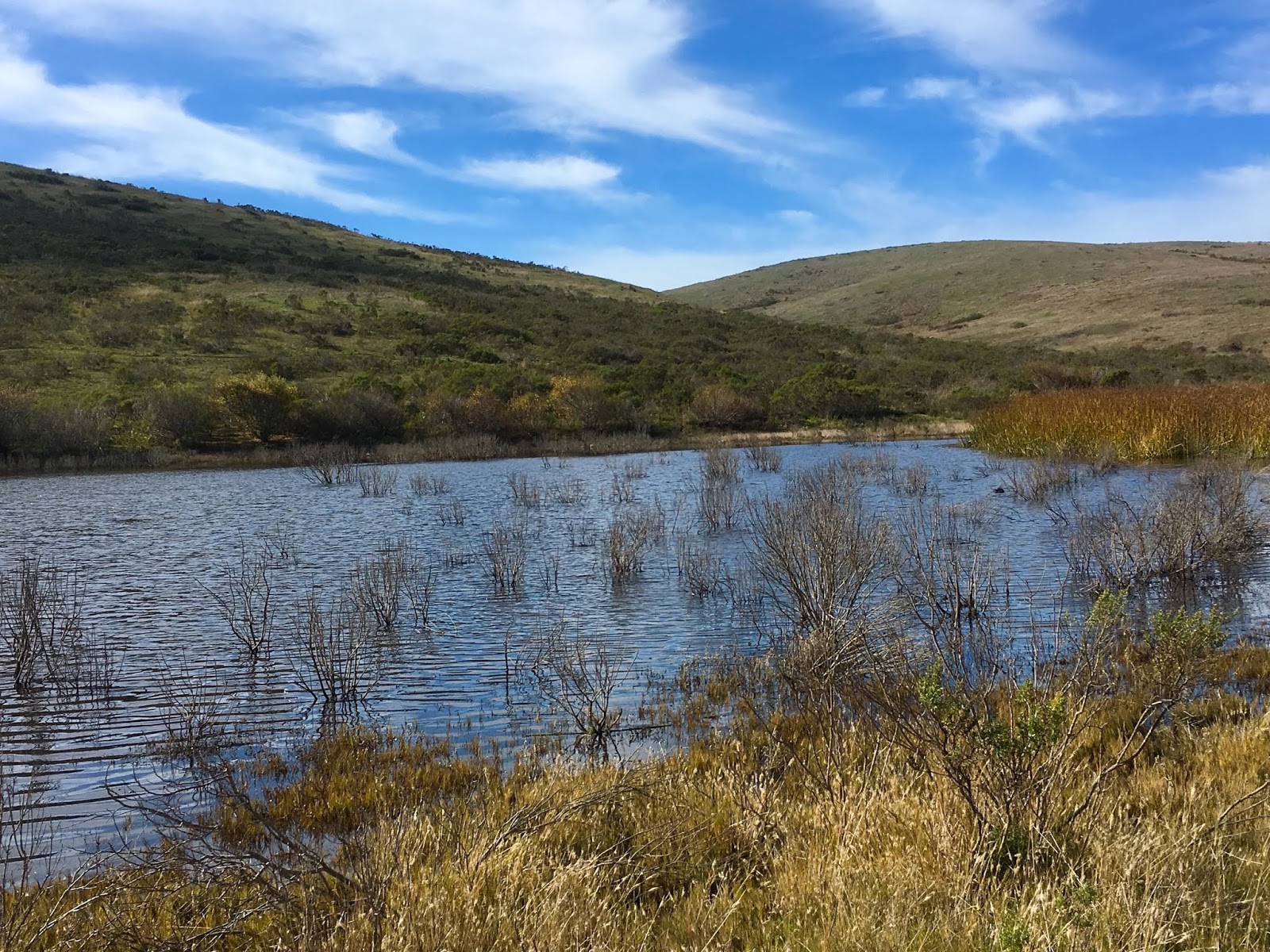
The primary pond is not huge but large enough to attract ducks.  I was hoping to see a Redhead.   As can be seen in the photo, the pond spreads into the brush.  In the brush on the far side were several Mallards, as far as I could determine there was no Redhead among them.  I am planning a return trip after the current rainy season passes.  On the pond were Coots, Pied-billed Grebe, and a small flock of Ruddy Duck.  Taking advantage of the insects were Black and Say’s Phoebe.  The robust song of California Thrasher was pervasive.  This time of year Harmony Headlands is truly magical. 

Harmony Headlands State Park is located directly off Hwy 1, about a mile north of Villa Creek Road.  


Thursday, January 17, 2019

Birding Between Rain Storms


 Laguna Lake - The rain had just stopped and I was headed to Laguna Lake.  I believe I was the only birder in the county that had not seen the Vermilion Flycatcher.  It’s not that I hadn’t tried.  Upon arrival at the small fishing dock, actually the area where the little darling has frequently been seen,  I heard a sweet, yet unfamiliar song.  On are twig, at the top of a scraggly willow, perched the Vermilion Flycatcher. ( Photo of the Laguna Lake Flycatcher by Roger Zachary.)
This little traveler is considered a rare visitor to the Central Coast.  He may have journeyed here from East Texas or from suitable regions in the Eastern Ca. deserts such as Zzyzx, near Baker Ca. or the Big Morongo Preserve, east of Palm Springs, Ca. where the Vermilion Flycatcher has been known to nest.

Turri Road - The weather was blustery.  In recently plowed fields were large flocks of Red-winged Blackbirds.  Perched on fencing were Say’s Phoebe, Western Bluebird, and Lark Sparrow (below).
 Morro Bay Marina - Looks like the storm has passed - Seven species of underwater foragers, Bufflehead, Ruddy Duck, Common Loon, Western Grebe, Eared Grebe, Pied-billed Grebe, Double-creasted Cormorant, and a cooperative male Belted Kingfisher (below).  I love birding the Marina as the water birds are in a confined space and much easier to identify.
Sweet Springs -  Two Ruby-crowned Kinglet and a Blue-grey Gnatcatcher frolicked in Silver Lupine bushes growing along the path to the east overlook.  Kinglet and Gnatcatcher can be difficult to observe as they are usually flitting thru dense foliage. 
In the shallower water, Cinnamon Teal, Blue-winged Teal (above), Green-winged Teal, and American Wigeon.  In the deeper water many hundreds of water birds.  Regardless of the weather birding the Central Coast is always a memorable experience.

My favorite photo of the day, California Towhee bathing.


Wednesday, January 2, 2019

Highlights of The 2019 Morro Bay Winter Bird Olympics

The Second Annual Morro Bay Winter Bird Olympics  - These last two weeks Morro Bay has been in a flutter of excitement.  Most of the events went off smoothly.  Of course when there is a diverse congregation of avian athletes, glitches are bound to happen.

        * Highlights of Events *

Feeding Pose - Open to all long-legged shorebirds - Allison Avocet from Tulare County, Ca. won first place.  It took two years of rigorous training for Allison to perfect her winning pose.  Her amazing time of 8.13 minutes exceeded the world record by .48 seconds.  After the event Allison graciously posed for photographers.
Willet Half Marathon - A Team Event
The powerful team from Pakowki Lake basin, Alberta Canada was the first team to cross the finish line.  Unfortunately, when the judges reviewed the instant replay, they found a ringer, a Godwit posing as a Willet, a definite no, no.  It appeared that the coach had made a poor last minute decision when a team member needed to be replaced.
Raptor Catch and Release
The competitor must catch a fish and gently carry it 300 meters (984ft) to the release pond.  The fish must be alive and active upon it’s release.  Oscar Osprey from Shasta Lake Ca. was nearing the finish line when he heard the crowd chanting his name.  The distraction caused Oscar to tighten his grip on the fish.  Oops!  Oscar graciously acknowledged his loss, flew up to a branch, and proceeded to eat his lunch with gusto.
One-Leg Sand Stand - Open to all Godwits, Willets, Whimbrels, and Long--billed Curlews.
Coralina Curlew from Oregon's remote grasslands comes from a long line of one-leg sand standers.  On the day of the event conditions on the beach were less than optimal.  For over six hours she persevered through fog, wind, and blowing sand.  What cinched her win was an impromptu flyover by a Peregrine Falcon that caused all but Coralina to take flight.  Later in the day as the winners were stepping up to the podium Gladys Godwit, known for being a poor looser, accused Coralina of using a pain killer on her ankle.
Kingfisher Synchronized High Dive - Open to all Kingfishers
The Kingfishers synchronized dive competition is fierce.  Few males enter the event as they cannot grasp the synchronized concept.  This year there were two male teams, three mixed gender teams, and 22 female teams.  Karmen and Klara* from Nome Alaska won the gold with three out of three beautiful dives.  No photos were allowed at the event as the photo/video rights had been sold to an international publication.  Fortunately a friend of mine managed to get a photo of Klara practicing her dive.  
Golf Course Challenge - A Team Event
This year's Golf Course Challenge was simplified, as last year's event caused mass confusion among the Coots.  The revised Challenge consisted of three segments, circle the 9th tee, waddle in a line to the pond, exit the pond and return to the 9th tee.  Much to their surprise and delight, the local team took 3rd place.

Unfortunately there was a minor glitch that few Coots noticed.  One of the judges for the Golf Course Challenge was B. B. Eagle* who was stationed in the Eucalyptus tree directly across from the pond. 
 
When our local team was exiting the pond he snatched the last Coot that happened to be the team captain.  B. B.  Eagle returned to his perch with the team captain securely clutched in his razor sharp talons.  I will spare you the rest of the details.

 I hope this glimpse into the highlights of the Morro Bay Winter Bird Olympics whets your appetite to attend next year's Bird Olympics.

* photos of Klara Kingfisher, Willet Half Marathon, and B. B. Eagle by Gary O'Neill.


Friday, December 14, 2018

The Morro Bay 2019 Winter Bird Olympics


The Morro Bay 2019 Bird Olympics are coming to town.  I can guarantee they will be just as exciting or more so than last years Olympics.  To refresh your memory of 2018 Bird Olympics I have included a link.
http://birdingthecentralcoast.blogspot.com/2018/02/the-morro-bay-winter-bird-olympics.html

Olympic Athletes are arriving on the Central Coast daily.  Most of the athletes take several days resting and spending time renewing their energy supply before they begin practicing for their chosen events.  What amazes me is the amount of time they spend in frivolous pursuits such as gossiping, stealing food, and partying on the beach.   

 Don't wait till the last minute to secure lodging, as accommodations are going fast.  Come prepared for cold and wet or warm and windy weather, a bright sun and fog.  Bring binoculars, a scope if possible, snacks, definitely a flashlight, hand warmers and sunscreen.  All events are free, children 3 and younger are welcome as long as they are attached to an adult by a child safety harness.


Tuesday, November 27, 2018

Birdiing Around the Bay


Morro Bay Estuary - The tide was high (6.3).  The morning was beautiful and warm, almost too warm for someone who gets overheated at 70°.

During high tides the shorebirds and water fowl hang out in a hard to view area at the north end of the bay until the tide ebbs enough for them to resume their feeding.  The above photo was taken from the Audubon Overlook.  There was not a bird in sight.
The Turri Road ponds had been filled by the previous day's high tides.  Sandpipers hang out on patches of pickle weed until the tide goes out.  In the photo, left center, there are a few hundred, mostly Least Sandpiper, waiting quietly for the mud and sand to be exposed so they can go back to feeding.  Sandpipers are known to be patient shorebirds.
 Morro Bay Marina Peninsular Trail - No birds within view from the boardwalk, although I could faintly hear Brant Goose.  I believe they have much to say to each other.

The trail is about 1/2 mile loop.  At extreme high tides birds that hang out in the estuary pickleweed come into the brush, and thanks to recent rains there were ample itty bitty insects for them to eat.  Had marvelous sightings - a Savannah Sparrow, whose yellow eyebrow made it easy to identify was foraging around a Lemonade Bush, nearby was a Hermit Thrush.

An Osprey glided past the boats to the end of the Marina eventually settling onto a limb in a scraggly pine tree.  Fortunately the Osprey, looking formal in his/her white and dark brown feathered attire, was still there when I got close enough for a photo. 
It was nearing time for a coffee break when, what to my eyes should appear, but a Clark's Grebe so very near.  I have always had difficulty in identifying Clark's Grebe,  as they are nearly identical to the Western Grebe.  The obvious differences are in the eye and the bill.  Clark's eye is surrounded by white, while the Western's eye is in the black.  However as they go into winter plumage Clark's white becomes greyer and the Western's black becomes lighter.  Now, Clark's bill is in tones of yellow, while the Western's bill is more olive/greenish, but in winter plumage the bill colors are less distinct.
My previous sightings of this regal beauty have always been at a distance, such as out in the middle of the bay.  I was delighted to have the pleasure of observing a Clark's Grebe only a few yards from where I was standing.  Not only was it's eye in the white, it's bill was yellow.  (The wiggly reflections are from sail boat masts.) Needless to say I was very happy at finally identifying a Clark Grebe.