Monday, August 24, 2015

Morro Bay - Return of the Sandpipers


  August 24 - Baywood - South Morro Bay - Western and Least Sandpipers (aka peeps) are returning by the thousands from their breeding grounds, Western Alaska for the Western Sandpiper and for the Least Sandpiper, the tundra and boreal forests of the Arctic.

The most notable difference between the two species is leg color - Western, black; Least, yellow green.  But if they are feeding in muck or standing in water nearly up to their knees, which are hidden in their feathers, luck is needed for identifying them.  (photo - Least Sandpiper)

As the migratory season progresses, a flock of sandpipers may include Semipalmated Plover, small flocks of Dunlin and Long-billed Curlew, and one of their best friends, my very favorite - the Black-bellied Plover.  For the keen of sight, a Baird's Sandpiper might be spotted.  Fortunately, the Baird's is one inch larger and a tad plumper than the Western and the Least.

The Western Sandpiper is the most abundant shorebird species in North America, whereas the Least Sandpiper, the smallest shorebird in the world, is numerous but is often found in much smaller flocks.

P. S.   Binoculars are a must when looking at peeps.  Now for some fun!


 How many Dunlin do you see in the photo?  Are the smaller birds Western or Least Sandpiper?  The answer will be in the next posting.  Happy Birding!


Tuesday, August 4, 2015

Return of The Terns

Elegant and Royal Terns have returned to Morro Strand Beach.  Huge flocks have been observed.  On Sunday the weather was lovely and the beach was filled with beach goers who often, unaware of bird etiquette, walk directly through a resting flock, disbursing them out to sea.  As a result of the busy beach, Terns were not abundant, but fortune did shine. 

North of the beach goers, was a long lagoon formed by recent, very high tides.  Three Terns were standing in shallow water, two were bathing. The smaller Elegant Tern was flanked by two larger Royals.  In the photo you will notice the smaller Elegant (right) has a slightly drooping, slimmer bill while the bill of the larger Royal is more robust in size and color.  Trying to identify the two species in a large flock may require patience.

 Arriving at the same time as the Terns are the Heermann’s Gulls.  Terns dive for fish, Heermann's Gulls do not, instead they steal fish from the Terns.  Technically speaking, Heermann’s Gulls are kleptoparasites, they feed by taking prey from another animal.  Heermann’s Gull is often found in close proximity to a flock of Terns.
Continuing north, stopped at Cayucos and Toro Creeks.  I would rate Cayucos Creek (above) as very sad and scummy, but did observe a flock of 7 beautiful Killdeer, one Canada Goose, and a bobbing Spotted Sandpiper in fading breeding plumage.  (The Cayucos pier is in the process of reconstruction.)

Nearly forgot to mention that on the Torro Creek beach, also know as Dog Beach, there was a mixed flock of Long-billed Curlew and Whimbrel. Since the dogs were playing down by the water, I was able to spend time looking at the flock, in particular two smaller resting birds.  Could they be juvenile Long-billed Curlew? I had never seen one. They stood up. Yes!  They were juvenile Long-billed Curlew.  That first time sighting definitely made my day.  

Wednesday, June 17, 2015

Pied-billed Grebe - Black Oystercatcher - Pigeon Guillemot

Update - Cloisters Pond - Good News!  At the back of the pond, a few weeks after my April 5th posting, four tiny Grebes appeared.  A week later an additional three little Grebes appeared at the font of the pond; all have grown to maturity.  Considering the hungry Hawks and Raccoons that frequent the area, their survival rate is amazing.
Update - Black Oystercatcher - Oystercatchers are nesting at Montaña de Oro.  A monogamous pair makes a nest by tossing rock flakes, pebbles, or shell fragments toward their chosen nest site.  Two eggs can be seen in a nest, located on a seamount about 100 feet from the cliff.  Only one egg is visible (nest circled in red).  Unfortunately, anytime a person walks out to the point, the Oystercatcher gets off the nest;  when the person finally moves on, the Oystercatcher returns to the nest.  The photo by Mike Baird shows the proximity of the nest to the people standing on the trail.  Unfortunately, the viability of the nest depends on how many people walk out on this popular trail and how long they spend looking at the view.  This area is also popular with fisherman.
Update - Pigeon Guillemots - The action continues - Guillemots are dashing between rocks and the water and the water and the holes in the cliff, but much to my disappointment I have yet to find a nest that I can actually recognize as a nest.  The Guillemots are numerous, so there is hope that some are nesting.   A juvenile Guillemot usually leaves the nest at night; they flutter and tumble from the cliffs to the sea.  Once in the sea, it will take another couple of weeks for their flight feathers to fully develop.  I am thinking positively that during those weeks, I will see a juvenile Guillemot before it fully matures and flies out to sea.  
I am afraid that our love of nature is taking its toll on the nature we love.

Thursday, June 11, 2015

Yosemite Birding

Yosemite National Park - On the road to Glacier Point is a peaceful and beautiful meadow.  The majority of visitors to the park do not know what they are missing as they speed by in a rush to the famous Glacier Point.  A few days ago I spent a couple of hours at the meadow looking for birds and listening to their songs.  The only other sounds, besides the birds, were the cars and buses speeding by.  Trying to find a tiny bird in a tall, dense tree is rather a challenge.  I was determined to not only hear the birds but to see them.
Cute and perky Dark-eyed Junco (photo) and Song Sparrow, who sang continually were the easiest to see.  Brown Creeper, and Steller's Jay finally made an appearance, but there was no luck with the Red-breasted Nuthatch whose tinny, single, note call echoed thru the trees continually.

After the Meadow, I headed into Yosemite Valley to Happy Isles, one of the less touristy areas, and to the Happy Isles restored "fen" - a peat-forming wetland fed by moving groundwater.  The Fen restoration project began in 2002.  Today the wetland is a functioning fen habitat that provides nesting and feeding for many species.  A sweet boardwalk provides the only access.  While on the boardwalk I saw only one small group of hikers.  They were headed to the mist trail which leads to Vernal and Nevada Falls, and if you have the stamina, Half Dome.
The bird songs were nearly overwhelming - flitting around were Robin, Red-Winged Blackbird, Song Sparrow and an eye-popping, Yellow Warbler, and to my amazement managed to spot a White-headed Woodpecker. (Wow!)  The trickling sound of water flowing under the boardwalk was music to my ears.   Like magic, a deer appeared out the dense water plants (above photo), nearly close enough to touch - gently the young deer proceeded to nibble on a variety of leaves.  The deer was nibbling long enough to take a video.    https://www.youtube.com/watch?v=rQBpZ-rBcT8&feature=youtu.be

Although Yosemite is the third most visited National Park in the United States with nearly 4 million visitors a year, it is possible to find serene, natural spaces where one can experience nature at their own pace. 


Monday, May 18, 2015

The Pigeon Guillemots of Montaña de Oro

Of all my favorite birds, the Pigeon Guillemot (Cepphus columba) is number one.  During the breeding season, their rounded body is very black with brilliant white wing patches (photo by Mike Baird).  Their legs, feet, and mouth lining a brilliant orange-red; the feet are so red they look like they have been photoshopped.

Montaña de Oro's rocky shoreline with all its nooks and crannies provides the Pigeon Guillemot with ample areas to nest.  Like clockwork, every March, these hardy little sea birds arrive in Montaña de Oro.
 The Pigeon Guillemot uses its short strong wings to swim while searching for food, diving to depths of 150 ft.  When not feeding, they often rest on cliff edges (above photo).  By vigorous flapping of their wings, combined with the use of sharp claws on webbed feet, the Guillemot is able to climb the steep, rocky cliffs. 

A few days ago, from the Bluff Trail, I observed several pairs of Guillemots acting very frisky, with much splashing, wing stretching, and shallow dives.  I focused on a pair that was the easiest to view. For the ease of explanation I will call them Frank and Doris.  I would describe their antics as a pre-mating ritual.  Like some males Frank was the aggressor.  Doris was enjoying the attention but was rather standoffish, not ready for the grand finale.  Frank would close in, and Doris would scoot out of reach.  They participated in this behavior repeatedly.  Twice they flew to and from a nesting hole in the cliff. 

 As Frank (above photo, lower right) chased Doris he was constantly chatting.  Unable to understand the high pitched sounds, I made an unscientific assumption.  Frank was telling Doris that time was of the essence, as they must return to sea mid August.  He was reminding her that incubation takes at least 30 - 32 days, and then there is the intense 35 - 50 days of feeding the little darling; two eggs may be laid, but only one chick will fledge. (below photo - Doris checking out a nesting area)
Both parents incubate the egg and bring small fish to their chick.  Success raising a chick to maturity depends on the weather, the impact of human activity, and the warming ocean and its disastrous affect on the food chain.  Hopefully, Doris and Frank will incubate an egg, produce a healthy, well adjusted nestling which will one day return to the rocky cliffs of Montaña de Oro.

Monday, April 20, 2015

Laguna Lake April, 19, 2015


Laguna Lake Park - On silent wings a vortex of Turkey Vultures soared overhead, riding the thermals; with their acute sense of smell they locate their next meal - they are nature's clean-up crew.  I headed directly to the lake.  The water appeared down, but not drastically low.  The above photo shows about 1/3 of the lake.

As I pulled into a parking space, my eyes were directed to a Greater White-fronted Goose, accompanied by two Snow Geese, marching across the road to the picnic tables; hoping (if a bird can hope) for a handout. 

From a dense cluster of willows sang Song Sparrow, Wilson's Warbler, and Common Yellowthroat - a most delightful serenade. I walked down the road for a wider view of the lake, to be more precise, a view of the lake bed - not a pleasant sight; a large portion of the lake had evaporated, a stark example of our on-going drought.  


On the far side a small flock of migratory water fowl lingered, Northern Shoveler, Green-winged Teal, Ruddy Duck.  Feeding in the muck a flock of Western and Least Sandpiper, Semipalmated Plover, and two Killdeer. As the lake continues to shrink, and the water is confined to a smaller and smaller area, the birds will be feeding in a toxic soup.

On a more pleasant note, I was returning to my car when a Red-tailed Hawk swooped in, grabbed a Coot and flew into the trees.  If I had blinked, I would have missed the action.

Could not leave the park without visiting the horses grazing in the open space.  There were 17 females, 5 adorable colts and one very lucky white stallion.


Sunday, April 5, 2015

Pied-billed Grebe - Cloisters Pond - Morro Bay


 The Pied-billed Grebe - Podilymbus podiceps - (Photo by Mike Baird) is the most widespread Grebe in the New World, nesting from Southern Canada to Argentina.  There is barely a pond, lake, marsh, bay, estuary, or marina that does not have a pair of these stout-billed absolutely adorable divers.  Photo shows the Grebe in breeding plumage.  Most distinguishing marks are white eye ring, and a white bill with a black ring.
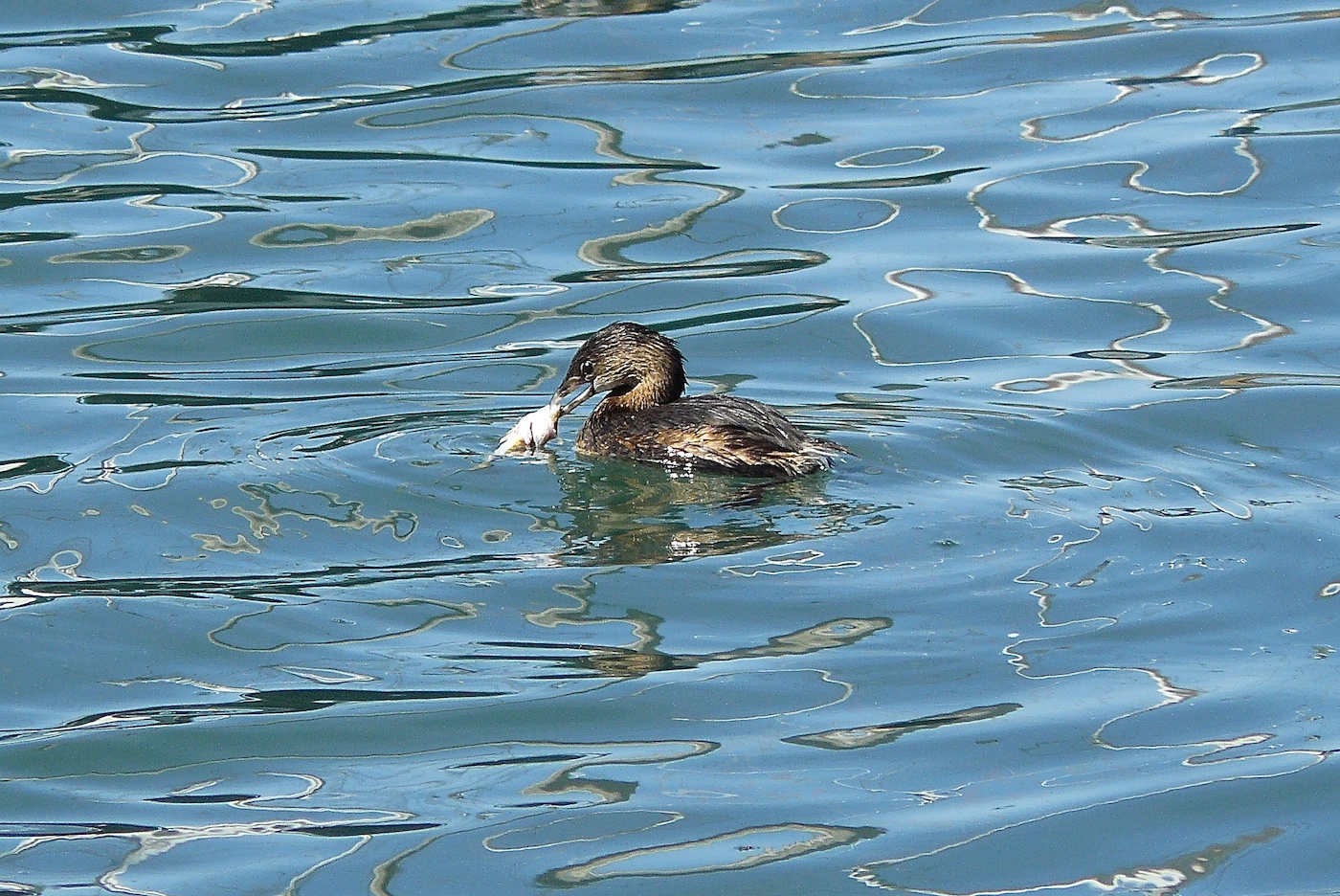
 The Pied-billed Grebe forages by diving from the surface; swimming under water propelled by the feet.  Diet consists of fish, and all types of aquatic life.  The above photo was taken mid March; The Grebe is clad in winter plumage.  Perhaps the little darling is a late bloomer.
A few days ago, at Cloisters Pond, noticed a nest in the reeds with a Pied-billed Grebe sitting on it.  The nest built by both sexes, consists of a dense mat of reeds and plant material and is usually situated so that it can be approached under water.  While I was watching the nest another Pied-billed Grebe appeared a few yards out from the nest.  Like magic it disappeared into the water.  A few moments later a little head popped up at the rear of the nest sitting Grebe.  The sitting Grebe moved off the nest into the water and the new sitter slowly and gently settled itself on to the nest.  Photo is of the second sitter settling down on the nest.   The expanded image shows the white eye ring.

Today, I checked on the nesting Grebes.  One Pied-billed Grebe in the water and none on the wet and muddy nest.  To be honest I felt sad, but I am hopeful the potential parents have constructed a new nest in a better location, and within a few weeks adorable young Grebes will be seen floating on Cloisters Pond.
Young Pied-billed Grebe at Cloisters Pond by Mike Baird.  A few seconds before the photo was taken, a gull had grabbed on to the Grebe, but this little defenseless Grebe managed to escape.
 You may find this video of a baby Grebe of interest.   https://www.youtube.com/watch?v=9UfA12eSZyw&feature=em-share_video_user