Sunday, June 12, 2011

EASY BIRDING AT SWEET SPRINGS

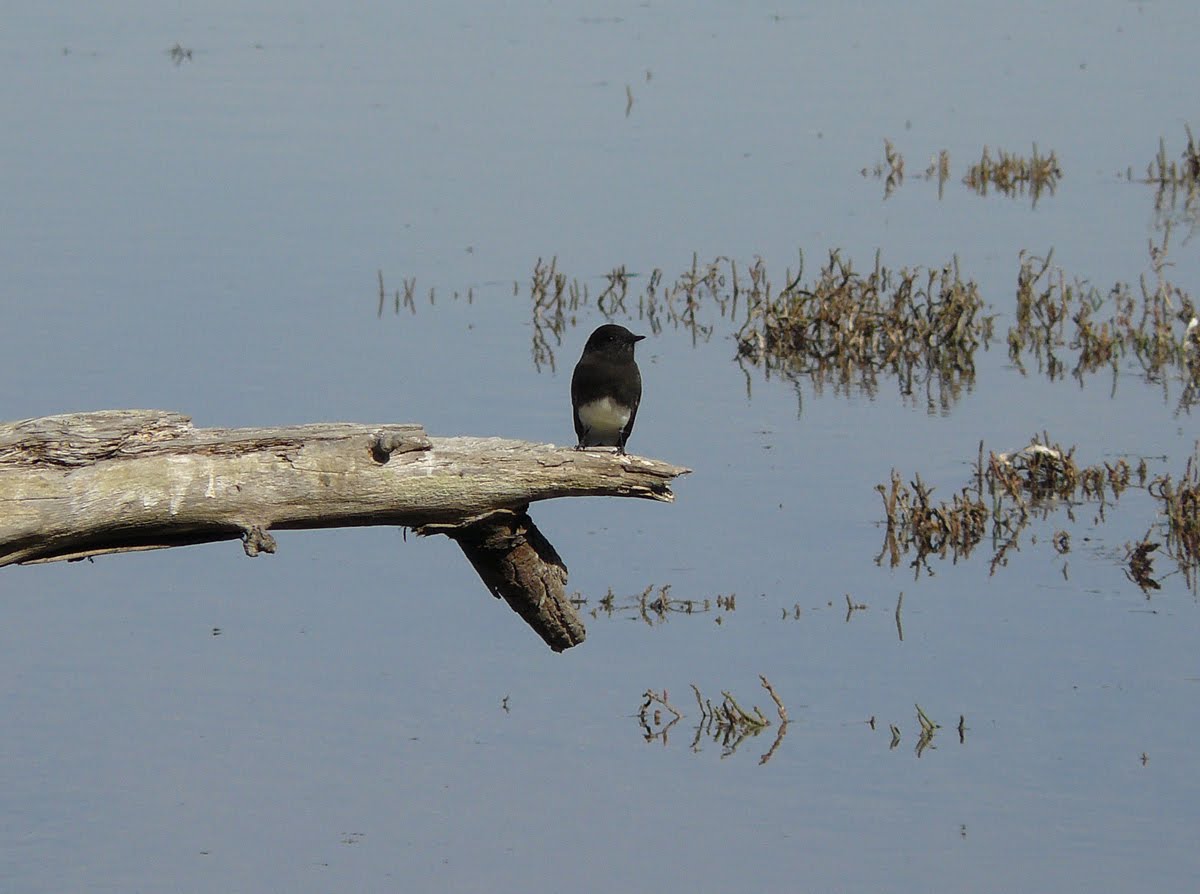
Walked to Sweet Springs. The morning was sunny with a slight breeze. Took the path to the right that loops around the pond. Nine turtles were sunning themselves on a board in the pond. I believe the board was placed there just for the turtles. For awhile I was the only person enjoying the preserve. Birds twittering and singing - music to my ears. Saw or heard 21 species. (Photo - Black Phoebe)

I was sitting on a bench rebooting my iPod, which now serves as my bird book, when Teddy, a photographer/birding friend happened by. She mentioned the Great Horned Owls that live in the preserve, and asked if I had seen them. Last year I had seen them, but was not quite certain where to look this year. Teddy had taken photos of them and said she knew where they were. There were two fluffy teenage owlets, so very precious, and a parent. A real treat to see them.

Another treat was finally getting to see a Pacific Slope Flycatcher. I often hear them, but had not seen one this year. How fortunate I am to have this wonderful birding area so close to home.

Sunday, May 29, 2011

ISLAY CREEK

Unbelievable as it may seem I was on the Islay Creek Trail a tad after 8:00 a.m. In the morning there is less wind, better lighting, and the birds are active. The day was sunny with a deep blue sky.

The top photo is the view from the beginning of the trail. Actually, the trail, for the first couple of miles, is a narrow dirt and rock road.

During my walk, I was accompanied by a choir of bird songs. Swainson's Thrush, Wilson's Warbler, Wrentit, and Song Sparrow. Cliff Swallows swooped over my head. Spotted and California Towhees were everywhere. A Great Egret flew up the creek - such a beautiful bird.

Meandering through the center of the willows and oaks on its route to the sea, is Islay Creek. (see photo) Reservoir Creek Trail is on the left side of the creek and Islay Creek Trail is on the right. The dense vegetation provides nesting and resting for many species of birds, including Owls.

All along the trail and particularly in the shaded areas were wild flowers and flowering shrubs. Saw several little white-tailed rabbits. At one month of age they are ready to have a family of their own. Except for a couple of runners, I had the trail and Islay Creek to myself.

Sunday, May 22, 2011

SUNDAY MORNING

Weather this morning was cool, breezy and overcast. Singing deep in the willows of Islay Creek were Wilson's Warbler and Swainson's Thrush. Saw a few Quail but no little ones, yet.

In the creek also saw a Brown-headed Cowbird - the third this month. I had never seen a Cowbird in this area until a few weeks ago.

The Brown-headed Cowbird is a brood parasite. It lays its eggs in the nests of other small perching birds, particularly those that build cup-like nests. Brown-headed Cowbird eggs have been documented in nests of at least 220 host species. The young cowbird is fed by the host parents at the expense of their own young. Brown-headed Cowbird females can lay 36 eggs in a season. In a nutshell, the Wilson's Warbler and the Swainson's Thrush, may be raising the much larger and aggressive Cowbirds instead their own nestlings.

Pigeon Guillemots (see photo) were flying between their nests in the cliff and the water - delightful to observe. Seven Black Oystercatcher's on the big rock formation where the Pelagic Cormorants hang out.

Spent some time in the Native Plant Garden taking photos for the MdO plant book. Click on the link for a few plant photos. Flowering Plants of Montana de Oro State Park


Monday, May 9, 2011

SWEET SPRINGS MONDAY

Sweet Springs Nature Preserve , which includes the Willow wetlands on 4th near Ramona. Weather, sunny with a cold wind blowing off the bay. Precious little Juncos were busy doing what ever it is that Juncos do. On a narrow board in the pond were 6 male Mallards. Joining them on the board were 2 pond turtles. Bird count for the morning, 27 species.

It was much warmer at the entrance to the Preserve, so sat on one of the tree stumps and looked for movement in the trees. Within a few minutes saw an immature male, Western Tanager - not an every day sighting.

In the Willow wetland Mr. Wilson's Warbler was singing. In the distance could hear Common Yellowthroat, Pacific-slope Flycatcher, and Black-headed Grosbeak. The major treat of the morning was watching 2 Tree Swallows and a White-throated Swift consuming insects. The Swift was true to its name - flew higher and much faster than the Swallow.

Sunday morning a quick trip to Montana de Oro. I was standing outside the ranch house talking to a ranger when a bobcat ambled by. He turned and looked at us as he passed. A few minutes later he climbed into the old Buckeye tree in back of the ranch house. Two crows were very upset. Was able to get a photo and a short movie. I have included a link to the photo. Male Bobcat (Lynx rufus) Montana de Oro State Park | Flickr - Photo Sharing! May post the movie later.

Sunday, April 24, 2011

SAN SIMEON AND THERE ABOUTS

Saturday was overcast, mild with no wind. Checked out the creek at San Simeon State Park. First sighting were two (photo) adorable Northern Rough-winged juveniles. There were also hundreds or thousands of Cave and Cliff Swallows nesting under the Hwy. I bridge that crosses the creek. In the reeds were noisy Great-tailed Grackles, Marsh Wren, and the precious Common Yellowthroat. In the Willows, along the boardwalk, saw a Hutton's Vireo.

Across from San Simeon State Park is a short road that ends at a trail head. There is an opening in the fence and a sign that says, "dogs on lease permitted." The trail goes about a mile to the little community of San Simeon. I had heard from a friend that there were some great wildflowers, and indeed there were. The trail follows the edge of the bluff, quite moist in areas. The only birds I saw were Cormorant, Oystercatcher, Meadowlark and Savannah Sparrow. I was enchanted by the flowers. The Coastal Dandelion, Blue-eyed Grass, Lupin, Sheep Sorell, Filaree, Thrift, and Scarlet Pimpernel were numerous. The majority of the plants I could not identify, but I certainly enjoyed looking at them. (photo - reddish plant, Sheep Sorell; blue plant, Lupin; yellow, Dandelion.)

Coast Sun Cup (Camissonia ovata) was prolific along the edge of the trail.

Sunday, April 17, 2011

SATURDAY MORNING BIRDING


Cottonwood Creek Road above Whale Rock Reservoir. (photo - one of the many Turkey Vultures that were perched in a Sycamore Tree)

The weather could not have been finer. I was in paradise! The only sounds were the songs and tweets of many species of birds. After I turned on to Cottonwood Creek Road, crossed over the cattle guard (cattle wander freely), I stopped by a grove of huge old Oaks. A couple of House Wrens were in full mating mode, singing their beautiful song. Had no trouble seeing them as they were directly in front of me. Up the road a bit was another pair of House Wrens. I really like their cheeky nature.

Saw 30 species as I meandered about two miles up the road. Two mature Bald Eagles were perched in their usual oak tree by the water (Major Treat!).

The reservoir is about 80% full. On the water, near the reeds, were about 25 Western Grebe. Hopefully they will nest this year. The past few years the water has been too low for the Grebes to nest.

About a mile along the road is an open barn and corrals. A pair of Western Bluebird were once again nesting in an old post. An Ash-throated Flycatcher (a most fabulous bird) Ash-throated Flycatcher (Myiarchus cinerascens) | Flickr - Photo Sharing!
was attempting to hang out in the same area as the Bluebirds. He/she was chased off several times by the Bluebirds. The Flycatcher finally realized, this was Bluebird territory.

List of sightings: Bald Eagle, West. Bluebird, Kingfisher, Red-winged Blackbird, Coot, Double-crested Cormorant, Calif. Quail, Say's Phoebe, Mourning Dove, Killdeer, West. Grebe, Am. Goldfinch, House Finch, Wrentit, Calif. Towhee, Wilson's Warbler, Bewick's and House Wren, White-crowned and Song Sparrow, Great Blue Heron, Northern Harrier, Red-trailed Hawk, Ash-throated and Pacific Slope Flycatcher, Acorn Woodpecker, Scrub and Steller's Jay, Cliff Swallow, many Turkey Vulture. Conspicuous by its absence was Black Phoebe.

On the way home stopped by Morro Rock to get a Peregrine Falcon update. There was a biting cold wind. In the channel were Eared Grebe and Common Loon both in breeding plumage, also a pair of Surf Scoter. Bob, the Peregrine guy, said that at about day 30 the Peregrine pair abandoned their nest, mated again, and are in a new nesting site located below the first nest site. I have included a Flickr link to the location of the new nest. Peregrine Falcon Aerie #2 - | Flickr - Photo Sharing!
Wednesday, April 6, 2011

BIRDING THE OUTBACK

Wednesday enjoyed a most delightful field trip with Harry and Norma. Weather clear, and mild, no wind. We meandered around looking for birds and wildflowers. Our bird count came to 23 or so. Best birds - Raven, Yellow-billed Magpie. Northern Shrike (3), Western Kingbird. Red-tailed Hawks were numerous. We really enjoyed watching a pair of No. Harrier skimming along the hill tops looking for breakfast.

Lunched in Parkfield at a charming park shaded by cottonwoods. Parkfield is located in the Temblor Range between the San Joaquin Valley and the Central Coast - elevation 1,529ft. This quaint community of 18 also is located along the San Andres Fault, one of the longest and most active faults in the United States; it appears in the town as a dry creek bed (we drove over the fault). The fault marks the division between the North American Plate and the Pacific Plate. We ate lunch in Parkfield at a charming park shaded by cottonwoods. Acorn Woodpeckers were abundant and chatting up a storm.

We did not see any fields of flowers, but in the vast open space along Parkfield Road Norma spotted a herd of Prong Horn - a real pleasure seeing those splendid, animals.

Last sighting of the day was in Harry and Norma's yard, a handsome Phainopepla!!