Showing posts with label point lobos natural preserve. Show all posts

Friday, May 21, 2021

Point Lobos Nesting Cormorants - May 2021


 Point Lobos State Natural Reserve, Carmel Ca. - May 12, 2021 - Three years had passed since my last visit to the reserve.  I was on my first away from home outing in over a year; though in my reality, only two years had passed, as 2020 was a non-year.  - My goals for this quietly overcast morning were to enjoy the reserve's spring wildflowers and observe the nesting extravaganza of Brandt's Cormorant.

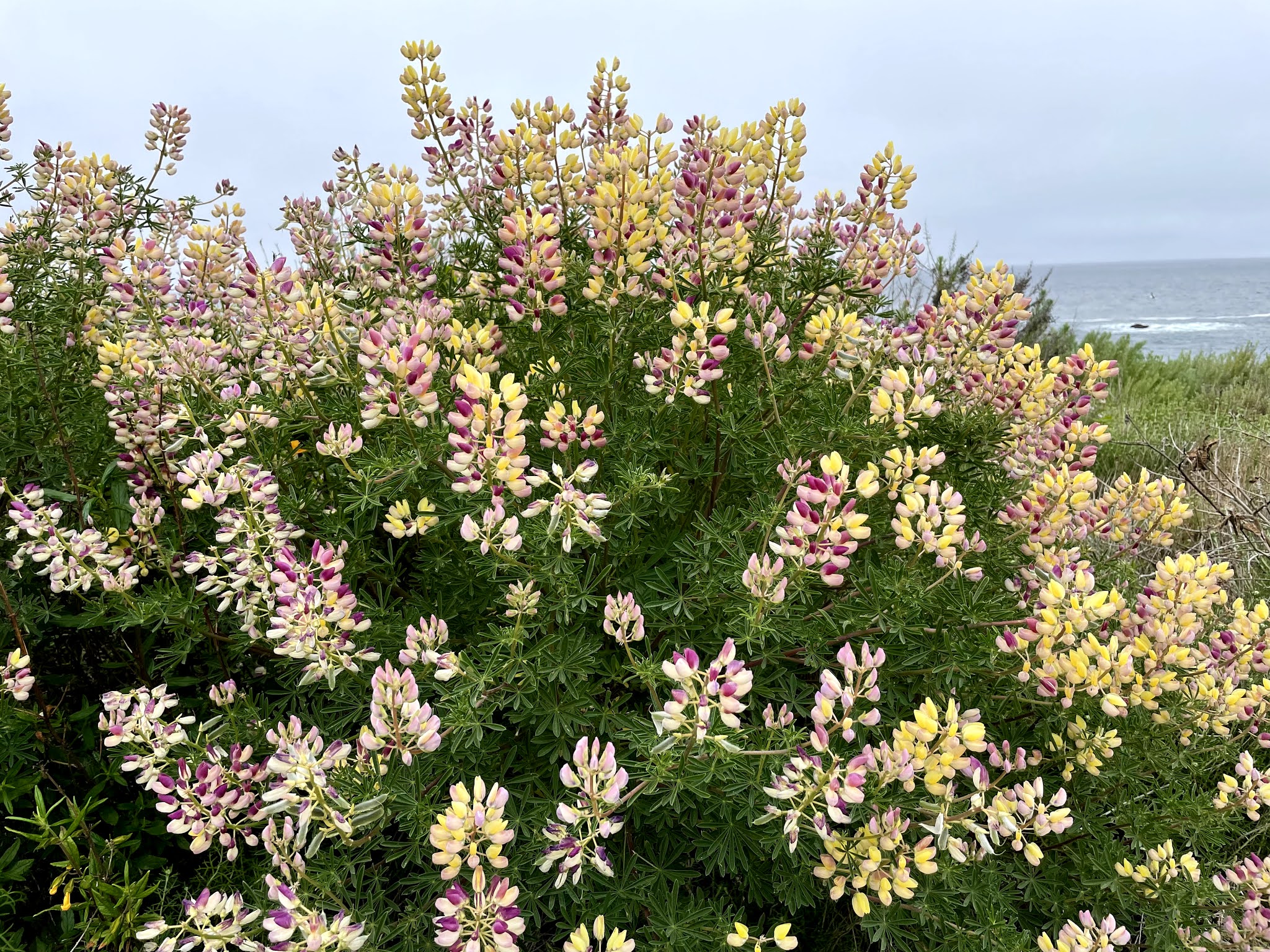
Point Lobos is a very popular tourist destination with limited parking.  By arriving early was able find parking at the Bird Island Trail Head.  Wildflowers lined both sides of the shaded trail - Sticky Monkey, Blue Dicks, Hedge Nettle, Seaside Daisy, Paintbrush, Calif. Poppy, precious Dudleya fairinosa, and the most gorgeous Lupine I had ever seen.  This Lupine was absolutely amazing!
I was in no hurry as the Cormorant's were not going anywhere for about three months.  The Gooseberry plant caught my eye.  I am familiar with a flowering Fuchsia Flowering Gooseberry, but had never seen the flower turning into a berry.  Had to be very careful while taking closeup photos due to the abundance of poison oak.  Poison Oak has a personality of its own and its goal is to catch you unaware.
Ceanothus, also known as California Lilac, was in full bloom in the more open, sunny areas of the trail.
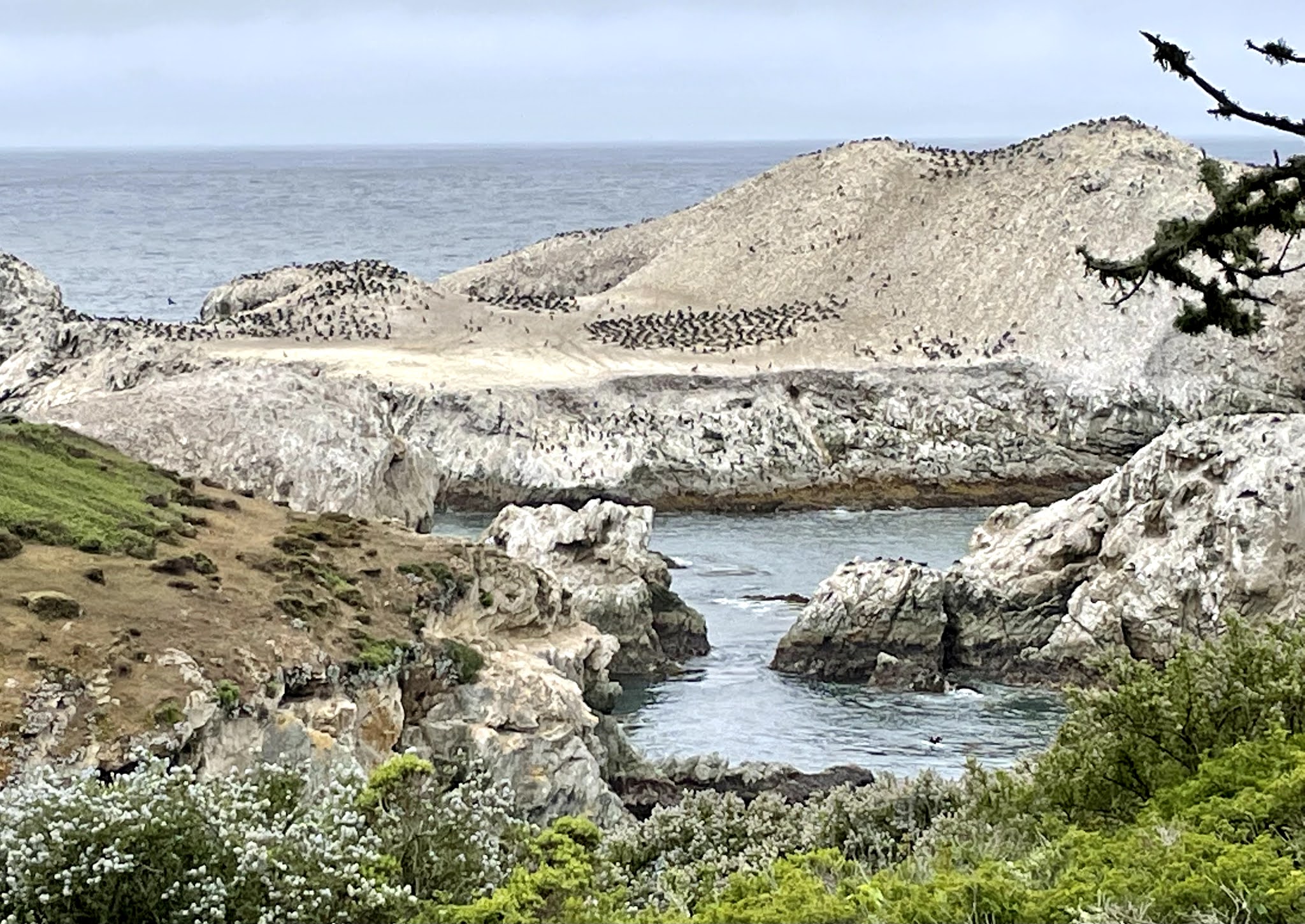
Finally, I came to my first view of Bird Rock.  Wow!  Word had obviously gotten out that Bird Rock was the place to nest - certainly looked like a much larger colony than in 2018.   I find their choice of nest location interesting, as they range from protected depression to open windy ridge.  If you were looking for the ideal nest site to brood, feed, and care for two or three offspring, what would be your choice, and why?
The collage compares the Brands's Cormorant population of May 2018, top image, to May 2021.
Bird Rock is a magnificent example of granodiorite, an igneous rock that is similar to granite.  Historically a young rock, only 80 million years old, give or take a few million.  All the rocks in this area are composed of granodiorite.
The scene before me was idyllic - thousands of birds peacefully nesting.  Incubation takes about 30 days.  Nestlings will fledge approximately 50 days after hatching.  They do not go far after fledging,  as parents will continue feeding them for a couple more weeks.  
The wind was getting stronger and I was ready for a warming cup of coffee - a spacious Starbucks is only a mile from the reserve.  As I heading back down the trail, I noticed the Cormorants had company, two Peregrine Falcon perched in a nearby tree.




Monday, July 2, 2018

The Cormorant Saga - Part 3

Point Lobos State Natural Reserve - Hundreds of newly arrived Brown Pelican find respite on Gibson Beach.  On this third and final adventure observing the nesting Brant's Cormorant, I am joined by my friend Cathy from Palm Springs.  Fifty days had passed since my first observation.
Both parents are active in feeding and protecting the young.  The small area around their nest is sacrosanct, anyone getting into their space is firmly scolded, and if not moving off, the invaders are pecked.  Nest tidying, unwanted items such as scraps of food, odd twigs, bits of eggshells, and dead hatchlings are tossed out.  Edible items such as food scraps and dead hatchlings may be eaten.   Included in nest tidying is adding fresh material.
From what I observed the average number of chicks per nest was about 2 - 3.  At 3 weeks of age the chicks are too large to shelter.  The adult stands at the edge of the nest, ready at a moments notice to protect them.   At 6 - 7 weeks adults may leave the nest unguarded but return to feed and roost.  The below photo shows chicks of all sizes.  Chicks will fledge (fly) about 50 days after hatching.  Adults will continue feeding for a couple of weeks after the chicks fledge.  (click on photos to see details)

Below photo - Parents perched on edge of nest.
Quite a few late comers have arrived since my last visit.  They seem to have had no trouble finding nesting sites.  
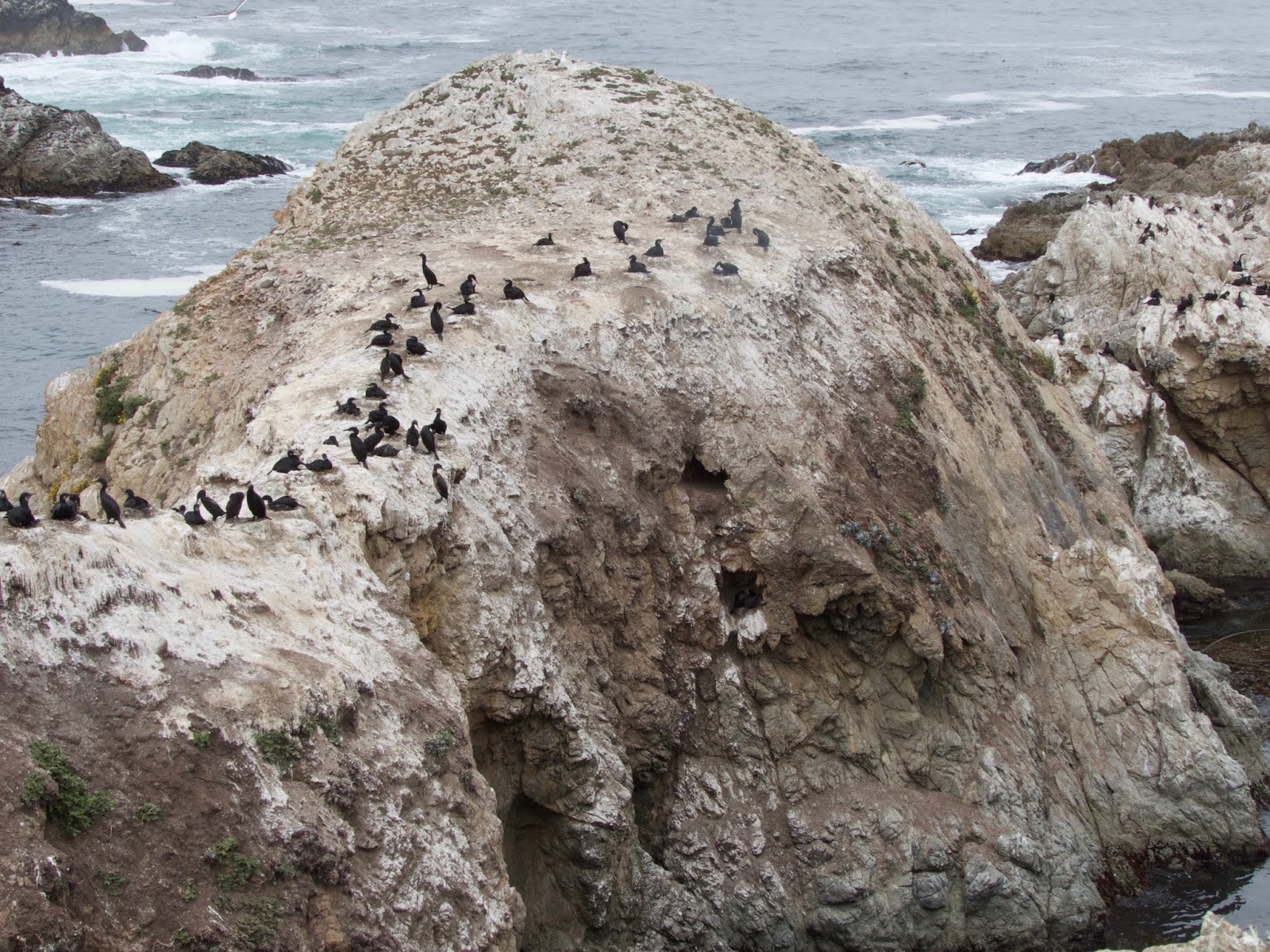
We discovered several Pelagic Cormorant nests in Brandt's territory.  Notice the large hole in the center of the rock formation, a cozy nesting site for a pair of Pelagic Cormorant.
At Sea Lion Point, a mile north of Bird Island, we checked on the progress of the Pelagic Cormorants.  Three nests had chicks.  The one on the left had small chicks that the parent was sheltering, below photo.  Both Pelagic and Brandt's extend their wings when they have small nestlings.
While looking at the far left nest, below photo, Cathy noticed a Pigeon Guillemot fly out from the left.  We concluded that a Guillemot and a Pelagic can nest in close proximity without a problem.  A portion of the Guillemot's head, bill and white wing patch can be seen.  The nests are roomier than I thought.  The center nest shows two large youngsters, and what are they doing - begging for food.
More than likely this is the last of the Cormorant Saga at Point Lobos Natural Reserve, but I cannot make any promises.  I may return during the rainy season, if we have one.   I am wondering if the low oval on Bird Island (below) is formed by water.   (photo - black specks Cormorants, beige specks Brown Pelicans)